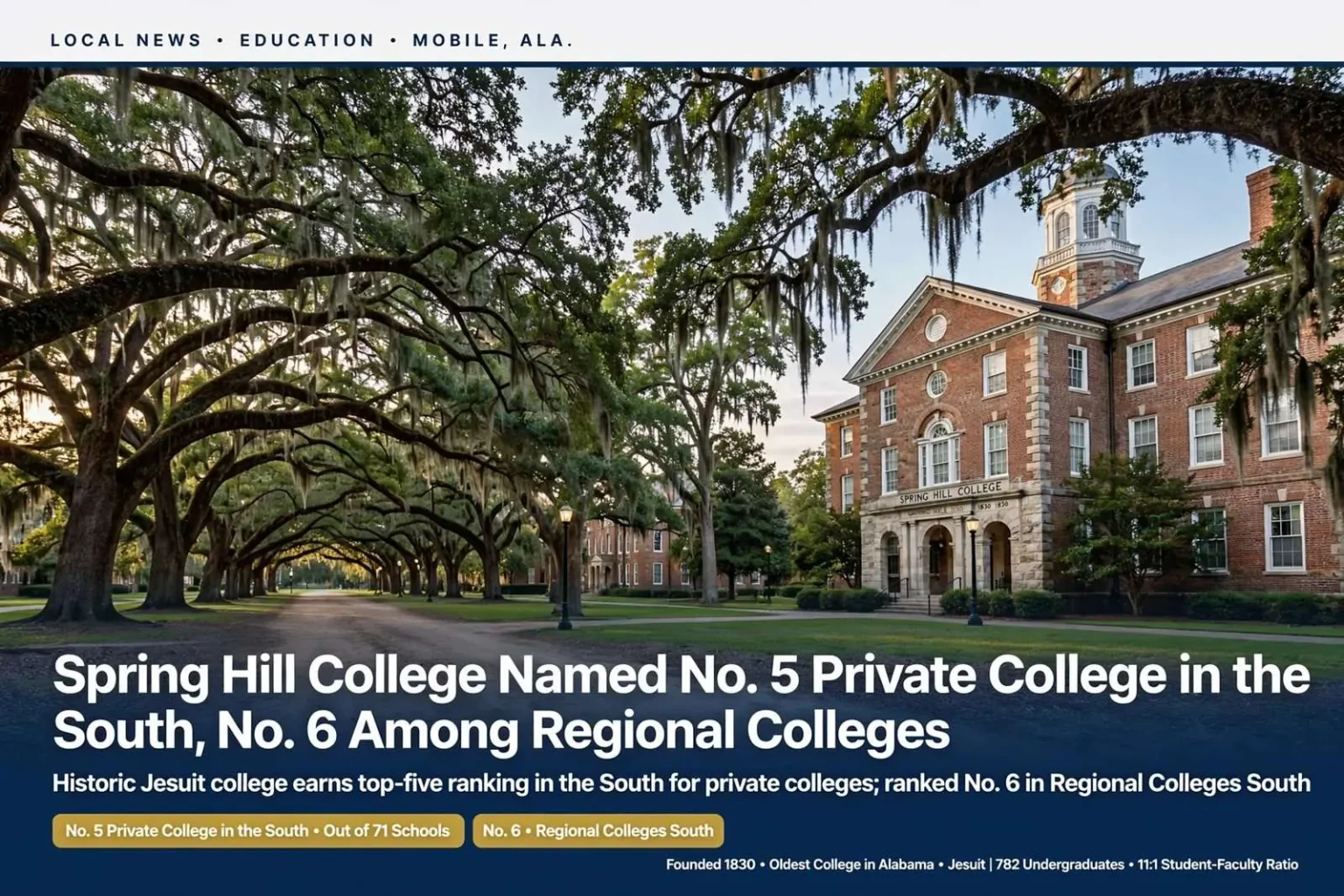
Spring Hill College Named No. 5 Private College in the South, No. 6 Among Regional Colleges
Mobile's Spring Hill College ranked No. 5 (tied) among private colleges in the South and No. 6 in Regional Colleges South, and has added Colleges of Distinction, logistics and MBA program rankings and a Phi Theta Kappa transfer honor.
Update (Oct. 9, 2026): Spring Hill College’s ranking as the No. 5 private college in the South (a spot it shares in a tie) is one of a growing list of national recognitions for the Mobile school. The college also placed No. 57, tied, among Top Performers on Social Mobility in the same national rankings, and it has been named to several 2026-2027 Colleges of Distinction lists, recognized in 2027 degree-program rankings for its logistics and MBA programs and honored by Phi Theta Kappa for its support of transfer students. Details are below.
MOBILE, Ala. — Spring Hill College, the historic Jesuit school tucked among the live oaks of west Mobile, has landed among the very best private colleges in the South in the latest national college rankings.
The college was named the No. 5 private college in the South out of 71 schools. Spring Hill was also ranked No. 6 in the Regional Colleges South category.
The recognition places the small Mobile college alongside a group of well-regarded private institutions across the Southeast and highlights the kind of close-knit academic experience that has long defined the school.
The top five
The private colleges ranked at the top of the list in the South were:
- Catawba College — Salisbury, N.C.
- Flagler College — St. Augustine, Fla.
- University of the Ozarks — Clarksville, Ark.
- Wesleyan College — Macon, Ga.
- Spring Hill College — Mobile, Ala.
Spring Hill was the only Alabama school in the top five, giving Mobile a place among a regional group that stretches from the Carolinas to Arkansas.
More national recognitions
Beyond the regional rankings, Spring Hill has collected a series of other honors recognizing its academic programs, affordability, career preparation, transfer student support and educational value. The college’s business, logistics and nursing programs were singled out as well. The recent distinctions include:
National college rankings
- No. 6 among Regional Colleges South
- No. 5, tied, among Top Private Schools in the South
- No. 57, tied, among Top Performers on Social Mobility
2026-2027 Colleges of Distinction
- Best Affordable Colleges
- Best Private Colleges
- Best Catholic Colleges
- Best Colleges with Outstanding Career Services
- Nursing College of Distinction
- Business College of Distinction
2027 degree rankings
- Best Logistics Degree Programs in Alabama
- Most Affordable Logistics Degree Programs in the USA
- Most Affordable Logistics Degree Programs in Alabama
- Most Popular Logistics Degree Programs in Alabama
- Most Valuable MBA Degree Programs in Mobile
Phi Theta Kappa Honor Society
- One of 275 four-year institutions recognized for excellence in transfer student support
Phi Theta Kappa is the honor society for students at two-year colleges, and its recognition highlights four-year schools that do well by students who start at a community college and transfer to finish a bachelor’s degree. A social mobility ranking, meanwhile, generally reflects how well a college enrolls and graduates students from lower-income backgrounds.
Mary H. Van Brunt, Ph.D., president of Spring Hill College, said Spring Hill’s continued recognition across a wide range of areas speaks to the experience they strive to provide every student. She said their Jesuit tradition calls them to pursue academic excellence while caring for the whole person, and that commitment is reflected in the work of faculty and staff, the opportunities available to students, and the support they receive. She added they are proud to see Spring Hill recognized for the quality and value of that experience.
The college says 100% of its students receive some form of financial aid. Transfer students have access to personalized academic advising, scholarships and an enrollment process designed to help them make the most of credits they have already earned.
A small campus with a small-class feel
According to the rankings data, Spring Hill enrolled 782 undergraduate students in the fall of 2024. The college’s student-to-faculty ratio was 11 to 1.
Those numbers help explain the kind of education the college offers. With a relatively small undergraduate population and a low student-to-faculty ratio, students are more likely to be in smaller classes, to be known by name by their professors, and to have opportunities for one-on-one mentoring, research and advising. For many families, that personal attention is a major reason to choose a small private college over a larger university.
What the Regional Colleges category means
Colleges in national rankings are generally grouped into categories so that schools are compared with similar institutions. The Regional Colleges category typically includes schools that focus on undergraduate education and award most of their degrees at the bachelor’s level, often across a mix of liberal arts and professional programs. Schools in this category are compared with others in their own region, so Spring Hill’s No. 6 placement in Regional Colleges South reflects how it measures up against peer institutions across the Southern states.
The separate ranking as the No. 5 private college in the South, out of 71 schools, reflects the college’s standing among private institutions in the region.
Rankings are only one measure of a college, and students and families are encouraged to consider many factors, including academic programs, cost, financial aid, campus culture and location, when choosing a school. But for a college of Spring Hill’s size, a top-five placement is a notable mark of recognition.
A long history in Mobile
Spring Hill College holds a special place in Alabama’s educational history. Founded in 1830 by Bishop Michael Portier, the first Catholic bishop of Mobile, it is the oldest institution of higher learning in Alabama and the oldest Catholic college in the Southeast. It is also among the oldest Jesuit colleges in the United States; the Society of Jesus took over operation of the college in the 1840s.
The campus sits in the Spring Hill neighborhood of west Mobile, where its oak-lined Avenue of the Oaks and historic buildings have made it one of the most recognizable settings in the city. Generations of Mobile families have ties to the school, and its alumni can be found throughout the region in business, law, medicine, education, the arts and public service.
The Jesuit approach to education
As a Jesuit institution, Spring Hill is part of a network of Jesuit colleges and universities across the country. Jesuit education traditionally emphasizes the education of the whole person, often described with the Latin phrase cura personalis, along with a strong liberal arts foundation, critical thinking, ethical reflection and service to others.
That philosophy fits naturally with the small-college model. Close relationships between faculty and students allow professors to act as mentors, and service-learning and community engagement give students opportunities to connect their studies with needs in the surrounding community.
Why rankings matter to a small college
For a college the size of Spring Hill, national recognition can carry real weight. Rankings are one of the tools prospective students and their families use when building a list of schools to consider, particularly families who may not be familiar with a college from outside the region. A strong placement can help a small school stand out among hundreds of options.
Rankings can also be a source of pride for current students, alumni, faculty and staff, and they can help colleges make the case to donors and partners that their investments are paying off.
What it means for Mobile
Mobile is home to a range of higher education institutions, from the University of South Alabama and the University of Mobile to Bishop State Community College and Spring Hill. Each fills a different role, and together they help make the Port City a regional center for education.
Spring Hill’s ranking adds to that picture. A well-regarded private college helps attract students from outside the area, some of whom stay in Mobile after graduation to build careers and families. Colleges also contribute to the local economy as employers, as buyers of goods and services, and as hosts to visitors who come for campus tours, athletic events, graduations and cultural programs.
A look at the other schools in the top five
The colleges ranked ahead of Spring Hill each bring their own history and character:
- Catawba College in Salisbury, N.C., is a private liberal arts college in the Piedmont region of North Carolina.
- Flagler College is located in historic St. Augustine, Fla., where its campus includes the former Hotel Ponce de Leon, built by railroad magnate Henry Flagler.
- University of the Ozarks sits in Clarksville, Ark., in the Arkansas River Valley near the Ozark Mountains.
- Wesleyan College in Macon, Ga., is a women’s college with deep roots in Georgia history, recognized as the first college in the world chartered to grant degrees to women.
Spring Hill’s place in that company reflects well on a college that has been educating students in Mobile for nearly two centuries.
Looking ahead
As Spring Hill College approaches its bicentennial in 2030, the latest ranking offers a timely reminder of the school’s standing in the region. For current students, it is a point of pride. For prospective students and families weighing their options, it is one more reason to take a closer look at the small Jesuit college on the hill in west Mobile.
Related coverage from South AL News
- Spring Hill College and the University of Mobile Earn National Recognition in U.S. News Rankings
- Alabama College Application Campaign Week Lets Seniors Apply Free to 60-Plus Colleges Through Oct. 9
- University of Mobile Named Alabama's Safest College Campus for Sixth Straight Year in 2027 Niche Rankings
- Spring Hill College Sets Inauguration Dates for New President