The Family Behind the Tablecloths: Taylor Linen Services and Andalusia’s World Championship Domino Tournament
How the Taylor family turned an Andalusia laundry into a Gulf Coast linen empire, and why their town hosts the World Championship Domino Tournament.
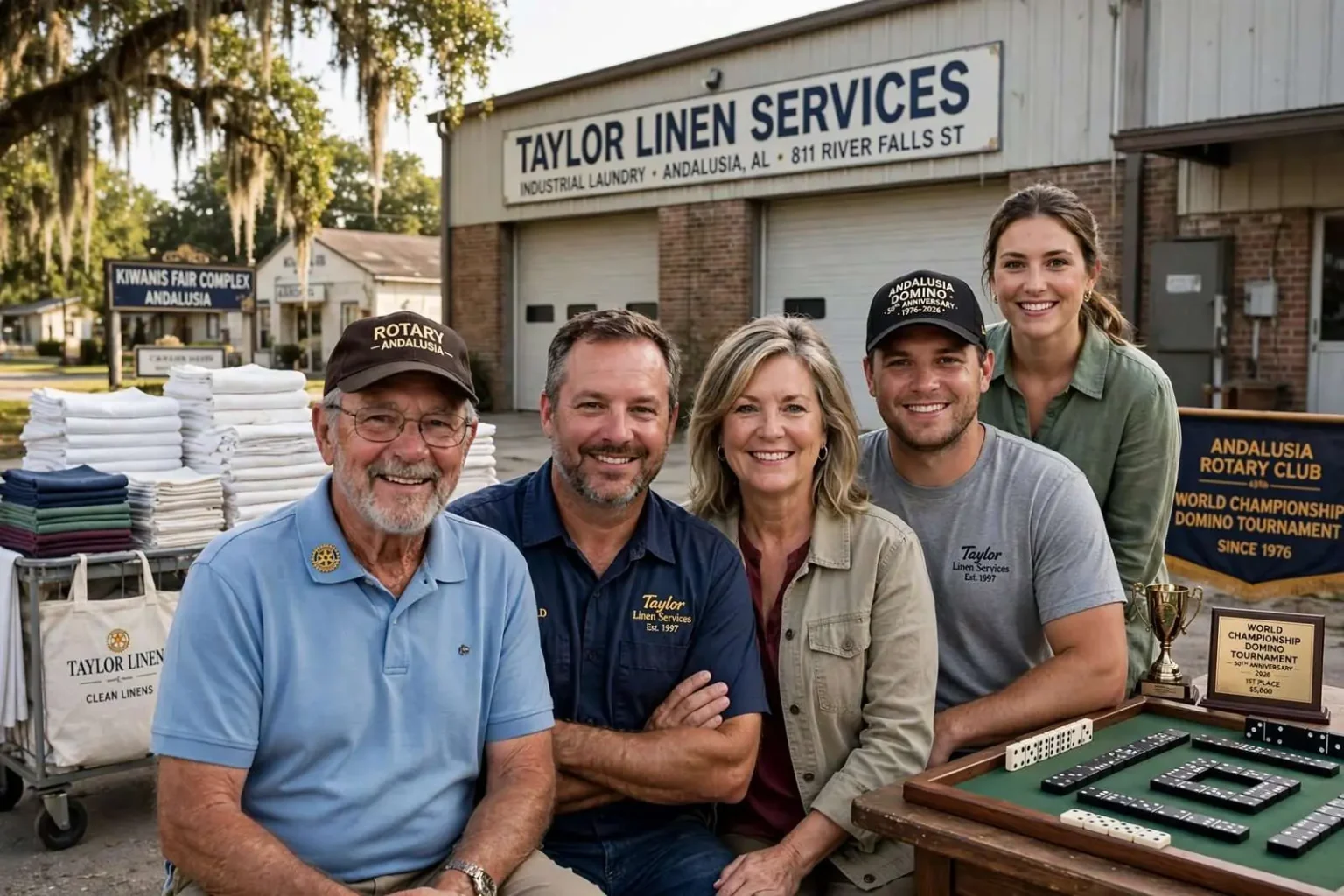
Most people who sit down to dinner at a restaurant along the Gulf Coast never give a thought to the tablecloth under their plate, the napkin folded beside it, or the crisp apron worn by the server who takes the order. But somewhere between the kitchen and the laundry dock, an entire industry works around the clock to make sure those items are clean, pressed, and back on the table before the next seating. In south Alabama, that work is centered on a family operation in Andalusia that has quietly grown from a single small-town laundry into one of the largest independent linen services in the region.
Andalusia, the seat of Covington County, is a town of roughly 8,000 people north of the Gulf Coast, and it holds a distinction that surprises even many Alabamians: it is home to the World Championship Domino Tournament, an event that has been produced by the Andalusia Rotary Club every year since 1976. The same family that has been deeply involved in that tournament for three generations also runs the laundry business. The two stories — one of tiles and tournament tables, the other of tablecloths and truck routes — are inseparable in Andalusia, and together they tell a story about how small-town institutions grow up and stay put.
A Tournament Born of the Bicentennial
The domino tournament traces its origin to 1976, when Andalusia’s mayor challenged every civic organization in town to come up with something special to celebrate the nation’s bicentennial. At the Rotary Club, a member named Dr. Charles Tomberlin — a local radiologist with a fondness for the game — suggested a domino tournament. According to accounts of the meeting, no vote was ever formally taken; the club president simply concluded that the thing would be done, and the World Championship Domino Tournament was born. Tomberlin carried the nickname “Dr. Domino” for the rest of his career.
The event grew far beyond what anyone in that meeting expected. Each July, hundreds of players have traveled to Andalusia from across the country — Texas, Oklahoma, Missouri, Mississippi, Georgia, Florida, and beyond — to compete for singles and doubles titles. Over the years the tournament has drawn recognizable names, including football coach Paul “Bear” Bryant, humorist Jerry Clower, and Auburn coach Doug Barfield. More than $900,000 in prize money and trophies has been handed out since the first tournament, and the modern event offers more than $20,000 in prize money, with a first-place check of $5,000.
The competition celebrated its 50th anniversary in July 2026, drawing international competitors to Covington County for the semiquincentennial year. Along the way, the Rotary Club has directed the proceeds to local charities, with donations from the tournament totaling more than $2 million since the event began. For a town Andalusia’s size, that steady annual contribution has made the tournament one of the most consequential fundraisers in the region — all built on a game played with rectangular black tiles.
Three Generations on the Domino Stage
The Taylor family’s connection to the tournament runs as deep as anyone’s. Riley R. Taylor Sr. was president of the Andalusia Rotary Club when the first tournament was held in 1976. His son Riley Taylor and the rest of the Taylor siblings grew up with the event as a fixture of the town’s summer, and the family’s involvement carried into a third generation when Riley’s son Reid Taylor served as chairman of the tournament’s 49th edition, held over two days in July at the Kiwanis Fair Complex in Andalusia.
The family also owns one of the largest independent laundry services in the region, Taylor Linen Services — which is no coincidence. The tournament and the business are both rooted in the same Rotary culture of service, and both reflect a distinctly Andalusian brand of ambition: build something substantial, keep it in the family, and give the proceeds back to the community.
From Mann Laundry to a Regional Operation
Taylor Linen Services began in 1997, when Riley Taylor and his wife Beth purchased Mann Laundry, a local laundry and dry cleaning business, after its owner died. The Taylors had four young children to support at the time, and Riley made a deliberate bet on one customer base: the food and beverage industry. Cloth napkins, tablecloths, aprons, kitchen towels, and chef’s uniforms became the backbone of the business.
“Food and beverage, hospitality, light medical, that’s us,” Riley has said of the company’s mix. “You may not know us by name, but more than likely, you’ve used one of the products we provide.” Anyone who has eaten at a fine-dining restaurant or had a professional massage on the Gulf Coast has very likely used something that passed through the Andalusia plant.
From the beginning, the company worked the panhandle from Mobile to Panama City, building its book of business largely on referrals. Today Taylor Linen serves more than 750 clients, from the Gulf Coast north to Huntsville, with a footprint that includes 30 to 40 country clubs and hundreds of independent restaurants. The company operates service depots in Pensacola and Birmingham supported by its production facility in Andalusia, and its route network reaches 50 to 60 towns and cities across the Florida panhandle and central and south Alabama. According to the company, its service depots allow it to cover customers from Panama City across the panhandle and throughout Alabama from its base at 811 River Falls Street in Andalusia.
That growth pattern is common in the linen business: assistant managers and chefs move on to open their own places, and they bring their laundry provider with them. Long-term relationships, not national contracts, built the company. Taylor Linen is a member of CSC, an independent trade organization for regional laundries, whose members compete against the national chains that serve the big restaurant groups by relying on personal relationships with independent owners.
Inside the Plant: 400,000 Pieces a Week
The scale of a modern industrial laundry is easy to underestimate. Taylor Linen processes approximately 400,000 pieces per week — about 200,000 pounds of laundry. When Riley started, the business could handle about 20,000 pounds a week in 50 hours of operation; the same volume now moves through the plant in four to five hours. “Technology trumps everything,” he says.
Every item carries a Radio Frequency Identification tag, so the company knows which client each tablecloth belongs to and where it sits in the inventory at any moment. Each client is essentially dedicated five sets of linens, rotating through a four-day turnaround — one set on the table, the rest in the wash, delivery, or storage pipeline. The company offers linens sized for any table and twenty colors of cloth napkins, most of them supplied by Milliken Napery in Spartanburg, South Carolina.
The product list reaches well beyond fine dining: bar towels, floor mats, aprons, janitorial supplies, chef’s uniforms, and even sheets for massage tables. Whatever the class of restaurant — white tablecloth or casual — the linen demands are the same, only the volumes differ.
Weathering the Peaks and Valleys
The linen business on the Gulf Coast is intensely seasonal, and the company has learned to manage through shocks. Demand once flourished at the height of summer and went dormant in the off-season, and holidays were brutal, with every restaurant on the route increasing its orders threefold at the same time. Hurricane season added a layer of risk that coastal businesses know well.
The decision to expand north came directly from disaster. The BP Deepwater Horizon oil spill in 2010 decimated the company’s coastal customer base almost overnight, and Taylor concluded that the business needed insulation from the peaks and valleys of a seasonal, tourism-driven market. Expansion northward, ultimately reaching Huntsville, was the answer. The company also built resilience by doing things larger competitors decline to do, taking on the awkward, low-margin work that keeps independent restaurants loyal.
Then came the pandemic. In April 2020, demand stopped almost entirely as dining rooms closed across the region. By fall, as restrictions lifted, the plant was bursting at the seams with orders from customers eager to get back to normal life. Riley notes that he was fortunate not to have broken ground on a new plant just before the pandemic — the company was 18 months into design and planning when COVID hit, and had deliberately held off. Instead of a new building, the company upgraded technology and capacity within the same 20,000-square-foot facility it operates today.
The company employs about 90 people, and Riley sends a monthly newsletter to remind them that they work for, in his words, “the most important industrial laundry in the world” — a bit of institutional swagger meant to reinforce that treating each other, the customers, and the assets with care is what keeps the business healthy. The operation also emphasizes environmental practices, offering recyclable products and laundering at scale, which spreads the water and energy cost of cleaning across thousands of reusable items instead of millions of disposable ones.
The Next Generation Takes the Handles
All four of Riley and Beth’s grown children — Auburn University graduates — are now involved in the business. The succession has been deliberately slow: the siblings hold sweat equity and are moving toward full ownership under what Riley describes, with a laugh, as a one-and-a-half-generation operation that is ten years into a five-year transition plan. Reid, who heads customer relations, is among the children now running day-to-day operations, while Riley remains involved daily and spends more of his time hunting, fishing, playing golf, and, as he puts it, doing “grandfather stuff” — he and Beth have 13 grandchildren, many of whom gather at Navarre Beach in Florida.
“We are a small part of our customers’ business operations,” Riley says, “but to each, we are a big part of their customers’ and employees’ experience.” That is a fair description of what an industrial laundry actually is: an invisible utility for the hospitality economy, judged by whether anyone ever notices it at all.
A Town That Plays for Keeps
Back at the fairgrounds each July, the domino tournament carries on the same way. Players return year after year — some have competed since the late 1970s — and the tiles clatter across tables at the Kiwanis Fair Complex while the Rotary Club tallies another year of charitable proceeds. The connection between the two Taylor institutions is more than incidental. Both are family businesses in the oldest sense: built slowly, passed down deliberately, and measured by what they give back to Andalusia rather than by how far they reach beyond it.
The laundry now reaches from the beaches of the panhandle to Huntsville, and the tournament draws champions from across the country to a town most maps render as a dot between Montgomery and the Florida line. But in both cases, the operation runs on the same fuel — long relationships, careful service, and a willingness to do unglamorous work extremely well. Sounds like a succession plan, and a legacy, worth keeping an eye on.
Related coverage from South AL News
- Isaias Rainfall Totals: Andalusia Got Up to 6 Inches While Mobile Saw About an Inch
- Regions Bank Asks Judge to Reopen Mabel Amos Settlement, Rejecting Terms Drafted by AG’s Office
- 2,000 Letters Later, Andalusia Gets Its Chick-fil-A: Doors Open Oct. 8 on Hillcrest Drive
- Missing Florida Woman, 67, Found Dead Near Andalusia Campground After Multi-Agency Search