

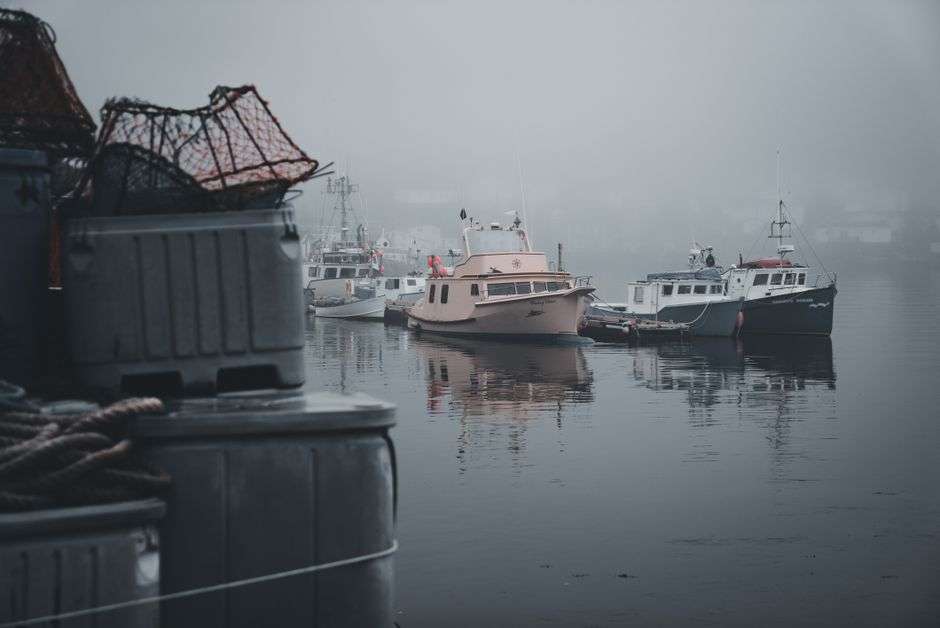
Every harbor has one — the boat nobody can quite explain. On Perdido Bay, in the Baldwin County town of Lillian, it is a 45-foot Canadian lobster vessel called the Flauna II, riding at anchor in water a couple of thousand miles from any lobster fishery, piloted by a landscape contractor with a degreed naturalist’s eye and a boyhood story worth the whole trip.
Snowbirds from coastal Canada or Maine would recognize the design instantly: the long, wide, open stern built for hauling traps in the North Atlantic. Natives of the Perdido Bay region, meanwhile, could likely tell you the captain’s name without being asked. David Ellis has made himself part of the local scenery — a fixture who collects friends the way his boat collects bilge water, and who takes them out on the water for free because what he really wants, he says, is for them to understand the water.
Why a lobster boat in Alabama
The answer begins with the boat builders. The Hutt family of Prince Edward Island has constructed vessels for North Atlantic fishermen for half a century, and they had never sold a boat to a drawling waterman from an estuarine bay in Alabama. When David Ellis called, their curiosity got the better of them.
He was not crazy, they concluded, but very calculated. He wanted a long stern with a wide beam for a stable work deck; a relatively shallow draft for the estuarine shallows of Perdido Bay; and a skeg on the keel to protect his propeller when he nosed the bow into marsh cuts chasing speckled trout and redfish. The Hutts knew lobstering was not a thing in Alabama. They also knew the boat he was describing was exactly the boat for it.
The Flauna II — designed and built for lobstering by the Hutts on Prince Edward Island — turned out to be a perfect Gulf Coast fishing platform. Her deck easily deploys fishing kayaks, tackle and coolers. She is stable enough for blue-water runs offshore for diving and fishing. And at her center sits an enormous ceramic kamado grill, because an Ellis outing is as much about the meal as the catch: guests should expect to socialize, take in the view, angle, sip a good wine and eat their fill.
The first Flauna: a floating sauna
The name, ostensibly, combines “flora” and “fauna” — fitting for a trained naturalist. But over time, and with some prodding, Ellis admits the name’s true root: “floating sauna.”
The original Flauna was a floating sweat lodge built in the mid-1970s by some ingenious teenage boys — old barrels lashed together, a wooden deck built on top, a salvaged wood stove feeding a sauna room, all towable by boat to any corner of Perdido Bay. The boys — Ellis among them — could steam themselves clean, then dive off the deck into the bay.
The contraption became a local institution. An eclectic collection of locals, newcomers and meditative hippies started showing up for a steam and a swim. One affluent visitor arrived in a new white designer ensemble with perfect deck shoes — and stayed on the platform for two days, leaving happy and dazed, gray with mud, shoeless, and relieved of his genteel bearing.
The floating sauna also taught the boys, in the way water always does, something about people. The girls liked it; the fathers of the girls did not. Provisions were pilfered, beer was bold, and nobody much cared where they came ashore — a short walk to civilization, a borrowed telephone and a vague description of their location always produced a rescue. They had seasons of youthful magic that every human should feel, even for a short while.
A naturalist at the helm
The captain of the Flauna II is an alumnus of the University of the South, a landscape contractor by trade and a degreed naturalist by training, and it shows the moment the lines come off. A day on the Flauna II is a floating ecology seminar: bald eagles and ospreys overhead, mudflats and grass beds below, cypress trees at the waterline, and — the part Ellis finds endlessly fascinating — the invisible boundary where freshwater rivers meet saltwater bay and everything about the ecosystem changes.
He exercises his fascination with how it all fits together, and he is as interested in the people aboard as in the water below. His friend group, locals say, spans farmers, fishermen, academics, millionaires, blues musicians, preachers, authors and high-haired church ladies — a cross-section of coastal Alabama that would be hard to assemble any other way.
The boat, the bay and la bonne vie
The Flauna II’s name is a portmanteau with a wink, and her history with a boyhood sauna is the kind of detail that makes Perdido Bay feel like the small, interconnected place it is. David is content to take people fishing or birding. But he is happiest, friends say, when somebody aboard feels a little of the joy — the “la bonne vie” — of his boyhood on a floating sauna.
As the day’s voyage winds down, somebody usually asks the question: why doesn’t he charter the boat for a living? His usual reply: “I will one day. Right now, I’m having fun with you.”
Then he says, “Man… look at that sunset.”
The waters he sails
Perdido Bay itself deserves the mention it rarely gets. Straddling the Alabama-Florida line at the western end of Baldwin County’s beach country, it is a quieter cousin of the resort bays to the east — a place where estuarine shallows, grass flats and river channels support a fishery that locals guard the way fishermen guard any good spot. The boat’s shallow draft is not an affectation; it is the design requirement of a bay where the fish are often found in water a larger hull cannot float.
That is the quiet genius of the Flauna II. A North Atlantic lobster hull, transplanted to the Gulf, turns out to be exactly the right tool for reading Perdido Bay — stable, shallow, seaworthy and commodious. And a boy who once floated a sauna made of barrels across the same bay has grown into a captain who uses the finest version of that idea to teach his neighbors where they live.
David Ellis is content to keep it that way. The boat runs, the grill smokes, the ospreys circle, and the charter business can wait. “Right now,” he says, “I’m having fun with you.”