

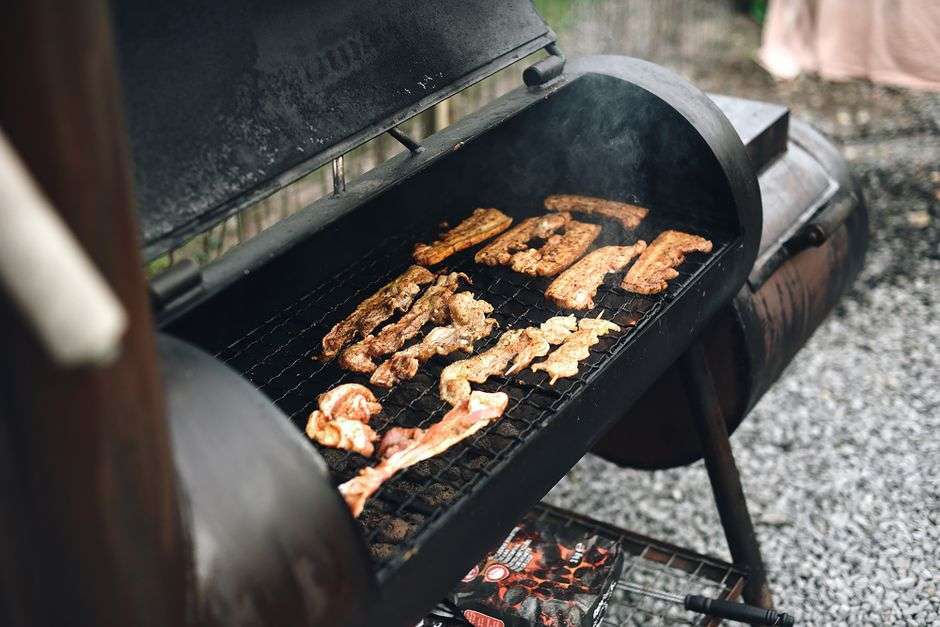
Mark White keeps a Paul “Bear” Bryant quote hanging in his new Moe’s Original BBQ store in Daphne: “If you believe in yourself, have dedication and pride, and never quit, you’ll be a winner. The price of victory is high, but so are the rewards.” It reads like a decoration. After an afternoon of listening to White tell his story, it reads like a summary of his life.
“The difference between stepping stones and stumbling blocks is how you use them,” White says, and his biography is a working demonstration of the line. His is a story about perseverance and faith, about music and barbecue, about being knocked down hard enough to break bones and land in wheelchairs, and getting back up every single time. It ends, for now, at a 15,000-square-foot restaurant complex in Daphne that he describes as everything he has always wanted in a restaurant. The road there was anything but straight.
A Dream Fifteen Thousand Square Feet Big
The new building sits next door to the original Moe’s on Bayfront Park Drive in Daphne, and it distills lessons from White’s five existing locations: Orange Beach, Foley, Daphne, downtown Mobile, and the Airport Boulevard store in West Mobile. Everything he has learned about feeding Gulf Coast barbecue crowds went into its design.
The opening was choreographed down to the holiday. After hosting an Easter egg hunt on the Saturday before Easter, the team planned to shut down the old place, clean every piece of equipment, and move the operation next door, with a soft opening targeted for the end of the week on April 25. “It will be a soft opening at first, so not a lot of fanfare until we get on solid footing,” White says. The calm in his voice as he walks through the plan comes from decades in the business. “It takes a lot of work to run a restaurant business. The rewards come after putting in the time. There’s no other way around it. You have to be present.”
White knows what presence costs, because he learned the restaurant business the hard way: starting at 14 in a dish pit and grinding his way up. But the story starts long before that, in Birmingham.
A Birmingham Kid Between Two Worlds
White grew up in Birmingham and attended Briarwood Christian School, where his parents taught Sunday school. Athletics carried him: he made the varsity baseball team in the eighth grade and played offensive and defensive line in football. He later transferred to Hoover High School and kept playing. School itself, he admits, was mostly a place to play sports.
Then two things happened that pulled his life in a different direction. First came music. In 1995, when he was 15, he went to a two-day Grateful Dead concert at the Birmingham Jefferson Civic Center, and a door opened. Following Widespread Panic and the Allman Brothers from show to show became part of who he was, a traveling tribe of fans he would cross paths with again years later in the most unexpected place: a ski town in Colorado.
The second was a move. Not quite in line with his parents’ thinking, White went to live with his uncle in Norman, Oklahoma, during his sophomore year. There he was exposed to horses, learned to bow hunt, and earned his spending money stringing barbed wire on fence posts. He played football and baseball at his new school, where coaches put him at defensive back because of his size, on a roster deep enough that around ten teammates went on to Division 1 college football. He loved the time with his uncle, but Birmingham and his friends called him home. On his second day back at Hoover High, he says, he was “tapped back in.”
The Concert That Changed Everything
Soon after his return came the moment that derailed his carefully ordinary teenage life. At a Hank Williams Jr. and Lynyrd Skynyrd concert at Oak Mountain Amphitheater in Pelham, a huge fight broke out in the hillside seating area and rolled toward him like a wave. The crowd came from behind and fell on him, and White found himself buried under people with his left leg bone sticking through the skin at a right angle.
“It was the best of the ‘good ole boys’ fight,” he says dryly. “That set me back a while.” “A while” is generous: four weeks in the hospital, four screws and a rod in his leg. Teachers brought schoolwork to the hospital, and he kept up, making As and Bs. Then a staph infection took hold, requiring emergency surgery to remove the rod and screws and costing him several more weeks, much of it in a wheelchair. The missed days added up, and the school told him he would have to repeat the eleventh grade.
He was devastated. He persuaded his parents to let him drop out, promising he would earn his GED and go to college. He made good on both halves of that promise, earning the GED while living with his girlfriend’s family in Mountain Brook and enrolling at Jefferson State Community College. His leg healed well enough that he even played American Legion baseball.
The Kitchen Calls
Work had been part of White’s life from the beginning. His first job, at 14, was at Fuddruckers, where he started in the dish pit and was moved to the kitchen after his very first shift, an early signal of where he belonged. He went on to work at Armand’s Restaurant and Ralph and Kacoo’s, and as the man of the house in his girlfriend’s family, he did most of the grilling and cooking.
His girlfriend’s mother made a suggestion that would shape the rest of his life: look into culinary school. White had not known such a thing existed. “I didn’t even know what that was,” he says. He found out that a person could actually make money being a chef. He applied for grants and loans, saved his money, and put himself through Johnson and Wales Culinary University, earning a degree in the College of Food Innovation & Technology in Charleston, South Carolina. The school’s lineage runs deep in American food, training generations of chefs since its founding in 1914 in Providence, Rhode Island, and its Charleston campus gave White a launching pad in one of the country’s great restaurant cities.
In Charleston he worked at two highly regarded restaurants, Magnolia’s Uptown Down South and Hank’s Seafood, both institutions of the city’s dining scene. His own account of the pace says everything about his temperament: “I worked three straight months without a day off. Not one.”
Then a friend with an extra room extended an invitation west, to Vail, Colorado. White, still chasing Widespread Panic concerts, followed. He landed two jobs on arrival, one at La Tour, an upscale French bistro, and another at the Gore Range Brewery in nearby Edwards. Around fifteen people from Alabama worked at the brewery, so he was, as he puts it, comfortable with the language. A broken collarbone from snowboarding, requiring three surgeries with plates and screws, would have slowed most people down. It barely slowed the story.
Vail, and the Birth of Moe’s
Vail is where the pieces of Moe’s Original BBQ finally assembled. White met Mike Fernandez, Jeff Kennedy, and Ben Gilbert, three friends from the University of Alabama who had moved to the mountains after college to ski. Mike had learned to smoke meats working with Moses Day, the man for whom Moe’s is named, at Indian Hills Country Club in Tuscaloosa. In Vail, while working at the Train Station, Mike had tinkered with smoking barbecue butts because the bar needed to serve food to secure a liquor license. After Moses passed away, Mike enrolled at Johnson and Wales’ Colorado campus and earned his own culinary degree, then stayed in Vail cooking in restaurants. Ben Gilbert was cooking at the Grouse Mountain Grill in Beaver Creek. Jeff Kennedy had discovered his love of the industry at the Coyote Cafe.
The four of them noticed a gap: Southern folks living in ski country had no Southern cooking. So the trio went to junkyards, collected parts, and built a smoker, then began hustling barbecue to construction job sites. Moe’s Original BBQ was born in that scrappy, practical way, feeding hungry workers out of a machine they welded themselves.
The operation grew in stages: a concession trailer on a corner in Edwards, then a rented kitchen in Minturn to expand production. White, just 21 years old, started helping his three friends on the side. Then he quit the brewery and joined full time. “It was a logistical nightmare,” he says. “There were lots of moving parts, and we were running all over town.” They quickly put him on the log fire smoker. He was the first person they ever hired, and he never quit. The four of them knew everyone in Vail, met plenty of musicians, and began opening more locations and building a catering business.
When White finally reached the top of the pay scale, he began looking for a mountain location he could run with equity in it. Then his father passed away after a long illness, and his priorities snapped into focus: he would move back to Alabama to be closer to family.
That homecoming, and how a Vail barbecue company took root on the Gulf Coast, is the story of Part II, which picks up in South Alabama. As the Robert Earl Keen song says, “The road goes on forever, but the party never ends.”