

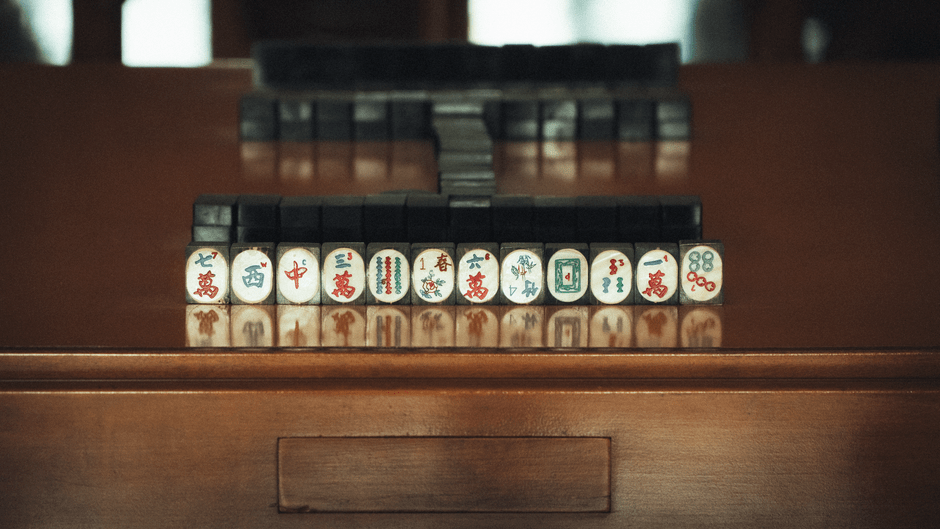
The tiles clink. The table fills. Someone shouts “Mahjong!” and four players dissolve into laughter and disbelief. Around the Gulf Coast, this scene is repeating itself at a remarkable pace — in breweries, restaurants, clubhouses and living rooms — as an American tile game with roots in 19th-century China becomes one of the fastest-growing social pastimes on the coast.
The numbers behind the surge are striking. Eventbrite, the global ticketing platform, recorded 179 percent growth in mahjong events from 2023 to 2024, including a 150 percent spike in San Francisco alone. Yelp reported that searches for mahjong clubs have jumped 4,500 percent in a single year. And along the Gulf Coast, the boom has produced something more durable than a trend: a volunteer-run community that now organizes weekly games across Mobile and Baldwin counties.
How the game works
American mahjong is played on a mat scattered with intricately decorated tiles — craks, bams, dots, dragons, flowers, jokers and winds, many hand-painted with miniature renditions of their names. Four players draw and discard from the tiles, trying to replicate one of the dozens of patterns on the current year’s card, published each April by the National Mah Jongg League. The first player to complete a pattern and call “Mahjong!” wins the hand.
The strategy is sneakier than it looks. Players hide their hands, pivot mid-game, and — when a win is out of reach — deliberately sabotage the player closest to victory by withholding needed tiles or discarding jokers. “If you know you can’t win, you try to offset someone else from winning by tossing out jokers or taking tiles they need,” said Jill Elliott, a Mobile mahjong instructor and avid player. “Because if everyone loses, everyone gets points.”
Getting started costs as little or as much as a player wants: sets range from under $10 to more than $500, and free online versions let newcomers learn before they buy.
From TikTok to a Facebook group of 1,200
Mobile’s mahjong community has a specific birthday, and its founder traces it to something unlikely: a TikTok scroll. Rachel Helton said she wasn’t a game person until she saw the tablescapes and mahjong parties filling her feed — “and I thought it would be fun.”
Then came the problem: she couldn’t find a class. “With mahjong, you’re encouraged to take a class to learn the ropes,” Helton said. Intro classes in Mobile were nowhere to be found, so she looked across the bay, found Fairhope’s Mahjong Magnolias, and drove over with her mother nearly every weekend from April to June until the commute wore her down.
So Mobile got its own community, seeded by the Magnolias and a handful of Helton’s friends. It outgrew the email threads and text chains used to organize early games, and Helton created the Mobile Mahjong Facebook group, which has grown to more than 1,200 members since August 2025 and now posts events every week.
The Mahjong Magnolias, meanwhile, are still at it — offering everything from introduction classes to open play on the Eastern Shore.
Retreats, breweries and the social pull
The phenomenon has grown well past weekly games. Overnight mahjong retreats now draw players from across the country — Lynn Cooper, owner of the mahjongcollective_ Instagram account with nearly 50,000 followers, hosted an event with 72 women from around the country in Fairhope just last week. Locally, restaurants and breweries including the Slurp Society and Fairhope Brewing Company host free mahjong events that bring in around 40 players at a time; the only thing organizers ask is that guests buy something to support the venue.
For Elliott, the game filled a gap that grief had opened. “My husband passed away three years ago, then my younger brother about 18 months later,” she said. Weekends emptied out, and she found herself dreading Friday afternoons. “I was craving a social outlet, then I discovered Mahjong.” Now she describes the table as an equalizer — retreats pull players from all over the country, and strangers become regulars within a game or two.
Her friend Sandy Gibson puts it in terms of the tiles themselves. “The clink of the tiles is very therapeutic,” she said. “Just to be able to turn the whole world off for a few hours and laugh.”
A game with a deep American history
The game’s American chapter is older than most players realize. Mahjong originated in mid-19th-century China as an adaptation of gambling-hall strategy games and crossed the Pacific in the luggage of Joseph Park Babcock, a Standard Oil representative in China — arriving, notably, during the era of the Chinese Exclusion Act. American enthusiasm boomed in the early 1920s and then faded, but the game survived in dedicated communities, particularly among Jewish women in large cities.
That persistence paid off in 1937, when four women — Viola Cecil, Dorothy Meyerson, Herma Jacobs and Hortense Potter — founded the National Mah Jongg League in New York City and standardized the rules that American players still use. Classic Chinese mahjong, played without jokers or an annual card, remains a fixture in China; the American version is the one taking over Gulf Coast tables.
Where to play
The local scene runs almost entirely on volunteers. Players who want to host can take over organizing duties — like the volunteer who runs weekly games in the event room at the Chicken Salad Chick in Saraland, which the restaurant lends out for free. Organizers have no budget, but Helton says they have something better: a large, easygoing group of players who bring foot traffic wherever they land.
“We would love more places to play,” Helton said. “We might not be able to pay them up front, but we will bring them a lot of foot traffic and business during the event.”
To find a game, newcomers can join Mobile Mahjong on Facebook or Instagram, where events are posted weekly. Bring a set if you have one — and if you don’t, someone at the table always does.