

If you have seen John Tony Grubbs on stage playing harmonica in his wheelchair, you may have wondered what the story is. It starts in the Robertsdale area of Baldwin County in the 1950s, passes through a football field that changed everything, runs through Muscle Shoals and the beach bars of 1970s Orange Beach, and arrives — improbably, gratefully — at a Midtown Mobile living room where an artificial intelligence turns his lyrics into songs.
“I broke my neck when I was 15 playing football,” he says. “I tackled a guy, and I couldn’t get up. I was just lying there on the field.”
Drums, Then a New Life
The 1969 injury left him paralyzed from the neck down at first; surgery restored the ability to walk, with difficulty, for many years. He took up drums to rebuild coordination and played steadily for about a decade with popular groups in Orange Beach and Gulf Shores — until the drumming itself began damaging his neck and he had to put down the sticks.
That ending became a beginning. He moved to Mobile to study vocational counseling at the University of South Alabama, earning a master’s degree and a 24-year career with what was then the Mobile Association for Retarded Citizens, now MARC. He started as a service coordinator building vocational plans for people with developmental disabilities, then ran the MARC Enterprise work center in Irvington — a busy facility where clients built cypress outdoor furniture, sorted wire hangers for a uniform company and raised hydroponic lettuce for grocery stores. He retired in 2016, having driven himself to work every day.
He still drives, in a van with hand controls and an automatic ramp, though his mobility has narrowed to a power wheelchair. He describes himself as an incomplete quadriplegic: he can move his legs and feet, though not normally; his hands won’t open; sensation is delayed. “Once I get in my chair, there’s not a lot I can’t do,” he says. “I love to cook, and I love to work in the yard, though I can’t mow anymore.”
Walter, Shine, and Sometimes John
The music came first, and it was better than a hobby. In the 1970s he fell in with a group answering to the unlikely name Walter, Shine, and Sometimes John — regulars at the old Gulf Gate Lodge in Orange Beach’s Bear Point area. Walter and Shine (real name Madison Powell) were marine biologists; John was a Birmingham realtor who could sometimes make the gig. “They were a really good vocal group,” Grubbs says — good enough to record at the legendary FAME studio in Muscle Shoals. “I was 20 or 21 and had barely been out of Baldwin County. They heard about me somehow, and we went up to Muscle Shoals in a big ol’ car, like an Oldsmobile 88. We recorded three songs, and then we went to Nashville to Charlie Rich’s studio, where they mixed it.”
Later came Shine and Blackwater, holding court Sundays at Sam and Shine’s Lounge — a big club in a former bowling alley at U.S. 59 and Fort Morgan Road that later became Margaritaville. His last gig before his body forced a stop was back at the Gulf Gate with Clark & Joanie and the Quarter Moon Band.
The Harmonica, and Then Suno
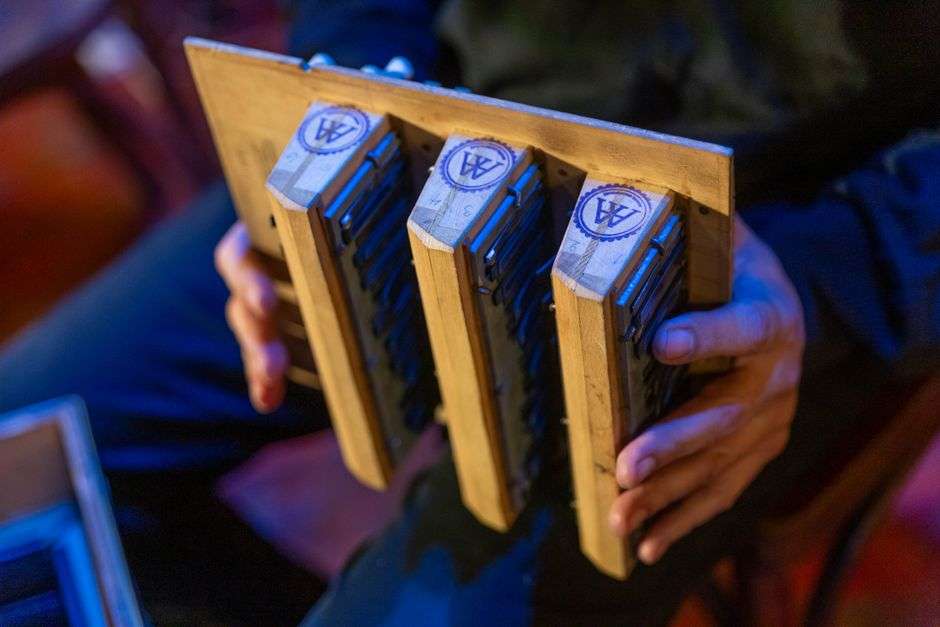
For 25 years he played nothing at all. Around 2010 the itch returned, and the harmonica — playable from a wheelchair with limited hand function — became his instrument. He sits in with the Family Jewels at Veet’s downtown, and more often with Phil & Foster at Callaghan’s. “Whenever I go see them, they are very welcoming,” he says. “I’m honored that they let me play with them.” Phil’s reply: “He’s a super nice guy, he plays well, and he behaves like a pro. Anyone with those qualities is a shoo-in with us.”
Two years ago, he started writing lyrics — ideas that arrived at night, recited over and over until morning, then typed into his iPhone with the knuckle of his little finger. Then he found Suno, the AI app that composes full songs from lyrics, and heard his words come back as radio-ready arrangements. The real musicians in his life have been measured; his Facebook friends have not. “I expected a backlash, but it’s been pretty mild, really,” he says. “I love it, though. It’s given me a way to be more creative, and it’s helped me improve as a songwriter. The weird thing is, all those years I was playing music full-time, I never even considered writing songs.”
His catalog ranges wide — “I Believe,” a statement of faith; “Daddy Come Back to Me,” a child’s plea in a broken home; “Until the Next Time,” sung from the perspective of a woman in an abusive relationship. And there is “Silent Wings,” written for his wife, Barbara — a recreational therapist he met through wheelchair basketball, deaf since birth, who has never heard a note of his music and has supported all of it for 37 years. “She truly has a heart of gold,” Grubbs says. “She married me knowing what she was getting, and I don’t know what I’d do without her. All I can say about that is God has a plan, and he laid it all out for us.”