MOBILE, Ala. — By the time an audience at the University of South Alabama settles in for a Theatre USA production, the students on stage have usually crammed weeks of building, sewing, lighting and rehearsing into a schedule that would make most professional companies wince. A senior in the university’s drama and theatre arts department, now working on her seventh campus show, offers a look at what that process involves and why she would not trade it.
The Mobile native, who is also minoring in psychology, has performed in six Theatre USA productions since arriving on campus and is currently rehearsing the department’s staging of The Government Inspector. Her path to the stage, and the habits she has built along the way, show how a small academic theatre program turns students into working artists.
Five Weeks From First Read to Opening Night
The biggest difference between a university production and a professional one is time. Professional theatres may spend months, or even years, developing a show. In an academic program built around the semester calendar, the student explained, the entire production window is typically five weeks at most.
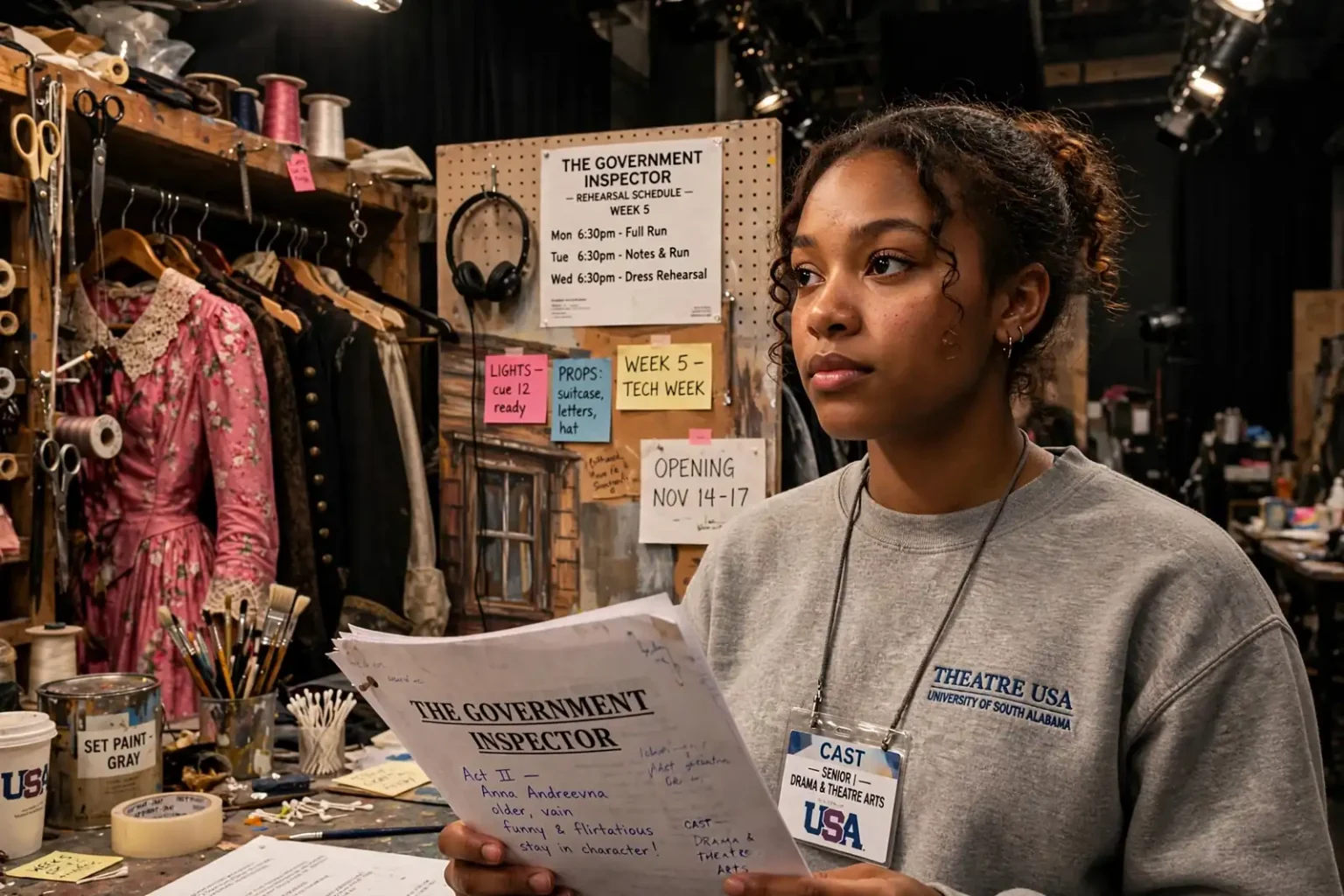
Within that span, students and faculty share the work of designing and building the set, creating the lighting, gathering props, preparing costumes and makeup, and rehearsing the show. She said the cast and crew are on campus almost around the clock during that stretch, but that nobody minds because everyone involved loves the work. She compared the long hours to spending extended time with a group of friends.
Backstage, she said, the atmosphere is unlike anything else. A great many things are happening at once, and the pace can feel chaotic, but everyone stays aligned on what has to get done and is pushing toward the same result. That shared purpose is what she finds most rewarding.
Inside a Typical Rehearsal Night
A normal evening rehearsal begins around 6:30 p.m. One of the students takes charge of the opening, guiding the cast through stretches and vocal warm-ups. Before the director arrives, the actors go over their blocking, which is the planned movement and positioning on stage, run their lines and work through scenes together on their own.
As opening night draws closer, the rhythm of rehearsals changes. The cast moves to full run-throughs without scripts in hand. After each run, the director gives notes, and the company goes back and runs the show again, refining timing, transitions and character choices with each pass.
Learning lines between classes
Fitting that schedule around a full course load is not easy, and she said repetition is the key. She keeps her script with her throughout the day and looks over her lines whenever she has a few free minutes. People often ask how she remembers so much material, and she said she honestly cannot explain it; the words simply stay with her.
Part of that comes from training. Students in the program are taught to remain in character at all times on stage. If something goes wrong during a performance, she said, the mistake happens in character, and the actor corrects it in a way the audience never notices, rather than breaking and panicking.
No more stage fright
That level of preparation has also taken the edge off performance nerves. She describes herself as a perfectionist, and by the time a show opens the cast has rehearsed it roughly 200 times. By then she feels completely at ease, and she said the nervousness she once felt is gone. Her approach on show day is to remind herself to do exactly what she has been doing in rehearsal and to give it more than everything she has.
From Church Stages to a College Major
Her love of performing started early. She grew up taking part in church productions and was singing by age 2. In middle school, she said, she became deeply involved in performing and realized it was one of the ways she could best express herself. She said she simply loves performing for an audience.
Even so, theatre was not her first academic choice. She transferred to South Alabama and began as a psychology major, but she felt something was missing from her studies. That missing piece turned out to be performance, and she changed her major to drama while keeping psychology as a minor.
A Range of Roles at South
Her first show at South was The Giver, the stage adaptation of Lois Lowry’s novel. She arrived nervous and did not know anyone in the department, but being cast helped her form lasting friendships and find a place for herself in the program.
Since then she has appeared in Shakespeare’s The Comedy of Errors, Oscar Wilde’s The Importance of Being Earnest and Skeleton Crew, Dominique Morisseau’s drama about autoworkers at a Detroit stamping plant. She said Skeleton Crew, which was performed by an all-Black cast, drew a strong response, and that the production held special meaning because it gave Black students, herself included, a chance to see their own stories represented on stage.
Her current role in The Government Inspector, Nikolai Gogol’s 19th-century satire about small-town officials who mistake a visitor for an undercover government inspector, pushes her in a new direction. She is playing an older woman who still believes she is young and attractive and craves attention from every man she meets, a character well outside the age range of her earlier parts. She said the role is very funny, and she revealed that she has borrowed from her own mother in shaping the character.
Small Program, Personal Teaching
She credits the department’s faculty with much of her growth. Because the program is small, students get individual attention and form close working relationships with their instructors, which she said gives them a well-rounded preparation for professional work.
From one faculty member, students learn the technical and backstage side of theatre, including costumes, hair and makeup and lighting design. From the program’s director, they learn acting, how to move within a scene and even how to direct. As a result, she said, graduates come out able to do more than just technical work or just acting, and can step into nearly any role in a production and know what to do.
Learning in the department looks different from a typical lecture course. Instead of sitting in a classroom, students learn by working on real productions in a group setting and by learning from each other. She described it as a passing down of knowledge, in which students pick up skills from more experienced classmates and then teach what they have learned to those who come after them.
That model is common in theatre education generally. Productions require dozens of distinct jobs, from stage management and carpentry to sound, props and wardrobe, and students who rotate through those roles gain a practical understanding of how every piece of a show fits together. Many working theatre professionals describe that broad experience as one of the most useful things a training program can provide.
Plans After Graduation
Looking ahead, she would like to work with the SouthEast Alabama Community Theatre once she has her degree. She is also a certified daycare teacher, work she said would give her the flexibility to attend auditions and continue taking acting classes. Further down the road, she has set a five-year target for relocating to New York City.
Community theatres play an important role for emerging performers. They offer regular chances to perform in front of live audiences, build a resume and work alongside experienced local artists, all while performers continue training and auditioning for larger opportunities.
The move would put her in the country’s best-known theatre market, home to Broadway, off-Broadway and a large network of smaller companies, training studios and casting offices. Performers who make that move typically continue taking classes and auditioning regularly while building their careers.
Advice on Rejection
Asked about the most valuable lesson she has taken from her professors, she pointed to advice about rejection. Hearing no is a normal part of a performing career, she said, and it should not shape what comes next. Missing out on a role does not mean an actor is going unnoticed or lacks talent, and it should not be taken personally, because it usually is not personal.
Instead, she urges other students to keep auditioning, ask plenty of questions and look for feedback. A rejection today, she said, does not mean the answer will always be no.
Seeing the Show Differently
For audience members, her experience is a reminder that every Theatre USA production is the product of a short, intense collaboration among students and faculty. The set pieces, lighting cues, costumes and polished performances that appear on opening night are built in a matter of weeks by people who are also attending classes, studying for exams and holding down other responsibilities.
Residents interested in seeing student work can contact the drama and theatre arts department at the University of South Alabama for information on The Government Inspector and upcoming Theatre USA productions. Attending a performance is one of the simplest ways to support the students who spend those long evenings in rehearsal and the faculty who guide them.