Thomasville Residents Living Near a Proposed Data Center Want Answers. The Mayor Says the City Can’t Legally Stop It Yet.
Residents near a proposed Thomasville data center pressed the city council for answers this week, but Mayor Sheldon Day said the city has limited legal authority to block the project outright.
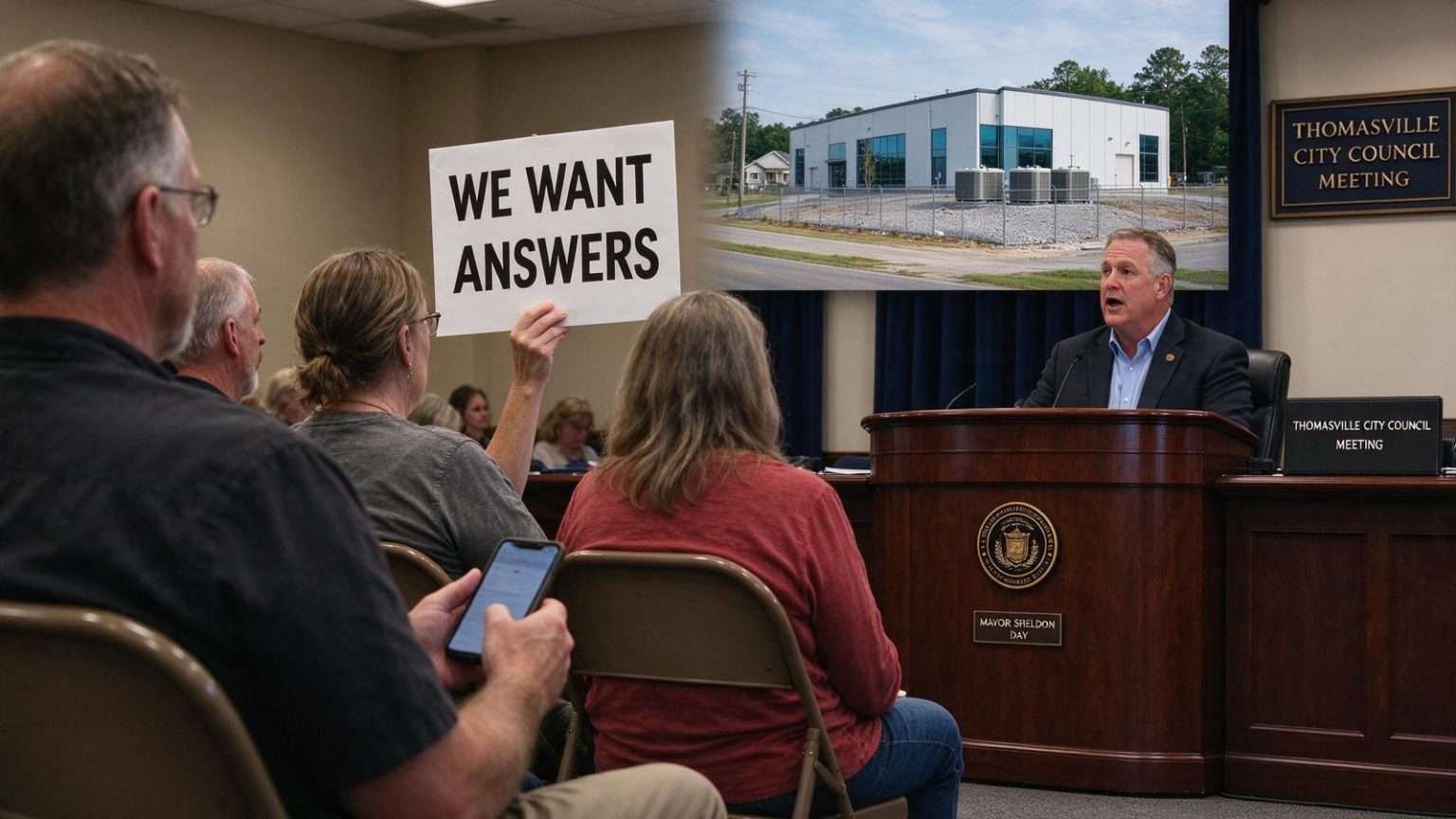
Concerns over a proposed data center dominated Thomasville’s city council meeting this week, as residents living near the project site pressed council members for answers about whether the city has any real power to block it. The exchange laid bare an uncomfortable reality of rural economic development: a project big enough to reshape a community’s infrastructure may sit just beyond the boundary where that community’s government can do much about it. For the Dummy Line Road residents who filled the room, the meeting was the first sustained public airing of fears they have been raising since word of the proposal spread.
Residents from the Dummy Line Road area urged the council to oppose the project, but Mayor Sheldon Day told them the proposal remains in an early investigative stage, with key details — including the final design, utility demands, and whether the project happens at all — still unknown. “We’re investigating this,” Day said. “We’re going to find out what’s coming about and look at it hard.” His message was neither endorsement nor rejection; it was a caution that neither the city nor the residents yet know the full scope of what a developer has in mind for the site.
Limits on the City’s Power
Day said the city’s authority to stop the project is limited because the proposed site sits outside Thomasville’s city limits, in an area with no countywide zoning. “There’s no vote that this council can take directly to stop the project,” Day said, though he noted the council could vote against any local incentives the project eventually requests. That distinction matters: without zoning jurisdiction, Clarke County has no land-use rules the project must clear, leaving the council’s leverage largely in the money it might or might not offer and the utilities it might or might not extend.
He added that the developer has not yet completed a required power supply study, which typically takes five to six months, meaning no final decision is likely soon. A data center’s feasibility rests on whether the electrical grid can supply it, and that question is answered by engineers rather than city councils. Until the study is done, even the project’s backers cannot say with certainty what its demand on the region’s power system would look like — a fact that shaped the mayor’s message that patience, not an immediate vote, is the city’s realistic posture.
The legal landscape Day described is familiar across Alabama’s rural counties. Where counties lack zoning authority, landowners can develop their property largely as they see fit, and municipalities can only regulate what falls inside their police jurisdiction or city limits. Thomasville could extend its influence by annexing the site, but Day did not propose that; instead he framed the council’s practical options as transparency, scrutiny and, if it comes to it, a refusal to subsidize.
The Residents’ Case
Resident Chris Whitfield told the council that neighbors understand the city’s interest in economic development but believe the data center would hurt nearby homes. His list of concerns tracked the issues that follow large data facilities wherever they are built: power consumption, water usage, industrial noise, quality of life and what he described as limited long-term job creation. “We strongly oppose building this data center,” Whitfield said, asking council members directly whether they would want to live within a mile of such a facility. The question put the debate in personal terms — not whether the region needs jobs, but whether the burden of attracting them should fall on the handful of families closest to the site.
The job-creation point cuts against the industry’s usual pitch. Data centers are capital-intensive but staffing-light: once constructed, a facility of the kind described typically employs a small crew of technicians and security staff, far fewer workers than the manufacturing plants Thomasville has historically recruited. Residents argued that the trade — permanent industrial neighbors in exchange for a modest permanent payroll — is a poor one for the homes around Dummy Line Road, whatever the construction-phase benefits might be.
Day noted that Alabama recently passed legislation requiring proposed data centers to undergo additional review of their impact on the state’s electrical grid, and said he has asked the city’s industrial development attorney to look into whether an alternate location could be considered. The review requirement reflects a growing recognition in Montgomery that the industry’s appetite for electricity can strain the systems that serve everyone else, and the alternate-site inquiry signals that the mayor is at least exploring whether the project could land somewhere with fewer neighbors.
Dummy Line Road resident Doyle Oates, who said his property sits roughly 150 yards from the proposed site, raised concerns about constant noise and declining property values. At that distance, the hum of industrial cooling equipment would be a round-the-clock presence rather than a distant background note, and comparable disputes elsewhere in the country have turned property-value effects into the central evidence in fights over data center siting. Oates asked the council to weigh what happens to families whose homes stand closest to the fence line.
Day said a public meeting with the developer is expected once more information becomes available, possibly in August, and pledged the city would remain transparent throughout the process. The promise sets up the next checkpoint in the dispute: a forum where residents can put their questions directly to the company, and where the project’s scale, staffing and utility demands might finally be stated in public rather than estimated from rumor.
Other Development News
The data center dispute wasn’t the only economic development news out of the meeting. Day reported that the prospective buyer of the city’s former hospital property is expected to conduct a final walkthrough this week — a major step toward completing that sale. The old hospital site has been one of the city’s most consequential pieces of idle real estate, and a finished sale would return the property to the tax rolls and, depending on the buyer’s plans, to productive use.
Day also gave updates on several other prospects, including a proposed $200 million wood-products project that could bring roughly 120 jobs and currently lists Thomasville as its top site candidate. A commitment of that size would rank among the city’s larger industrial wins, and the mayor’s presentation made clear that Thomasville’s recruitment pipeline extends well beyond the contested data center. Alongside it, a European company is weighing a separate wood-products operation, and additional steel-related projects remain under consideration for the city’s industrial sites.
The contrast between those prospects and the data center fight was not lost on the room. The wood-products and steel projects would land inside the city’s prepared industrial sites, where zoning, utilities and neighbor complaints are already managed; the data center, by contrast, is proposed for unzoned land outside the limits, next to homes with no recourse but persuasion. The evening demonstrated both sides of Thomasville’s long-running recruitment strategy — its successes and the friction that comes when development appears where the city’s rules do not reach.
Mill Repairs and Routine Business
Council members also heard from International Paper manager Reed Smith on repairs at the local mill, where heavy rainfall exposed extensive roof and truss damage that forced a shutdown. Replacement trusses have begun arriving, and the company hopes to restart operations in August. The mill is one of the county’s anchor employers, and a weather-forced outage ripples through the local economy in logging contracts, trucking schedules and paychecks until the machinery starts again.
In other business, the council approved annual supplemental retirement payments for eligible city retirees, a recurring benefit the city has maintained for its former employees. The council hired Terry Keiker as a full-time police officer, adding a position to the department’s roster, and promoted officer Chris Phillips to corporal, filling a leadership post within the force.
Members also heard that Clarke County’s updated FEMA Hazard Mitigation Plan is nearing completion. The plan, required for the county and its municipalities to remain eligible for certain federal hazard-mitigation and disaster-assistance programs, catalogs the region’s risks — from hurricanes and flooding to tornadoes — and lays out projects meant to reduce the damage those events cause. Its completion keeps the county’s communities positioned for federal support when the next storm arrives.
The meeting closed with the data center question unresolved, exactly as the mayor had framed it from the start. The power supply study will answer the technical questions in the coming months, the possible August meeting with the developer will test the company’s answers in public, and the residents of Dummy Line Road will keep pressing the only government they can reach for the answers they are owed. What the council cannot do by vote, it can still do by scrutiny — and this week it began.