A Jackson Woman Says a Shotgun Went Off While She Was Grabbing It From a Man Who Pointed It at Her. A Grand Jury Will Decide What Happens Next.
A Clarke County grand jury will consider a reckless manslaughter charge against Natasha Washington of Jackson, after a preliminary hearing over the shotgun death of Marcus Robinson on Walker Springs Road.
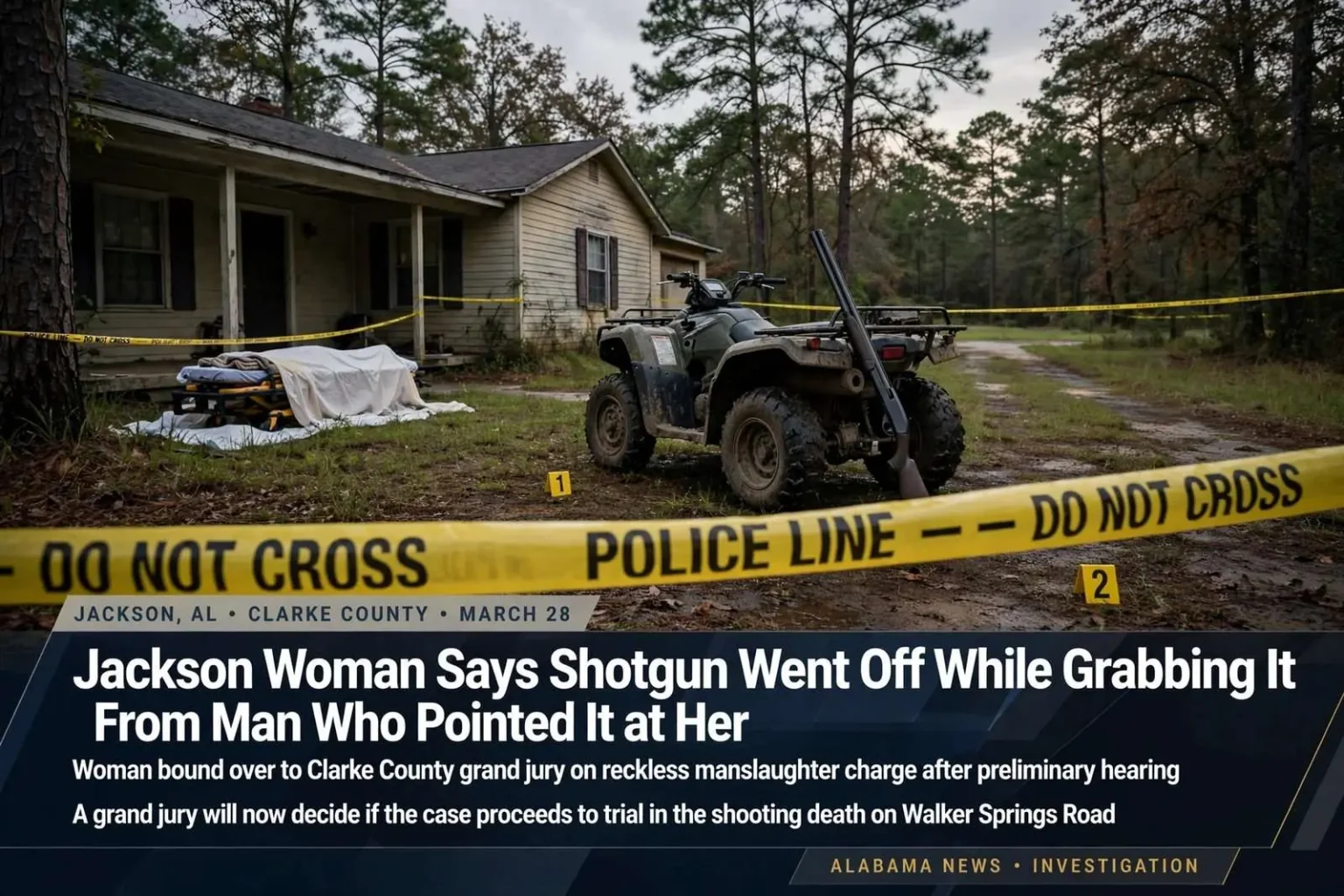
A Jackson woman has been bound over to a Clarke County grand jury on a reckless manslaughter charge after a preliminary hearing this week, in a case that centers on dueling accounts of exactly how a shotgun went off during an argument that turned fatal. Natasha Washington is charged with reckless manslaughter in the shooting death of Marcus Robinson at a residence on Walker Springs Road on March 28. District Judge J.R. Morgan ruled there was enough evidence at the preliminary hearing to send the case forward for possible indictment.
The charge means Washington will not face trial unless a grand jury first decides the evidence warrants one — a two-step filtering process built into Alabama’s criminal justice system. A preliminary hearing is not a determination of guilt or innocence. Its only question is whether the prosecution has presented enough evidence, viewed in the light most favorable to the state, to justify moving the case to the next stage. Judge Morgan’s ruling answers that question in the affirmative; it settles nothing about what ultimately happened inside the Walker Springs Road residence on the night of the shooting.
Jackson Police Department detective Ron Baggette testified that when officers arrived at the scene, they found Robinson’s body on the ground, covered with a sheet a neighbor had placed over him. Robinson had suffered a shotgun wound to the neck, and a 12-gauge pump shotgun was found leaning against a four-wheeler nearby. The detail of the weapon’s location — not in anyone’s hands, but propped against the all-terrain vehicle — was among the pieces of physical evidence laid out for the court as the hearing reconstructed the scene officers encountered.
Jackson, the largest city in Clarke County, sits in the rural timber country of southwest Alabama, where incidents of this kind draw close attention in a community where many residents knew the people involved, or knew of them. Cases that move from a district courtroom to a grand jury in small counties often carry an added weight for that reason: the witnesses, investigators and jurors all live within the same few miles as the events themselves.
Two accounts of how the gun went off
Preliminary hearings in Alabama district courts follow a familiar rhythm, and this one fit the pattern. The state calls its investigating officer, walks the court through the scene and the statements gathered, and rests; the defense then probes for weaknesses and, where it can, floats alternative theories. Judges rarely hesitate to bind cases over — the probable-cause threshold is deliberately low — but the hearing still functions as the first real test of the prosecution’s file, and the defense’s cross-examination establishes the themes a jury may hear months later.
According to Baggette’s testimony, Washington told investigators she had sent Robinson threatening text messages earlier in the day and had taken his clothes out of the house and scattered them across the yard. The messages and the clothing, as described in testimony, painted a picture of a relationship already in open conflict well before sunset that day — a background the defense and prosecution can be expected to frame very differently as the case proceeds.
When Robinson arrived at the residence, the two argued further, and Washington said he pointed the shotgun at her. She told investigators she turned and ducked, grabbed the gun, and it discharged, striking Robinson. That account places the fatal moment at the end of a chain of escalating events: texts, scattered clothing, a confrontation, and finally a struggle over a firearm. It is the version of events on which the state’s reckless manslaughter charge is built — a theory that the shooting happened during a reckless act rather than as an intentional killing.
Washington’s attorney, William Robert McMillan, raised the possibility that Robinson’s death was a suicide rather than the result of the altercation Washington described. The suggestion introduces a third narrative into a case already defined by competing accounts, and it puts the physical evidence — rather than either party’s recollection — at the center of what a grand jury will weigh.
But Baggette testified that the autopsy indicated Robinson was shot from an estimated distance of four to 10 feet — a detail prosecutors are likely to lean on if the case proceeds to trial, since it complicates a self-inflicted-wound theory. In forensic pathology, the range from which a shotgun is fired is one of the most consequential findings an autopsy can produce, because wound characteristics change dramatically with distance. A contact or near-contact discharge produces patterns very different from one fired from several feet away, and a range estimate of four to 10 feet is difficult to reconcile with a self-inflicted injury given the length of the weapon involved.
That range estimate also matters to the state’s own theory. A discharge during a close-quarters struggle over a long gun is consistent with a shooter standing a few feet away; the four-to-10-foot figure fits the account Washington gave investigators. Prosecutors will present the distance evidence alongside her own statements in arguing that the shooting was reckless rather than deliberate, while the defense will contest how the evidence is interpreted at every step.
What reckless manslaughter means in Alabama
Reckless manslaughter in Alabama sits between murder and the lesser homicide offenses in the state’s criminal code. The defining element is recklessness: the prosecution does not have to prove that the defendant intended to kill, only that the defendant consciously disregarded a substantial and unjustifiable risk of death. In a struggle over a firearm, the theory runs, pulling on the weapon or manipulating it in a way that causes it to fire at a person is exactly that kind of disregard — deadly even if death was never the goal.
The distinction carries real consequences. An intentional killing can expose a defendant to a much longer sentence than a reckless one, and jury instructions will differ accordingly. Defense counsel in cases of this kind typically argue either that the death was an accident without criminal recklessness, or that the circumstances — including any claim of self-defense — negate culpability altogether. Prosecutors, for their part, point to the preceding conduct, here the threatening texts and the escalating confrontation, as the context that makes the risk obvious.
The road to a grand jury
The case now moves to a Clarke County grand jury, which will decide whether to hand down a formal indictment. Grand juries in Alabama operate largely in secret: the defendant and the public generally do not hear the presentations, and the panel hears only the evidence the prosecution chooses to bring. If the jurors find probable cause, they return an indictment and the case proceeds to circuit court for arraignment and, eventually, trial. If they do not, the case ends there — what is often called a no-bill.
That secrecy is why the preliminary hearing record matters so much. The detective’s testimony, the autopsy findings and the competing accounts laid out in Judge Morgan’s courtroom form the public’s fullest picture of the state’s evidence, and they shape expectations for what the grand jury will hear behind closed doors. In practice, most cases bound over after a preliminary hearing are indicted, but the grand jury retains genuine discretion, particularly in cases where the evidence turns on conflicting accounts of a single chaotic moment.
No trial date has been set. If an indictment comes, the case would move to Clarke County Circuit Court, where pretrial motions — including any challenge to the statements Washington gave investigators and any litigation over the autopsy evidence — typically occupy months before a jury is ever selected. If no indictment follows, the file closes and the preliminary hearing testimony stands as the public record of the case.
For now, the question of what happened on Walker Springs Road on March 28 remains exactly where the law leaves it at this stage: an open question, moving through the machinery of the system, with a grand jury the next stop. The hearing established that there is evidence enough to continue; whether that evidence supports a conviction, or any of the competing explanations offered so far, will be decided — if the case gets that far — by jurors in a courtroom rather than by witnesses in a dispute.
Until then, the record shows only what the testimony established: a body found in a yard, covered by a neighbor’s sheet; a 12-gauge pump propped against a four-wheeler; an autopsy placing the fatal shot four to 10 feet away; and a defendant’s own account of grabbing a gun pointed at her. Each of those facts will be claimed by one side or the other as the case moves forward. What the grand jury makes of them will determine whether the community ever hears the question argued out in full at trial.