A Grant-Funded Home-Visit Program Is Quietly Reshaping How Often Clarke County Kids Get Read To Before They Turn 5
Clarke County's Parents as Teachers program says AlaTom RC&D Council grant funding has driven a measurable rise in early reading habits among local families with children under 5.
A Clarke County early-literacy program says a year of grant funding has translated into a measurable increase in how often families across the county read to their young children, crediting support from the AlaTom RC&D Council for the shift. The gain matters in a rural county where kindergarten readiness varies widely from community to community and where many families live miles from the nearest public library branch.
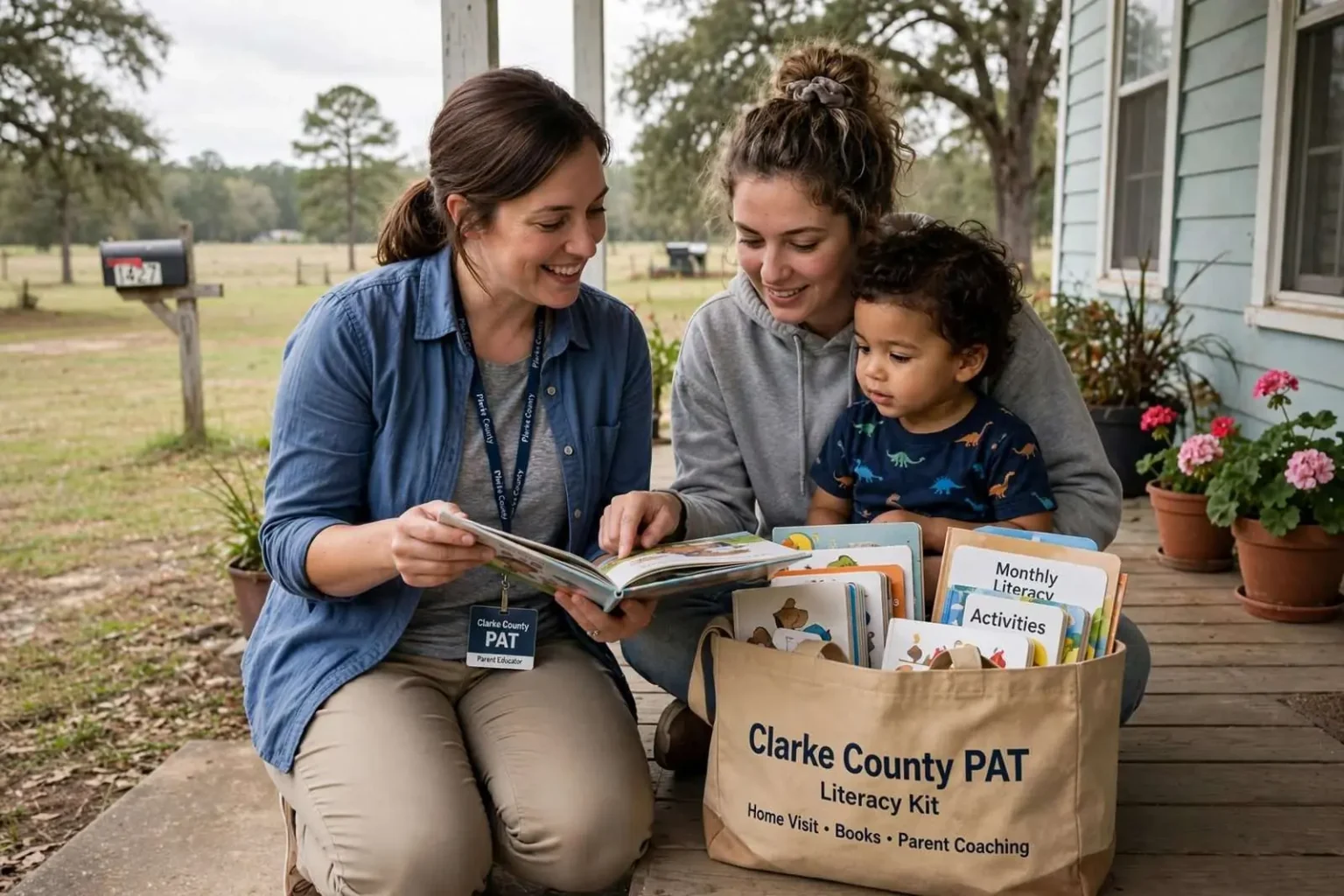
The Clarke County Parents as Teachers, or PAT, program provides families with high-quality children’s books, literacy kits and hands-on parent education aimed at building reading habits with children up to age 5. Rather than simply handing out materials, parent educators deliver books directly during home visits, model reading strategies in real time, and coach parents on making reading part of the family’s daily routine.
“The importance of reading begins long before a child is ever born,” said Donna Nelson, the Clarke County PAT coordinator. “When parents read to their babies during pregnancy and continue reading throughout early childhood, they are building the foundation for academic success, social-emotional growth and lifelong learning.”
The grant funding expanded the program in several concrete ways: increasing access to books for families who couldn’t otherwise afford them, adding monthly literacy activities to help parents engage their kids in more structured ways, expanding parent coaching to cover the period from pregnancy through age 4, and specifically targeting rural families who face transportation gaps, limited child care and a general shortage of early-learning resources.
How the program measures its work
Program staff track progress the old-fashioned way — through reading logs and documentation from home visits — rather than relying solely on standardized testing data that wouldn’t be available until children are much older. That tracking shows growth in daily reading habits across the families PAT has worked with over the past year. Parents in the program have reported reading with their children more often, feeling more confident supporting their development, and seeing their kids become more interested in books. The approach reflects the reality of early-childhood work in a county like Clarke, where the children served by home visiting may be years away from any formal assessment but where the habits being built now will show up later in classrooms in Grove Hill, Jackson, Thomasville and the county’s smaller communities.
Home visiting is the backbone of the model. Parent educators schedule visits at times that work for working families, bring materials with them, and leave them behind for the household to keep. That last detail matters: in households where money is tight, a steady supply of age-appropriate books at home is not a given, and research has repeatedly linked the sheer number of books in a home to later reading achievement.
The stakes behind the push
The stakes behind the push are well established in early-childhood research: children who are read to regularly are exposed to millions more words by age 4 than children who are not, a gap researchers have linked directly to school readiness, vocabulary growth and long-term academic outcomes. The disparity — often called the word gap — tends to open up before children ever set foot in a classroom, which is why programs that reach families during the prenatal and toddler years are considered among the most cost-effective investments a community can make.
In rural counties, the barriers compound. A parent in Clarke County may drive 20 minutes or more to reach a library, a pediatrician or a childcare center, and public transportation options are essentially nonexistent. Families with two working parents, or a single parent working shifts, often cannot attend scheduled programs at a fixed location. Home visiting sidesteps those obstacles by bringing the program to the family instead of the other way around, which is why the AlaTom RC&D Council’s support for transportation-targeted outreach was such a meaningful piece of the grant.
What the AlaTom RC&D Council does
The AlaTom RC&D Council is one of Alabama’s resource conservation and development councils, nonprofit bodies organized under a federal program that supports grassroots economic and community development across multi-county regions. Councils like AlaTom — which serves south Alabama counties including Clarke, Washington, Monroe, Conecuh, Butler, Lowndes, Dallas and Wilcox — channel modest grant funding toward projects that local partners identify as priorities, from fire protection and water improvements to education and health initiatives. In Clarke County, early literacy rose to that priority list because local educators and health professionals see its effects every fall when new kindergartners arrive with widely different levels of preparation.
RC&D councils occupy a useful niche in rural Alabama. They are small, locally led and flexible enough to fund the kind of incremental, unglamorous work — book purchases, printing, materials for literacy kits, mileage for home visitors — that larger grant programs often overlook. A year of support for a program like PAT can translate into hundreds of books placed in homes that might otherwise have none.
Why the prenatal years count
Nelson’s emphasis on reading beginning before birth reflects guidance that pediatric and literacy organizations have been giving parents for years. Reading aloud during pregnancy helps expectant parents build the habit itself, and research suggests babies begin recognizing voices and speech rhythms before birth. After delivery, the routine of daily reading becomes a bonding ritual as much as an educational one, and it establishes reading as a normal, expected part of the household day — which is far easier to sustain than to introduce later.
The PAT program’s expansion of coaching from pregnancy through age 4 covers the window in which those habits take root. Parents of newborns, toddlers and preschoolers each face different challenges — a fussy infant, a toddler who wants the same book twenty times, a preschooler who is ready for longer stories — and parent educators tailor guidance to each stage. The literacy kits that accompany the visits pair books with simple activities parents can do at home, turning reading time into a multi-sensory experience that holds young attention.
Reading habits as a countywide indicator
For Clarke County schools, the payoff arrives in increments that are easy to miss but hard to dispute. Children who arrive in kindergarten having been read to regularly typically know more letter names, recognize more words, sit for longer stretches and manage the social demands of a classroom better than children who have not. Over a school career, those differences compound, and districts with strong early-literacy pipelines generally see it reflected in third-grade reading scores — the checkpoint Alabama now measures formally under the state’s Literacy Act.
Alabama’s Literacy Act, passed in 2019, requires third graders to demonstrate sufficient reading skill before promotion to fourth grade, with support services and retention as tools of last resort. The law has pushed every district in the state to concentrate resources on the earliest grades, and it has made pre-kindergarten and home-based literacy efforts like PAT more relevant than ever: the work of preventing reading failure starts years before a child reaches a school building.
The rural advantage of meeting families at home
Home-visiting programs have grown across Alabama in recent years, supported by a mix of state investment, federal grants and private philanthropy, because they reach families that center-based programs struggle to serve. In Clarke County — a county of roughly 22,000 people spread across more than 1,200 square miles between the Tombigbee and Alabama rivers — geography alone makes the home-visit model practical. Grove Hill serves as the county seat, but families scattered through Jackson, Thomasville, Whatley, Gainestown, Fulton, Coffeeville and the county’s rural crossroads communities can all be served by a small team of educators willing to drive.
The model also builds trust in a way drop-in programs cannot. A parent educator who returns month after month becomes a familiar, reliable presence, and families are more likely to ask questions, admit struggles and follow through on suggestions when the relationship is personal. Program leaders say that trust is what converts a bag of donated books into an actual nightly reading routine.
What comes next for PAT in Clarke County
The program’s leadership has framed the past year as evidence that the model works when it is properly funded: more books in more homes, more structured literacy activities each month, coaching that now follows families from pregnancy onward, and deliberate outreach to the rural households that are hardest to reach. Staff plan to keep tracking reading logs and home-visit documentation as their primary measure of progress, watching for continued growth in daily reading habits across participating families.
For the families involved, the outcomes are smaller and more personal than any statistic: a toddler who brings a book to a parent instead of a screen, a kindergartner who walks into a Grove Hill or Jackson classroom already knowing how stories work, a teenager who remembers being read to and starts reading to a younger sibling. Those are the habits the Clarke County Parents as Teachers program set out to build, and with the AlaTom RC&D Council’s backing, its coordinators say the county’s youngest readers are off to a stronger start than they were a year ago.
The broader lesson for rural Alabama is one that early-childhood advocates have been making for years: school readiness is not created in school. It is created in living rooms, on laps and in the minutes before bedtime, one book at a time — and communities that invest in helping parents build those minutes into the day are investing in their own classrooms, their own workforce and their own future, years before the returns become visible in a test score.