Thomasville’s Water Board Is Trying an Ultrasonic Machine to Fight Algae After $10,000 in Chemicals Didn’t Work
Thomasville's Water and Sewer Board is testing a solar-powered ultrasonic system to fight algae in its wastewater lagoons after years of chemical treatments failed to solve the problem.
The Thomasville Water and Sewer Board approved a new contractor fee, signed off on a long-term water tank maintenance deal, and weighed a new approach to a persistent algae problem in the city’s wastewater lagoons at its July 13 meeting. The agenda blended routine housekeeping with bigger-picture decisions about how the small-city utility keeps its systems running — and who pays for them — as the board worked through a list of items touching everything from hydrant meters to multi-million-dollar storage tanks.
A New Fee for Contractor Meters
The board unanimously approved a new $100 setup fee for hydrant meters used by outside contractors. Superintendent Wendy Long said the fee, charged each time a contractor’s hydrant meter is installed, will help offset the labor and administrative costs of setting up and removing the meters and creating the associated customer accounts. Hydrant meters are the temporary devices contractors tap to draw water for construction projects, street sweeping and other jobs where a permanent connection is impractical.
Metering hydrant use matters to a water utility for more than bookkeeping reasons. Unmetered draw from a hydrant can go unrecorded, depress revenue and even introduce backflow risks if the connection is not handled properly, so departments that track each setup protect both their books and their systems. Mayor Sheldon Day said the utility fields frequent requests from contractors using hydrant meters, and the new fee should help the city recover more of its expenses. With construction activity coming and going in Thomasville and the surrounding area, the $100 charge amounts to a user fee on a service that until now the utility has largely absorbed as overhead.
Protecting the Tank Investment
The board also approved a maintenance agreement with American Tank Maintenance, beginning Oct. 1, covering all four of the city’s water storage tanks. The deal follows roughly $3 million in tank rehabilitation work funded largely through grants — an investment in painting, structural repairs and modernization that the city cannot afford to let deteriorate again through neglect.
Under the agreement, the contractor will perform annual visual inspections plus interior washouts every three years. The inspections catch coating failures, vent problems, security issues and early corrosion before they become expensive; the washouts clear sediment that accumulates on tank floors and can degrade water quality if left in place. Maintenance officials say the schedule should reduce long-term costs by catching problems before they require major repairs — the same preventive logic that shapes the utility’s approach to every other asset it owns. For ratepayers, the alternative is the boom-and-bust cycle that forced the recent $3 million rehabilitation in the first place.
Thomasville, the largest city in Clarke County, sits along U.S. Highway 43 in southwest Alabama’s timber country, and its water and sewer utility serves the city and surrounding customers across a rural service area. Utilities of that size operate with small crews who double as maintenance technicians, meter readers and emergency responders, which is why administrative charges like the new hydrant meter fee matter — every setup and takedown is staff time that previously came out of the department’s budget with no offsetting revenue.
The tank agreement also reflects how small utilities fund big projects. Grant funding that covered much of the roughly $3 million rehabilitation is typically secured through state and federal programs aimed at rural water systems, and those programs generally require applicants to demonstrate a maintenance plan. A signed preventive contract with a specialty firm strengthens future grant applications even as it protects the tanks themselves, giving the board a double return on the decision.
Storage tanks are the most visible infrastructure a water system has, standing over the skyline of small towns across Alabama, and they are also among the most expensive to replace. A signed maintenance contract of this kind effectively budgets a known annual cost in exchange for avoiding unknown seven-figure costs later, a trade utility boards across the state have increasingly made as state and federal grant programs reward systems that document upkeep.
An Ultrasonic Answer to Algae
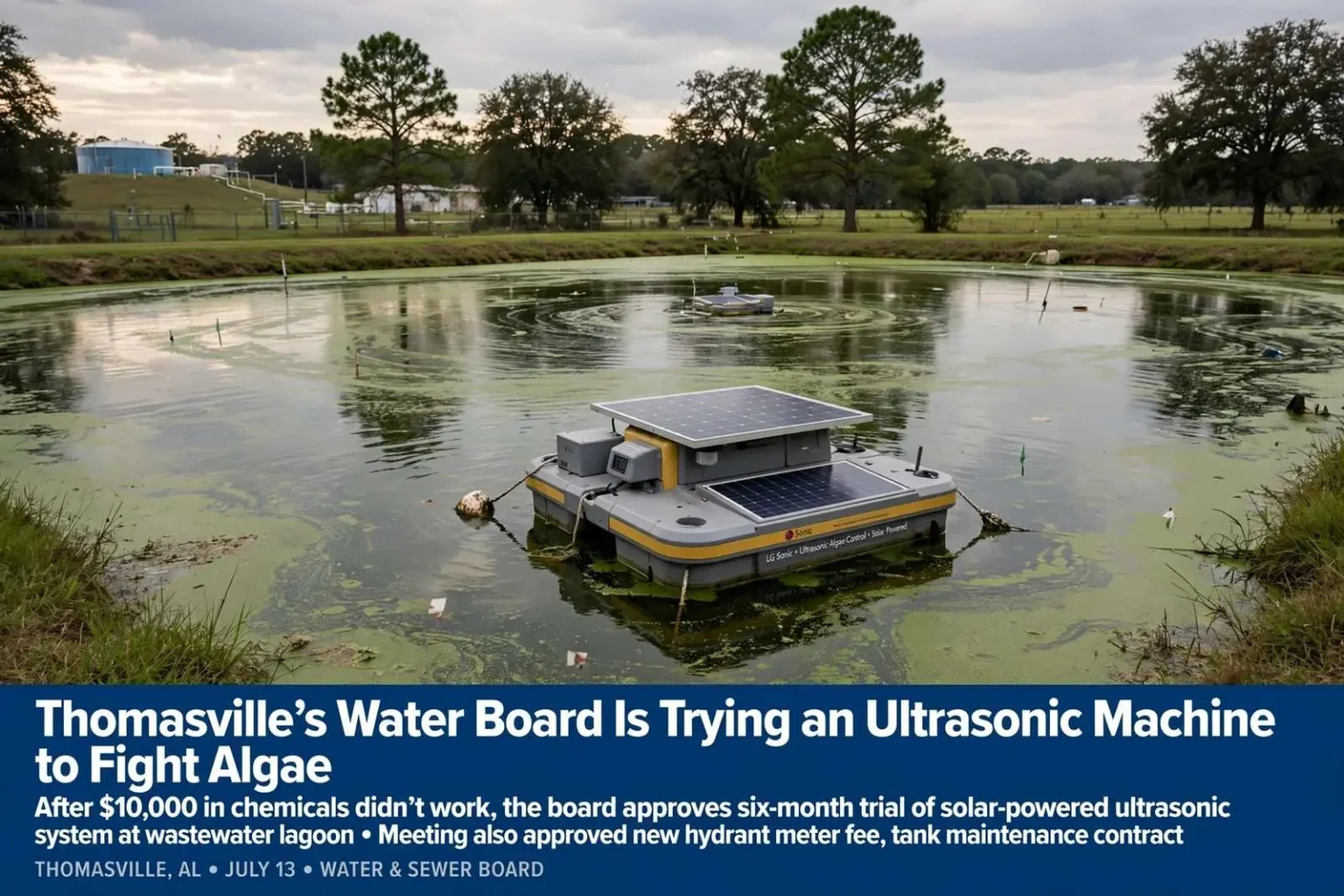
On the algae front, Long told the board that chemical treatments over the past several years, costing roughly $10,000, have not adequately controlled persistent algae growth in the city’s wastewater lagoons. Lagoons are the workhorse of small-town wastewater treatment across rural Alabama: waste is held in large earthen ponds where sunlight, bacteria and time break it down naturally. But algae blooms on the surface can interfere with that process, fouling the water’s ability to receive oxygen and complicating the facility’s discharge quality.
She presented an alternative: an LG Sonic system, a solar-powered floating device that uses ultrasonic technology to control algae growth while also monitoring water conditions. The units float on the lagoon surface, powered by onboard solar panels, and emit ultrasonic frequencies that disrupt algae cells’ buoyancy and reproduction without chemicals. The devices also carry sensors that report water-quality readings, giving operators data on conditions they would otherwise sample by hand.
Long recommended a six-month trial, with an initial setup cost of $13,546 and monthly payments of about $3,400 — payments that would apply toward the purchase price if the city decides to buy the system after the trial period. The structure functions as a rent-to-own arrangement: if the ultrasonic approach fails to outperform the chemicals it would replace, the city can walk away having paid a few months’ fees, and if it works, the money already spent counts toward ownership. Board members took the proposal under consideration as the meeting continued, weighing the trial cost against the recurring chemical expenses that have produced disappointing results.
Chemical treatment of lagoons has its limits. Copper-based algaecides and similar products must be dosed repeatedly through the warm season, and blooms often rebound between applications, especially in large, shallow ponds with heavy sun exposure. That recurring cycle is exactly why the city’s roughly $10,000 in treatments over several years produced frustration rather than a fix, and why technologies that attack algae continuously rather than episodically have drawn interest from small systems across the Southeast.
A six-month trial would carry the system through part of the cooler season as well, when algae pressure eases, giving the board comparative data from both a high-growth and a low-growth period. The sensors on the floating unit can document those changes objectively, replacing anecdote with readings when the time comes to decide whether to buy. For a board weighing a five-figure trial against a proven-but-underwhelming chemical program, that data is the real product.
The comparison is straightforward math. Roughly $10,000 spent over several years of chemical treatment has bought inadequate control; a six-month trial at about $13,546 up front plus $3,400 monthly would test a technology that, if successful, eliminates recurring chemical purchases and the labor of applying them. Utilities that have adopted ultrasonic control generally report the payoff comes in reduced chemical use and steadier lagoon performance through the hot months when algae thrive.
A Rundown of Recent Work
Long also updated the board on a run of recent maintenance work across the system. Crews installed a new flush hydrant at The Rock, replacing dead-end flushing capability that keeps water moving and quality high in outlying lines. They replaced a damaged washdown hose, continued routine fire hydrant maintenance across the system and located water lines for Alabama Department of Transportation projects near Pine Hill, the kind of locates that keep contractor excavation from cutting off service to entire streets.
The department also marked utility lines ahead of U.S. Highway 43 construction, protecting the city’s buried infrastructure as the state’s highway project moves through the area. Crews repaired a six-inch water main leak at the intersection of Highway 5 North and White Oak Road — a main of that size can lose tens of thousands of gallons a day if left running — and fixed a leaking service line on Pine Circle, the smaller lines that connect individual homes to the mains.
The list reads like a typical season for a small-city water department, and that is the point. Every locate, leak repair and hydrant check is preventive work that keeps major failures rare, and the board’s evening of decisions — a fee to recover contractor costs, a contract to protect the tanks, a trial to try something new on the lagoons — followed the same theme: spend small, known amounts now to avoid large, unknown ones later. The board’s next regular session will pick up where this one left off, with the algae trial among the items expected back before members.
The meeting’s maintenance reports, routine as they sound, trace the same preventive philosophy down to the smallest scale. A flush hydrant keeps water from stagnating in a dead-end line; a locate called in before an excavator rolls keeps a backhoe from shearing a main; a washdown hose replaced on schedule keeps equipment ready for the next call. In a system run by a handful of employees covering miles of rural line, that steady accumulation of small jobs is what stands between residents and the boil-water notices that follow when it is skipped.