University of South Alabama Mobile
$220,000 Grant to Transform Three Mile Creek Area Near Tricentennial Park
A $220,000 private grant will fund new kayak access, expanded walking trails and cleanup work along Three Mile Creek near Mobile's Tricentennial Park.
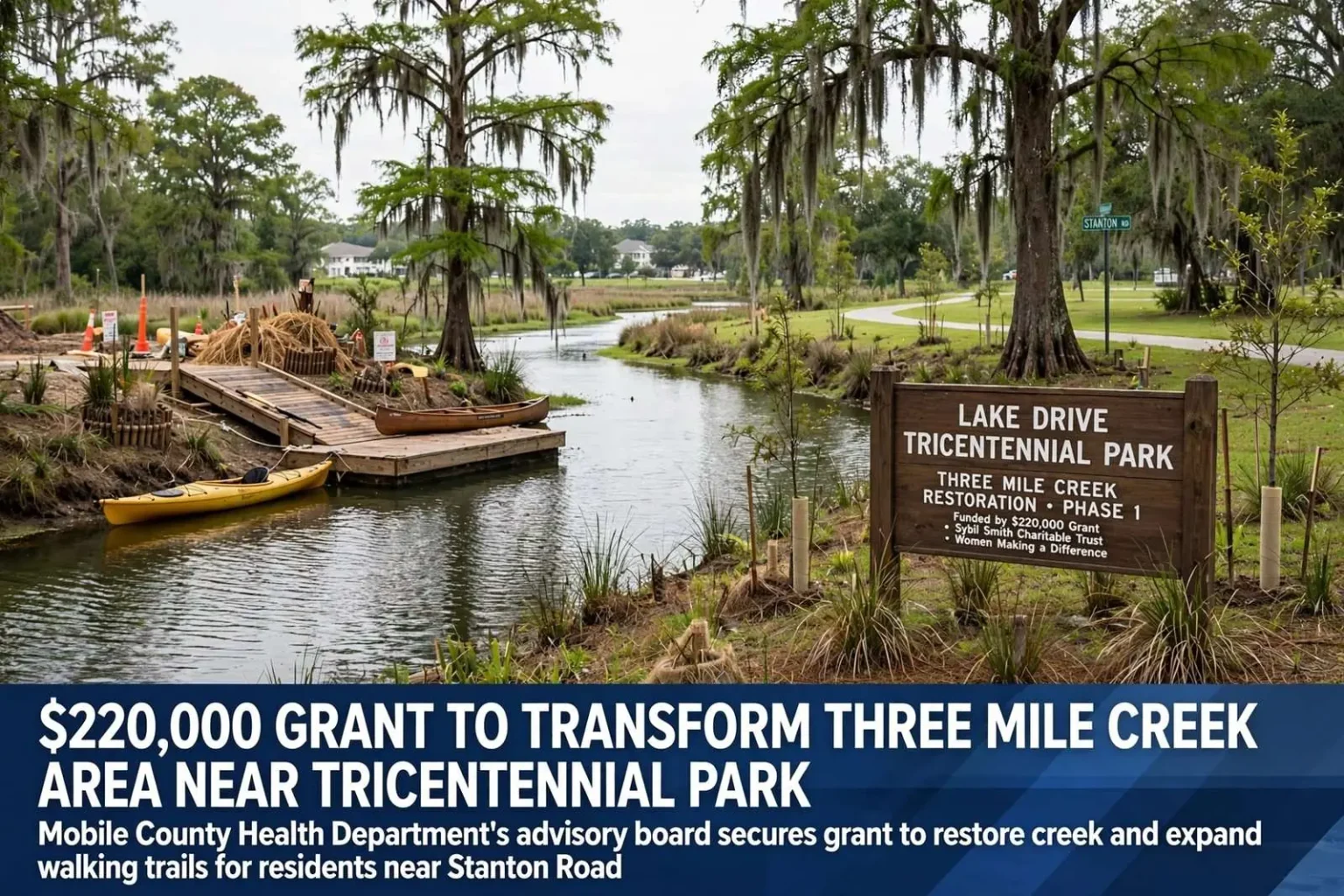
A stretch of Three Mile Creek near Lake Drive Tricentennial Park is set for a major facelift after the Mobile County Health Department’s public advisory board secured a $220,000 private grant to fund improvements to the waterway and surrounding green space. The work aims to restore the creek’s ecological health while opening it up to the residents who live closest to it.
The board, known as Women Making a Difference, has spent roughly two years pursuing the funding, which comes from the Sybil Smith Charitable Trust, a private foundation based in downtown Mobile. The grant is one of the more significant private investments in the midtown corridor in recent years, and it arrived after a sustained effort by the advisory board to make the case that the creek and its surrounding parkland were assets the city had underused for too long.
The health department’s director of prevention and wellness said the investment targets an area near Stanton Road that borders public housing and offers residents a rare stretch of accessible green space in midtown Mobile, close to the University of South Alabama Medical Center. For neighborhoods where many households do not have easy transportation to larger parks across the city, the creek corridor is one of the few places residents can walk to on foot.
Board members spent those two years mapping the site, meeting with community groups, and documenting what the corridor could become with proper investment, building the application that ultimately persuaded the trust to fund the work.
Officials described the creek as historically significant, noting it once served as the city’s first drinking water source. Three Mile Creek’s role in Mobile’s history stretches back to the city’s earliest days, when the settlement that would become Alabama’s oldest city relied on its springs and surface water long before modern utilities arrived. The creek flows through a broad swath of midtown before joining the Mobile River system, and its health has long been tied to the storm-water burden the growing city places on it.
The renovation plan focuses on restoring the waterway’s ecological health while creating new recreational opportunities for nearby residents. Planners describe a project that works on both fronts at once — stabilizing banks, improving habitat, and managing runoff, while adding the kinds of amenities that give people a reason to spend time at the park.
Three phases of work
The project will roll out in three phases. The first phase, expected to wrap up by February, involves installing a kayak and canoe launch near Tricentennial Park, an addition organizers hope will draw paddlers who already travel to other regional waterways and might bring their families into the area as visitors.
A public launch on the creek would put it alongside a growing list of urban waterways in the region where paddling has become a regular activity, giving Mobile residents a new place to get on the water without leaving the city limits. Organizers see the launch as the most visible early sign that the creek is changing, and the kind of feature that builds a constituency for the work that follows.
The second phase calls for extending the park’s existing paved walking trail west toward West Ridge Road. A third phase would continue that trail below the Stanton Road bridge, past the Strickland Youth Center, and connect it to a nearby residential neighborhood along the creek. Together, the trail extensions would turn what is now a loop within the park into a corridor that links distinct parts of midtown to one another on foot.
Organizers said phases two and three are targeted for completion by October 2015, with a longer-term vision of stretching the connected trail system to roughly 20 miles. That long-range ambition would tie the Three Mile Creek corridor into a citywide network of paths, connecting parks, schools, and neighborhoods across a large share of Mobile’s urban core.
Health department officials said the park itself remains underused despite offering playgrounds, docks, covered gathering areas and a walking trail around Day Lake, along with a diverse wildlife habitat. Lake Drive Tricentennial Park, named for the city’s tricentennial era, already offers more amenities than many residents realize, and organizers say the challenge is as much awareness as infrastructure — people who do not know the park exists, or do not feel it belongs to them, do not use it.
The trail extensions matter as much for what they connect as for the miles they add. A paved path that reaches toward West Ridge Road and down past the Strickland Youth Center turns the park into transportation infrastructure as well as recreation, giving residents without cars a safe route toward jobs, schools, and services on the other side of the creek.
A neighborhood asset reclaimed
A community event introducing the improvement project to residents is being planned for the spring to help raise awareness of the park’s existing amenities alongside the upgrades underway. Organizers view that outreach as central to the project’s success, since green spaces only deliver their health benefits when the people living around them actually use them.
Organizers also framed the project as an opportunity to educate residents about storm-water runoff and the community’s role in the creek’s long-term health, saying they hope local pride in the waterway grows alongside the physical improvements. Urban creeks like Three Mile Creek collect what the streets around them shed — litter, oil, fertilizer, and sediment — and the health of the water depends heavily on how residents and businesses along it treat their yards, gutters, and drains.
Simple habits — keeping yard debris out of storm drains, disposing of chemicals properly, limiting fertilizer use — make a measurable difference in water quality over time, and organizers plan to carry that message through the community event and future outreach as the phases are completed.
The connection between green space and public health is the reason a health department advisory board led the effort in the first place. Access to walkable parks has been linked to higher levels of physical activity, lower rates of chronic disease, and stronger neighborhood ties, and public health officials in Mobile have increasingly treated the built environment — sidewalks, trails, parks, and safe street crossings — as part of their portfolio alongside clinics and screenings. For the neighborhoods near Stanton Road, the creek corridor represents a chance to exercise, gather, and let children play outdoors within walking distance of home.
Paddling groups in the Mobile area have already demonstrated the appetite for urban water trails, organizing trips on the delta and along area rivers, and organizers expect those same paddlers to be among the first to try the new launch once it opens. Every visit, they note, makes the case for the next phase of investment.
The Sybil Smith Charitable Trust, which funded the project, has supported civic and community causes in the Mobile area, and the grant’s focus on a midtown waterway fits a pattern of private foundations underwriting public improvements that government budgets alone struggle to cover. The $220,000 award covers the early phases of work; organizers will need additional funding and partnerships to carry the trail system toward its longer-term vision.
The Three Mile Creek work is one of several active green-space initiatives in the city, alongside efforts such as the Crepe Myrtle Trail, as Mobile continues to invest in connecting residents to its urban waterways. Taken together, the projects signal a shift in how the city treats the creeks, bayous, and river edges that run through it — as features to build around rather than problems to pave over.
The Crepe Myrtle Trail, a long-envisioned loop around the Mobile-Tensaw Delta area, shares the same underlying idea: that the city’s water edges are assets, not liabilities, and that trails and launches are how residents gain access to them.
What residents can expect
In the near term, residents should see the kayak and canoe launch take shape near Tricentennial Park by February, with trail design and construction for the later phases following through the year. Organizers have stressed that the project moves only as fast as its funding, but the grant secured this week puts the first two milestones within reach.
For the families who live along the Stanton Road corridor, the improvements promise something simple: a cleaner creek, a safer trail, and a park that feels like it belongs to the people around it. If organizers are right, the residents who discover the park through the spring community event will be the ones who watch over the creek in the years that follow — the outcome, more than any single phase of construction, that the advisory board has worked two years to achieve.
Residents who want to follow the project or take part in the spring event can watch for announcements from the Mobile County Health Department and Women Making a Difference as the phases move forward.