
Tropical Storm Barry Washes Away 21 Sea Turtle Nests on Dauphin Island
Share the Beach says Tropical Storm Barry destroyed 21 sea turtle nests near Katrina Cut on Dauphin Island. Volunteers continue daily patrols for new nests.
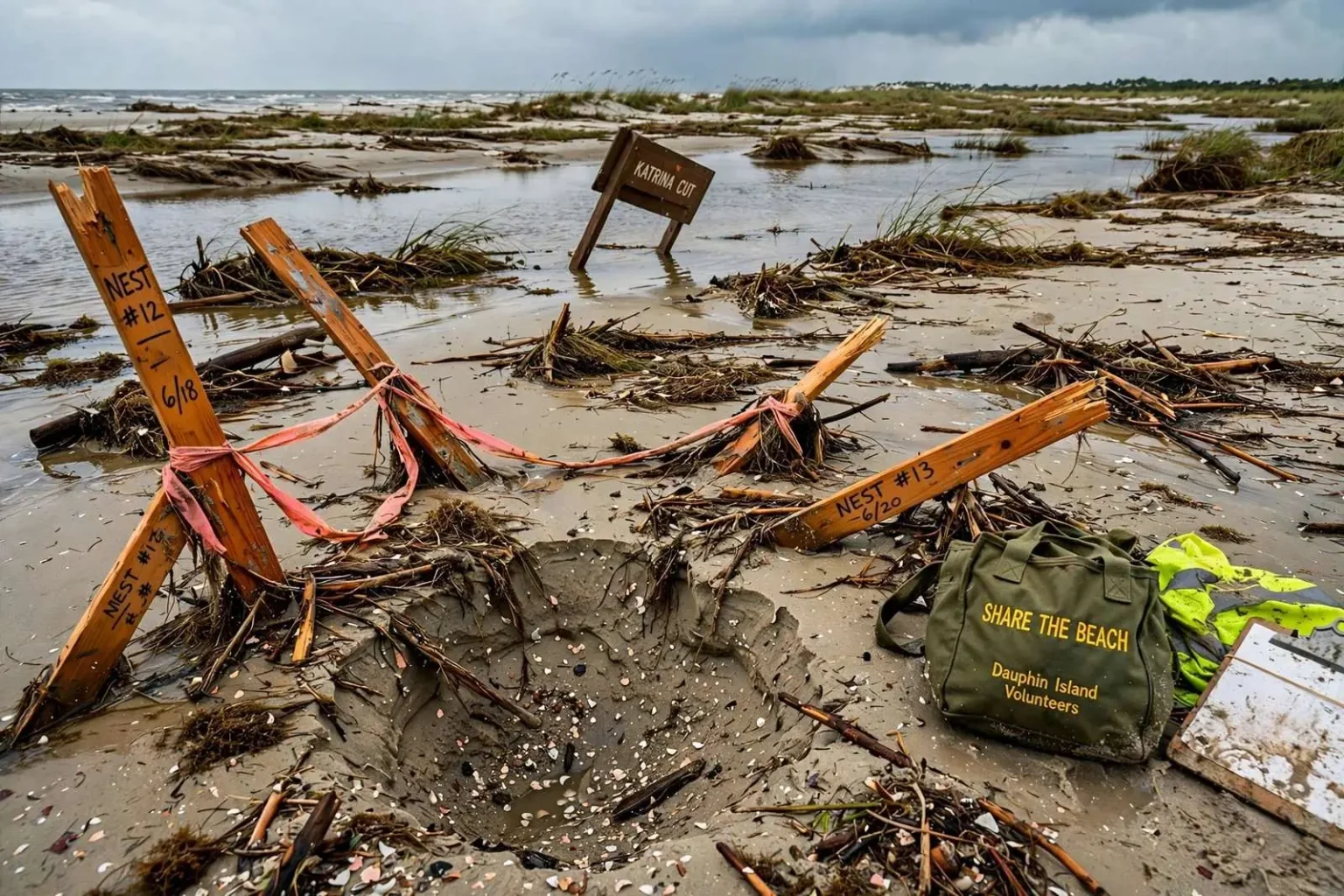
Tropical Storm Barry took a toll on Dauphin Island’s sea turtle season, washing away 21 nests near Katrina Cut as the storm pushed water over the barrier island, according to the volunteer group Share the Beach Dauphin Island. The losses on the island’s west end came as Barry’s surge overtopped the low-lying sand, erasing weeks of careful nesting work in a single tidal event.
In a Facebook post, the group said the western tip of the island had been cut off by the storm, leaving volunteers unable to even reach the two westernmost nests to assess them. That isolation is more than an inconvenience: until the water recedes and the sand firms up, nobody can say whether those two nests survived or joined the list of losses. A dead sea turtle was also discovered on the west end of the island near Katrina Cut, adding an adult loss to the season’s toll — a category that conservationists track as closely as nests, because each nesting female represents decades of survival and future clutches.
Dauphin Island sits at the entrance to Mobile Bay, a barrier island whose geography makes it uniquely exposed. The island is low, narrow in places and constantly reshaped by storms; Katrina Cut itself is named for the 2005 hurricane that sliced a channel through the island’s western end. When a tropical system pushes Gulf water northward across the island, beaches that hold nests in July can disappear entirely, taking the buried eggs with them.
What the storm washed out
Sea turtle nests are deceptively fragile for something buried two feet deep in the sand. The eggs need the warmth and oxygen of dry beach sand to incubate through roughly two months of development, and a nest that floods with saltwater loses the chemical balance the eggs depend on. Waves can also scour away the sand column itself, scattering eggs into the surf. Even nests above the obvious wrack line can fail when a storm surge pushes water and heavy debris across the back of the beach — which is why storm damage assessments involve walking every marked nest, not just those closest to the water.
The loss is significant for a barrier island that typically hosts a few dozen nests each summer. On a beach where the season’s total might be measured in the dozens, 21 washed-out nests represent a large share of the year’s production, and every nest holds roughly a hundred eggs. Not every egg would have hatched in an average summer — raccoons, crabs, ghost crabs, storm erosion and failed incubation take a natural toll — but a single tropical system compressing that much loss into one weekend is the kind of event volunteers remember for years.
Alabama’s sea turtle nesting season runs from May through October, with loggerhead and green sea turtles among the species that lay clutches in the beach sand before the hatchlings emerge weeks later. The timing of Barry, a July storm, caught the season at one of its most vulnerable moments: early nests laid in May were approaching hatch, while nests laid in June were at mid-incubation, all of them sitting in the sand with no ability to move out of the surge’s path.
The volunteers who guard the season
Share the Beach is Alabama’s volunteer sea turtle conservation program, operating under permits from the state and federal wildlife agencies with teams organized by coastal community. On Dauphin Island, the local chapter handles the island’s long, sparsely built shoreline, patrolling on foot and by vehicle each morning through the season to find the fresh crawls — the telltale tracks a nesting female leaves climbing the beach at night. Each new nest gets staked, flagged, dated and monitored until it hatches, and hatchlings are protected on their journey to the water.
The daily patrol is a considerable commitment: the island runs several miles from the town’s developed east end to the remote western tip, and volunteers walk or drive it at dawn through heat, rain and mosquitoes for months. Storms like Barry break that routine in the worst way. When the west end is cut off by water, volunteers can do nothing but wait and document — a frustration they described plainly in their post, having lost even the ability to reach the two westernmost nests to check them.
The discovery of a dead sea turtle near Katrina Cut added another responsibility. Strandings of adult turtles are reported to the authorities so the animal can be documented and, where possible, examined; each adult death matters disproportionately because females return to nest for decades once mature. A single adult female lost to a storm or a boat strike removes many potential future nests from the population, which is why conservation programs treat adult strandings as losses measured in decades rather than in one season.
Recovery is already underway
Recovery efforts were already underway as the storm’s water receded. Share the Beach volunteers resumed daily patrols looking for newly laid nests, since the nesting females themselves were unaffected by the surge — turtles that had not yet come ashore this summer would continue to arrive and nest through the season, replenishing the island’s losses one clutch at a time. Late-season nests laid after the storm still had every chance of hatching successfully in September and October.
There was encouraging news elsewhere on the coast: the Bon Secour National Wildlife Refuge, on the Fort Morgan peninsula, recorded a new nest the same day. The refuge, which protects miles of undisturbed beach across the bay from Dauphin Island, is the state’s most productive sea turtle nesting ground in many years, and a fresh nest there showed that the storm did not interrupt nesting coastwide. The same Gulf that pushed water over Dauphin Island left the peninsula’s beaches available, and the turtles kept coming ashore.
That resilience is built into the species’ biology. Loggerheads, the dominant nester on Alabama’s coast, lay multiple clutches in a single summer and return to nest in following years, spreading their reproduction across time and geography as a hedge against exactly the kind of localized catastrophe Barry delivered. A storm that destroys one beach’s nests does not reach the females still offshore or the nests on the next barrier strand.
Why the nests matter in Alabama
Alabama’s sea turtle nesting is modest by Florida standards but ecologically meaningful. The loggerheads that nest on the state’s beaches belong to the Northwest Atlantic population, which federal regulators have listed as threatened under the Endangered Species Act, and green sea turtles — less common nesters in Alabama — are likewise protected. Every beach that contributes hatchlings to the Gulf helps sustain the regional population, and barrier island beaches like Dauphin Island’s are among the state’s most important contributors because of their length and relative darkness.
That last point is where volunteers and local government intersect. Hatchlings emerge at night and find the Gulf by following the brighter seaward horizon; artificial light from beachfront development draws them inland, where they die of dehydration, exhaustion or predators. Programs like Share the Beach therefore pair nest monitoring with public education — turn off or shield beachfront lights, flatten sandcastles, fill holes, leave the beach clean — because a nest that hatches 100 babies still needs those babies to survive their first scramble.
Storms and the long season ahead
Barry arrived in July, which in an average year is only the middle of the Atlantic hurricane season’s long build. Dauphin Island volunteers know that more systems could follow before October, and each one brings the same calculation: which nests can be protected, which can be relocated where the program’s permits allow, and which are simply in the water’s path. Nest relocation — moving eggs to higher ground — is a specialized, closely regulated intervention used sparingly, because mishandled eggs fail. Most often, the program’s answer to storms is the one on display after Barry: document the losses, and keep patrolling.
The island’s own recovery will unfold in parallel. Dauphin Island’s west end has been rebuilt and reworked by storms repeatedly — Hurricanes Georges, Ivan, Katrina and Isaac all rearranged it — and the sand moves back, slowly, through the same coastal processes that move it away. The beach that volunteers patrol next summer will not be the beach they patrolled this summer. The turtles, whose nesting instinct is tuned to these shifting barrier strands over thousands of years, will come ashore on the new configuration just as they did on the old.
For now, the season continues with a smaller inventory than it held before the storm: 21 nests gone near Katrina Cut, two more unassessable behind floodwater, one dead adult found on the west end — and new nests still being counted, on Dauphin Island and across the bay at Bon Secour, as females keep coming ashore. The volunteers’ message after the storm was not despair but continuity: patrols resumed, the work went on, and the hatchlings of the nests that survived — along with the ones still being laid — will still make their crawl to the Gulf this fall.


