Two Drivers Killed in Head-On Crash Between Log Truck and Sedan on U.S. 45 in Citronelle
A head-on crash between a log truck and a sedan killed both drivers and shut U.S. 45 in Citronelle; victims were Gene Washington and Toby Menotti.
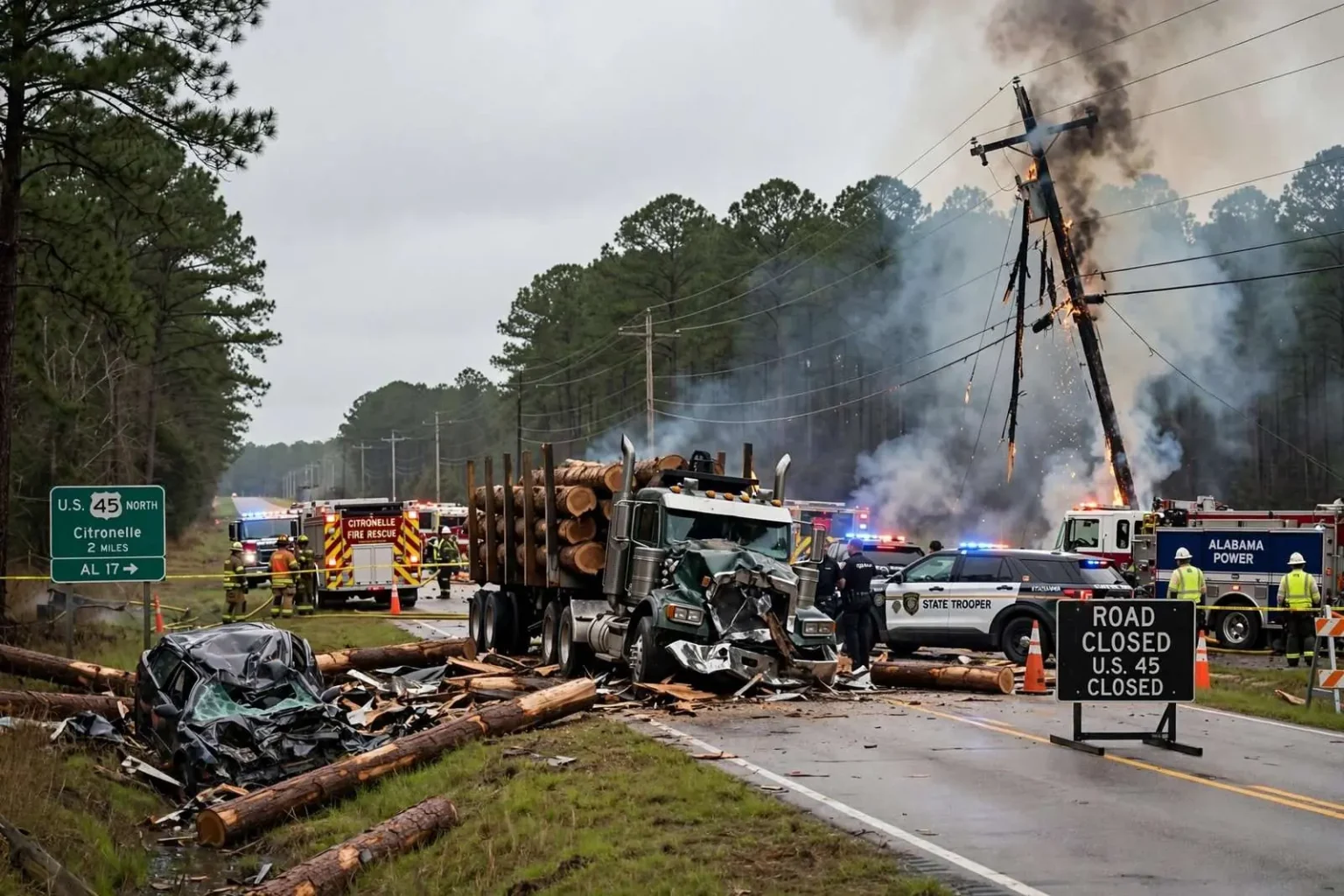
Both drivers died in a head-on collision between a log truck and a small sedan on U.S. Highway 45 in Citronelle, authorities said, in a wreck that shut down the highway for much of the day and set a utility pole on fire. The Alabama Law Enforcement Agency said the southbound log truck and the northbound car collided headlight to headlight along the two-lane route near AL 17, in one of the deadliest crash types that occurs on south Alabama’s rural highways.
The impact overturned a vehicle, closed U.S. 45 in both directions, and ignited a nearby utility pole that brought Alabama Power crews to the scene. The combination — a fatal collision, an overturned vehicle, downed or burning utility equipment and a blocked highway — turned a stretch of rural roadway into an all-day emergency operation involving troopers, local police, firefighters and utility workers, and it severed one of the region’s principal north-south routes for the better part of a day.
The Crash on U.S. 45
U.S. Highway 45 runs north from Mobile through Citronelle and on toward the Mississippi state line as a two-lane road for much of its length, carrying a steady mix of passenger traffic, school buses and heavy logging trucks that serve the timber country of north Mobile County. The crash occurred along that route near AL 17, where the highway’s two lanes and narrow shoulders leave little margin when vehicles meet at highway speeds. ALEA troopers reported that the southbound log truck and the northbound sedan collided headlight to headlight, the kind of closing-speed collision that leaves occupants with little chance to react.
The force of the impact overturned a vehicle and set a nearby utility pole on fire, adding a second hazard to the scene. Fire danger from energized electrical equipment is a standard concern at crash sites involving poles, and the arrival of Alabama Power crews was necessary before the roadway could be fully secured. Crews worked through the day at the scene, which stretched from the crash site itself to the utility infrastructure along the roadside.
The Victims
Family members identified the log truck driver as Gene Washington of Citronelle. ALEA later identified the sedan’s driver as 23-year-old Toby Nelson Menotti of Starkville, Mississippi. The two deaths mark another entry in the region’s long record of fatal collisions involving logging trucks on rural two-lane roads, where a commercial vehicle loaded with timber and a passenger car share the same narrow pavement with no median between them.
The loss of both drivers — one a local man from the town where the crash occurred, the other a young Mississippian who had crossed the state line onto Highway 45 — rippled through two communities. Citronelle, a town of a few thousand residents at the northern edge of Mobile County, knows its highway well; U.S. 45 is the town’s main artery, and a wreck of this scale closed the road that residents, commuters and loggers travel every day.
Closing a Highway for a Day
The wreck closed U.S. 45 in both directions, and Citronelle police officials said crews worked through the afternoon hoping to reopen at least one lane before rush hour. The highway was fully reopened by the next day once investigators finished documenting the scene — a timeline that reflects the work a fatal crash requires. Troopers must photograph and measure the scene, reconstruct the vehicles’ paths, examine both vehicles and coordinate with utility crews before anything can be moved, and the documentation of a fatal scene cannot be rushed or abbreviated.
For drivers who depend on U.S. 45, the closure forced long detours onto county roads not built for diverted highway traffic. North Mobile County’s road network offers alternates, but each adds miles to trips between Citronelle, Mount Vernon and Mobile, and local residents spent the day routing around a wreck that had claimed two lives on the road they use daily.
Troopers continue to investigate what caused one or both vehicles to cross the centerline. That question — which vehicle left its lane, and why — is the central puzzle in every head-on collision on undivided highways. Investigators will examine skid marks and gouges in the pavement, the damage patterns on both vehicles, the log truck’s load and mechanical condition, the sedan’s mechanical condition, and any evidence of distraction, impairment or a medical event. The investigation will draw on witnesses from the traffic that had been using the highway and on the physical evidence documented at the scene.
The findings matter beyond the two families involved. Determinations in crashes like this one inform whether charges are warranted, how insurance claims are resolved, and — when patterns emerge — where safety improvements might be targeted on rural corridors. ALEA’s Highway Patrol Division handles the reconstruction work, and its conclusions typically arrive weeks after the wreck itself, once the engineering analysis is complete.
Logging Trucks and Rural Roads
Head-on collisions on rural two-lane highways remain among the deadliest crash types in south Alabama, where logging trucks are a constant presence on routes like U.S. 45. The timber industry moves its product from forest to mill by truck, and south Alabama’s pine belt means log trucks are part of daily traffic from Mobile County north through Washington, Clarke, Monroe and Conecuh counties. The trucks are heavy — a loaded log truck can weigh tens of thousands of pounds — and when one meets a passenger car head-on, the physics leave the car’s occupants almost no protection.
The combination of heavy trucks, two-lane geometry and highway speeds is what makes corridors like U.S. 45 dangerous in a way that divided highways are not. A momentary lapse — a driver fatigued at the end of a shift, distracted by a phone, or reaching for something in the cab — can drift a vehicle across a centerline marked only by paint. Engineers have long identified such roads as candidates for safety improvements: wider shoulders, rumble strips, centerline buffer areas and passing lanes, each of which reduces the consequences of a moment’s inattention.
The Emergency Response
The scale of the response reflected the complexity of the scene. Fatal crashes on rural highways bring ALEA troopers, county sheriff’s deputies and municipal police together with fire and rescue personnel; a burning utility pole added Alabama Power to that list. Firefighters had to address the pole fire and its electrical hazards before the scene was safe, while rescue personnel confirmed the conditions of both drivers. The work of clearing a scene like this one — documenting, investigating, repairing infrastructure and reopening the road — spanned the entire day and continued into the next.
For Citronelle’s police department, the wreck landed in its own jurisdiction, on the highway that forms the town’s spine. Local officers assisted with traffic control, scene security and the detours that the closure forced, while ALEA led the investigation of the crash itself. The collaboration among agencies is routine in rural Alabama, where no single department has the resources to manage a daylong highway closure alone.
A Community and a Corridor
Gene Washington of Citronelle and Toby Nelson Menotti of Starkville, Mississippi, died in the crash near AL 17, and their families now face the aftermath of a collision that needed only a moment to cross a centerline. The highway reopened the next day, the utility pole was repaired, and the traffic that defines U.S. 45 — commuters, school buses and logging trucks — resumed its daily passage along the same two lanes where the wreck occurred.
What remains is the investigation, and the longer question it speaks to: how the region’s rural two-lane highways, carrying everything from school traffic to loaded log trucks, can be made safer for the people who depend on them. Until engineering, enforcement and driver behavior change the odds, head-on collisions like the one on U.S. 45 will remain the crash type south Alabama’s rural communities fear most — sudden, devastating, and, investigators say, preventable.
The highway’s role in the region’s economy helps explain both the traffic mix and the risk. U.S. 45 is one of the main routes connecting Mobile’s port and industrial base to the timber lands and small towns of north Mobile County and neighboring Washington County, and it feeds traffic toward State Route 17’s junction at the northern end of the crash scene. Logging companies haul timber year-round, and their trucks share the road with commuters traveling between Citronelle and Mobile, freight traffic heading to and from the port, and out-of-state vehicles like the sedan driven by the 23-year-old from Starkville who died in the wreck.
The crashes that occur on such corridors tend to follow the region’s broader traffic-safety patterns. Rural fatalities occur at higher rates per mile traveled than urban ones, a result of higher speeds, longer emergency response times, less lighting and more severe crash geometry. A head-on collision on a city street with a median is unlikely; on a two-lane rural highway, every oncoming vehicle passes within a few feet of every other, and the same proximity that makes the roads feel personal makes them unforgiving when something goes wrong.
Utility Infrastructure in the Crash Zone
The fire that drew Alabama Power crews to the scene is a reminder that rural highway rights-of-way carry critical infrastructure just off the pavement. Utility poles line roads like U.S. 45 at regular intervals, and a vehicle that leaves the roadway — or is struck hard enough to be thrown into one — can bring energized lines down with it. Crews from the utility must make the scene electrically safe before other responders can work freely, which is why the pole fire extended the closure even as investigators did their work.
The repairs themselves are usually completed quickly once the investigation releases the scene, and the highway’s full reopening by the next day suggests the damage was contained to the pole and its equipment rather than the wider line. For the residents and businesses along U.S. 45, that restored both the road and the power infrastructure that a day of emergency work had suspended.
Supporting the Families
The identification of both victims followed the patterns that fatal crashes typically take. Family members identified the log truck driver as Gene Washington of Citronelle, spreading word of the loss through the community where he lived and worked; ALEA’s formal identification of the sedan’s driver, Toby Nelson Menotti of Starkville, Mississippi, came later, as troopers worked to notify the young man’s family across the state line. Two families, in two states, now share the aftermath of a collision that lasted seconds on a stretch of highway that neither driver could have avoided once the centerline was crossed.
Fatal crashes on rural roads also place demands on the small communities where they occur. Volunteer firefighters, local police officers and neighbors who respond to the scene often know the people involved, and a wreck like Thursday’s — on the main highway of a town the size of Citronelle — becomes part of the community’s own history even as the official investigation proceeds in Montgomery.
The Road Forward
Troopers continue to investigate what caused one or both vehicles to cross the centerline on U.S. 45 near AL 17, and their findings will eventually provide the official account of why Gene Washington of Citronelle and Toby Nelson Menotti of Starkville, Mississippi, did not survive the stretch of highway south of Citronelle that Thursday. The overturned vehicle was removed, the utility pole was made safe, and the road reopened the following day — but the questions the crash raised about the safety of south Alabama’s rural two-lane highways will outlast the scene itself.
Until the answers arrive, the crash stands as the latest example of the region’s most lethal crash type: a loaded log truck, a passenger car, a strip of two-lane pavement near AL 17, and the few feet of painted centerline between them.