University of South Alabama Film Students Showcase Talent With ‘The Dreamers’
University of South Alabama students produced The Dreamers, a short film exploring college life and identity, filmed at the Greater Gulf State Fair in.
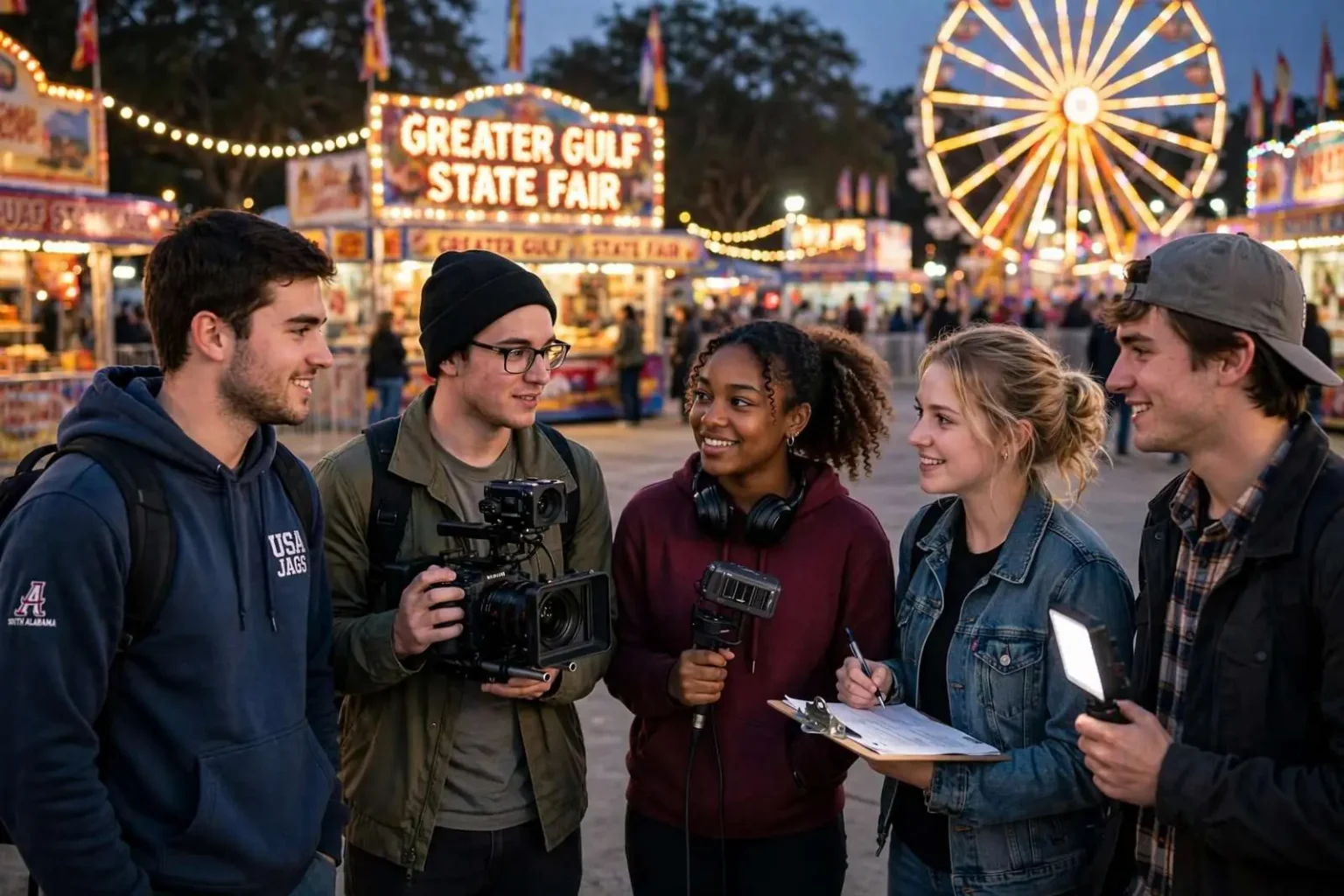
A group of aspiring filmmakers at the University of South Alabama turned a class assignment into a creative showcase with their short film, The Dreamers, a project that captured the spirit of college life and the pressures facing young adults. What started as required coursework became a full production with real locations, a cast of actors and a story the students hope resonates well beyond the classroom. The film stands as an example of what student crews on the Gulf Coast can accomplish with limited resources and a demanding schedule.
Stuart Sox, a Baker High School graduate and film student at USA, teamed up with fellow classmates Steven Spears, Melody Brickhouse, Erin Weninegar and Dylan Glass to produce the film as part of their CA340 coursework under Dr. Rockwell. The five students divided the many jobs a film demands — writing, directing, shooting, editing and sound — while also coordinating schedules, locations and a cast of additional actors. What began as a routine academic exercise evolved into a thoughtful exploration of identity, ambition and the unexpected connections that shape people’s lives.
Class projects at the university level often stop at a short exercise shot in a single afternoon, but the CA340 crew committed to something closer to an independent production. The difference shows in the scope of the finished work: a narrative film with multiple characters, several distinct settings and a story arc that carries through to a genuine resolution. The students treated the assignment the way working filmmakers treat a festival entry, and that mindset shaped everything from pre-production planning to the final cut.
Filming at the Greater Gulf State Fair
The team chose the Greater Gulf State Fair as a key filming location, drawn to its vibrant atmosphere and visual appeal. The annual fair, held each fall at Mobile’s fairgrounds, offers filmmakers a rich visual palette of midway lights, rides, crowds and carnival sounds that is difficult to recreate on a soundstage or a quiet campus lawn. The fair’s organizers granted the student crew free admission over four nights of shooting, providing an authentic backdrop that helped bring their story to life without straining a student budget.
Shooting at a working fair came with real challenges. Crowds, noise and limited control over the environment forced the crew to plan each setup carefully and to work quickly once the camera was rolling. Those constraints, the students said, mirror the conditions independent filmmakers face on location shoots everywhere, and learning to adapt on the fly became part of the education the project provided. The footage captured amid the rides and lights gives the film a texture that a staged set could not match.
Production spanned roughly three weeks, with the team juggling filming schedules around five group members and additional actors, all of whom balanced coursework, jobs and other commitments. They also secured permissions for multiple locations throughout the Mobile area, handling every aspect of the production themselves — from writing and directing to editing and sound design. For a student crew, managing location agreements and shooting logistics is often the hardest part of filmmaking, and the group learned that side of the business firsthand rather than reading about it in a textbook.
A Story About Breaking Down Barriers
At its core, The Dreamers follows five main characters who each begin the story with their own distinct perspectives on life. Through chance encounters, they challenge one another’s assumptions and ultimately find themselves changed for the better. The structure lets each of the five student filmmakers build a character arc of their own while the ensemble story weaves their paths together, a fitting design for a project made by a five-person team sharing one camera and one schedule.
Sox described the film’s central message as one of authenticity and human connection. The story tackles the intense pressure college students face to have their futures mapped out, and suggests that some of life’s most meaningful moments come from letting go of rigid expectations and being open to new people and experiences. That theme speaks directly to an audience of students approaching graduation in a difficult economy, many of whom feel that every semester must justify itself with a clear return on investment.
The filmmakers also wanted the story to feel true to the Gulf Coast rather than generic. Shooting in recognizable Mobile-area settings, from the fairgrounds to everyday streets and storefronts, grounds the drama in a place audiences here know on sight. The result is a film that doubles as a portrait of the city its creators grew up in or moved to for school, told by young people who are only beginning to figure out their own place in it.
Learning Every Job at Once
Because the students handled every aspect of the production themselves, each member of the group rotated through roles that professional sets divide among specialists. Writing sessions doubled as production meetings; location scouting doubled as budget planning; editing nights doubled as sound design sessions. The compressed learning curve is one of the most valuable things a film program can offer, and the CA340 crew emerged with a working knowledge of the entire pipeline from script to final export.
The experience also taught the realities of collaboration. A five-person team cannot afford ego or missed deadlines, and the group had to resolve creative disagreements the way professional crews do — by talking through the story’s needs and letting the film, not any single filmmaker, make the final argument. Cast members drawn from outside the class added another layer of coordination, since their availability dictated much of the three-week shooting schedule.
Projects like this one also show why access to locations matters so much to young filmmakers. The free admission granted at the Greater Gulf State Fair, and the permissions secured across the Mobile area, cost the crew nothing but paperwork and persistence. For students without money to rent studios or buy locations, a community willing to open its doors is often the difference between an ambitious film and a modest one.
Homegrown Talent in Mobile’s Film Scene
The project highlighted the growing creative talent emerging from the University of South Alabama’s film program. Sox, who cited directors like Sofia Coppola and Steven Soderbergh among his influences, said the team hoped the film would serve as a calling card for their abilities as both actors and filmmakers. A completed short that demonstrates story, craft and follow-through is the standard currency of the film industry for people without connections, and the CA340 crew now has a finished work they can submit to festivals and show to prospective employers.
The student production added to a budding local film community in Mobile, where independent creators and university programs were beginning to establish the Gulf Coast city as a place where cinematic storytelling could thrive. Mobile offers filmmakers a mix of settings — historic neighborhoods, working waterfronts, beach towns within a short drive and a downtown that photographs well at night — without the costs and congestion of larger production markets. Local crews, rental houses and city permitting offices have gained experience as more productions pass through, making the next project easier to mount.
University programs play a central role in building that ecosystem. Every student film shot on location trains residents in production work, introduces businesses to the rhythms of a film crew and leaves behind a reel of footage that showcases the city. Graduates who stay in the area carry those skills into commercial video work, and those who leave for larger markets do so with a network of Gulf Coast collaborators they can call on later. Either way, the region’s filmmaking capacity compounds with each project.
What Comes Next for the Crew
For the five students behind The Dreamers, the film is both a milestone and a starting point. The class that produced it will move on to new assignments, but the relationships, habits and portfolio piece built over three weeks of production outlast any single course. Screenings for classmates, friends and family give the team a first audience and a chance to see which moments land and which need rethinking in the next project.
The crew’s advice to other students, distilled from the experience, is to start with a story worth telling, secure locations early and treat every classroom exercise as if it were headed to a festival. The gap between a student film and an independent film, they discovered, is mostly organizational: planning, permissions, schedules and persistence. Talent matters, but the projects that get finished are the ones whose crews show up every shoot day prepared.
As Mobile’s film community continues to grow, projects like The Dreamers serve as proof that a complete, meaningful short film can be made here, by local students, with cooperation from local institutions. The film’s journey from a course requirement to a showcase of homegrown talent mirrors the path the city’s broader film scene hopes to travel — from occasional productions to a durable, self-sustaining creative industry on the Gulf Coast.