UWF engineering students build custom mobility vehicle for Pensacola boy
University of West Florida engineering students designed a custom John Deere-style mobility vehicle for a Pensacola boy with cerebral palsy.
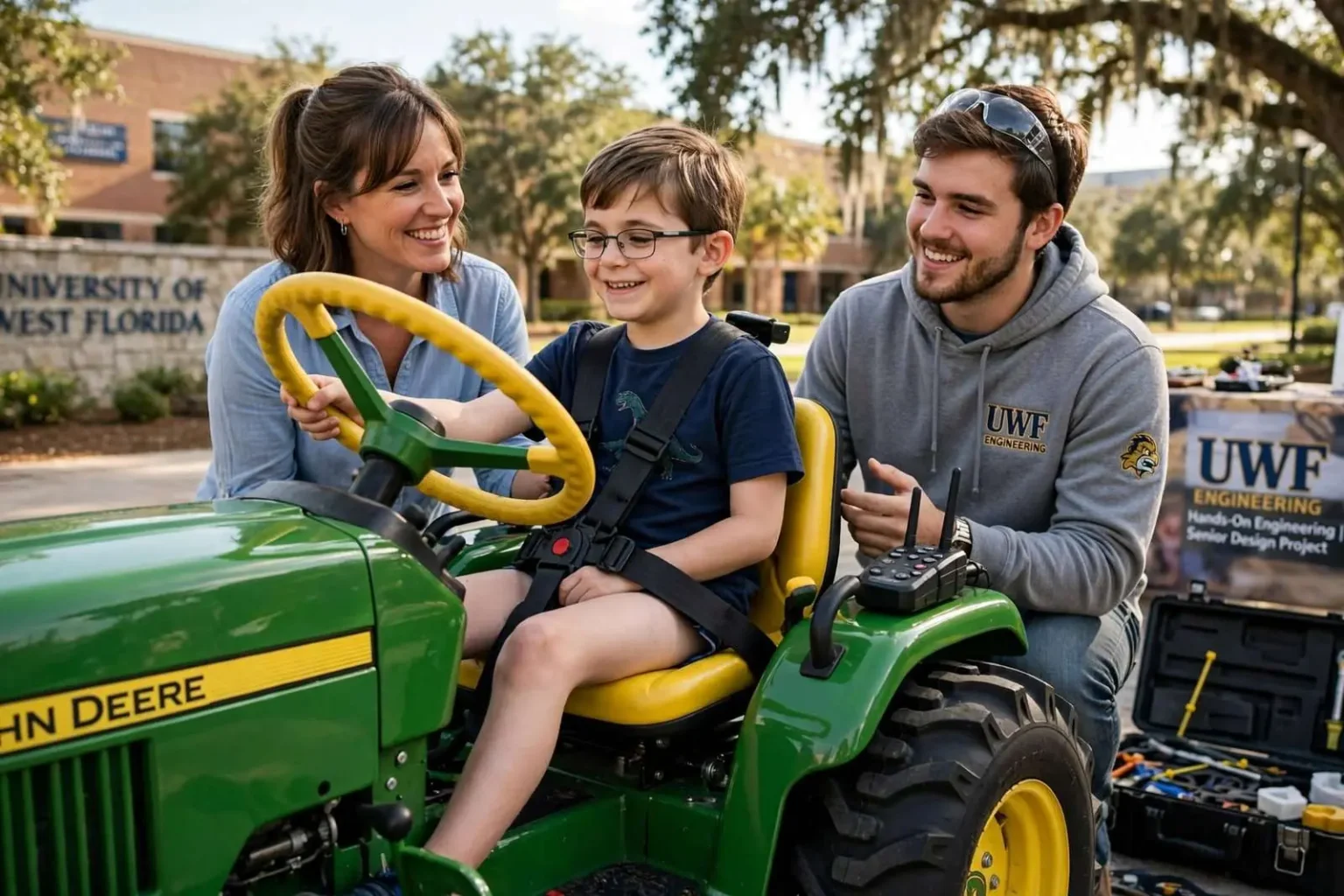
PENSACOLA, Fla. — Engineering students at the University of West Florida have built a custom John Deere-style mobility vehicle for a local boy with cerebral palsy, turning a childhood classic into a ride that Jack Carroll can operate on his own terms. The adapted ride-on vehicle features a three-point harness to keep him upright, an enlarged steering wheel sized for one-handed control, and a remote control that lets family and friends help guide him when he needs a hand.
The modifications were driven by Jack’s specific needs. Student Shane Smith, who worked on the project, said the team enlarged the steering wheel because Jack was weaker on one side of his body and had difficulty operating a standard wheel. The enlarged diameter gives him the leverage to steer with the hand and arm he can use most effectively, while the harness provides the trunk support that children with cerebral palsy often need to stay seated and secure on a moving ride.
The remote control adds a layer of safety and participation for the family. Jack’s mother, Danielle Carroll, said the device will give Jack more independence to ride on his own — and when his steering takes him somewhere he shouldn’t go, a parent or sibling can take over from a distance, letting the ride continue rather than ending in frustration. The project reflects the University of West Florida’s hands-on engineering program and its long tradition of work with the local community.
Cerebral palsy and the challenge of childhood mobility
Cerebral palsy is the most common motor disability in childhood, affecting roughly one in several hundred children by most estimates. The condition results from damage to the developing brain before, during, or shortly after birth, and its effects vary enormously from one child to the next — from mild muscle stiffness to profound impairments in movement, posture, and coordination. Many children with cerebral palsy, like Jack, have weakness that affects one side of the body more than the other, which is what makes standard controls like steering wheels, pedals, and grips so difficult to use without adaptation.
For a young child, the obstacles go beyond transportation. Ride-on toys — the battery-powered cars and tractors that fill driveways across America — are more than playthings. They are how many children first experience independent movement, spatial navigation, and the social play that comes from keeping up with siblings and neighborhood friends. A child who cannot operate those toys off the shelf is excluded from a whole category of childhood, and occupational therapists have increasingly emphasized that adapted ride-on devices can support motor development, confidence, and social participation at the same time.
The John Deere-style tractor format is a popular starting point for these adaptations. The tractor’s seat position, simple controls, and sturdy frame lend themselves to modification, and the instantly recognizable green-and-yellow styling means the finished product looks like the real thing rather than a medical device. That matters more than it might appear: children and their families consistently report that a device that looks like a toy, not therapy equipment, gets used more and draws the right kind of attention from other kids.
The engineering behind the build
Each of the three headline adaptations answers a specific problem. The three-point harness — the same configuration used in car seatbelts — addresses trunk control, keeping Jack upright and centered in the seat even when the vehicle turns or travels over uneven ground. Children with cerebral palsy often have difficulty maintaining seated posture against movement, and a secure harness converts the ride from a balancing challenge into something the child can simply enjoy.
The enlarged steering wheel tackles the one-sided weakness that Smith described. By increasing the wheel’s diameter, the team increased the mechanical advantage Jack gets from the grip he can apply — every point of contact is farther from the pivot, so less force is needed to turn the same amount. Combined with the ability to steer with one hand, the modification turns the vehicle’s most demanding control into one Jack can manage independently. On standard ride-on tractors, the wheel is small and light, tuned for children with full bilateral strength and coordination; scaling it up is the kind of practical fix that follows naturally from watching a child actually try to drive.
The remote control completes the design by solving the problem every parent of a young driver knows well. Instead of chasing the vehicle or cutting play sessions short, family and friends can take control remotely when Jack approaches a hazard or simply needs help getting unstuck. The arrangement preserves Jack’s independence while giving his mother and the rest of the family the confidence to let him ride — a balance Danielle Carroll said was the whole point of the project.
UWF’s hands-on engineering culture
The University of West Florida, perched on the western edge of Pensacola, has built its engineering programs around exactly this kind of project. The university’s engineering departments emphasize design courses in which student teams take real problems from real clients — often individuals, schools, or nonprofits in the Pensacola area — and carry them from concept through fabrication to delivery. For students, the projects fill the gap between textbook problem sets and professional practice: budgets are real, deadlines are real, and the end user is a specific person whose needs cannot be averaged away.
Adaptive device projects have become a staple of that hands-on model at universities across the country, inspired in part by national efforts that match engineering students with children with disabilities. The pattern is well established: a family describes what their child cannot do, the team measures, prototypes, tests, and iterates, and the finished device costs a small fraction of what a comparable commercial product would. Commercial adaptive ride-on vehicles can run into the thousands of dollars and often require long waits for customization, while student-built versions deliver comparable function for the cost of parts and student labor.
For the students, the payoff is perspective as much as skill. Shane Smith’s explanation of the enlarged steering wheel reflects the way good engineering is actually done — starting from an observation about how one particular child moves and working backward to a mechanical solution. No amount of calculation substitutes for watching a child try to turn a wheel with a weaker hand, and projects like this one are where engineering students learn that the most important specification on any drawing is the person it is drawn for.
What it means for the Carroll family
For Jack and his family, the vehicle represents something larger than transportation around the yard. Danielle Carroll’s comment about independence captures the change: a child who previously had to be pushed, carried, or assisted through this kind of play can now drive himself, make his own choices about where to go, and experience the small sovereignty that comes with being behind the wheel of anything, even a toy-sized tractor.
The remote control keeps the family in the picture without putting them in charge. A parent can shadow Jack’s play from the porch, intervening only when needed, and siblings and friends can join in rather than watching from the sidelines. Families who receive adapted vehicles through programs like this one consistently describe the same set of changes — more time playing with other children, more confidence on both sides, and a shift in how the child sees himself, from passenger in his own childhood to driver of it.
The vehicle also joins a longer story of community support for children with disabilities in the Pensacola area, where university programs, therapy providers, and volunteer groups have repeatedly partnered on adaptive equipment projects. Each build strengthens the network: families meet other families, students meet future clients, and the university deepens the community ties that anchor its mission in northwest Florida.
A model that keeps rolling
The UWF project is one example of a movement that has gained momentum nationwide as engineering programs have embraced assistive technology design. Teams at universities from Florida to the Midwest have built adapted vehicles, custom switches, modified trikes, and communication devices for children whose needs standard products don’t meet, and many of those efforts have grown into ongoing programs that produce new devices every academic year.
The economics continue to favor the model. The parts for an adapted ride-on tractor — harness hardware, an enlarged wheel, a remote control system, and mounting materials — cost far less than commercial equivalents, and the labor comes from students earning course credit and experience. For families navigating the costs that come with a cerebral palsy diagnosis, therapies, equipment, and everything else, a free custom vehicle built by local students is no small thing.
For now, the newest John Deere-style tractor in Pensacola belongs to one boy, one family, and one student team that took the time to understand exactly how Jack Carroll moves through the world — and then built him a machine that lets him steer it himself.