Advocate Pushes for Better Highway Signs to Spanish Fort Veterans Cemetery
A longtime veterans advocate is asking Eastern Shore officials to fund new highway signage after families repeatedly got lost en route to a loved one's funeral.
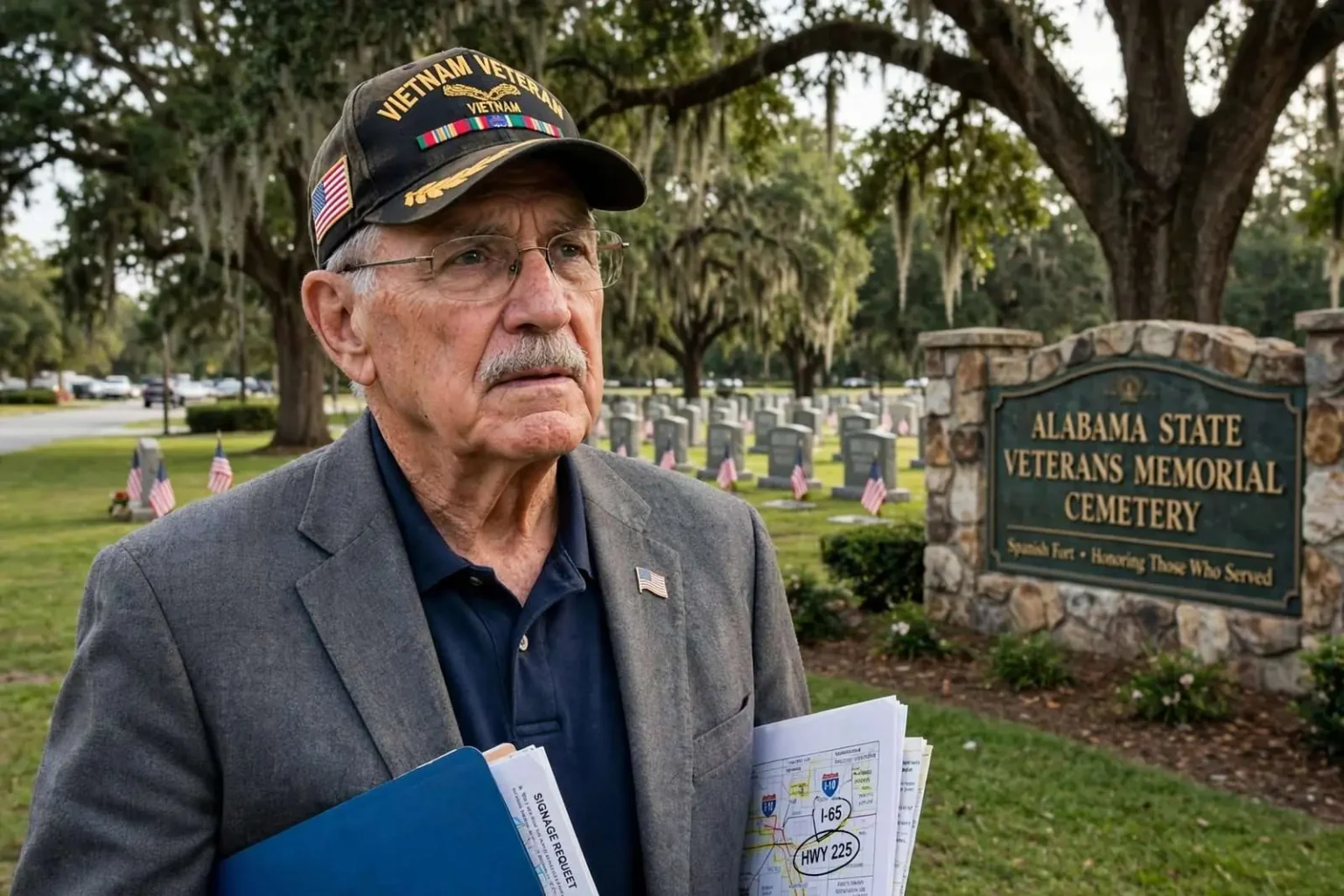
A longtime advocate for military veterans is pushing Eastern Shore officials to fund new highway signage directing motorists to the Alabama State Veterans Memorial Cemetery near Spanish Fort, after hearing repeated stories of grieving families who got lost on their way to a loved one’s funeral. The appeal, delivered to a regional transportation policy board, argues that something as simple as a handful of road signs could spare mourners the frustration of arriving late — or not arriving at all — to services that cannot wait for them.
Dr. Barry Booth, an Eastern Shore dentist, Vietnam veteran and organizer of veteran-focused honor flight missions out of Mobile, presented his case during a recent meeting of the Eastern Shore Metropolitan Planning Organization’s policy board. He described the emotional toll on families who arrive late, or miss services entirely, because they cannot find the cemetery. Booth told board members he has seen so many people miss the final salute of their relatives, and asked them to imagine that happening to their own family, stressing how important it is to be present for that final salute.
The numbers behind the request
Booth came prepared with data to back up his request. He said the Spanish Fort Police Department has fielded more than 100 inquiries from people trying to find the cemetery, while the Baldwin County Sheriff’s Office reports receiving more than a dozen similar calls each week. Those figures, gathered from the law enforcement agencies closest to the cemetery, quantify a problem that until now had been known mostly through anecdote — the site draws steady crowds of visitors who have no reliable way to find it from the region’s main highways.
Since opening roughly two years ago, the 22-acre cemetery has hosted more than 600 ceremonies, drawing an estimated 12,000 vehicles and 22,000 visitors. The pace of burials reflects both the size of the region’s veteran population and the demand for a state-run resting place on the Eastern Shore, where military families from Mobile, Baldwin and surrounding counties can lay veterans to rest closer to home.
Only two directional signs currently exist, and both are located within Spanish Fort itself, well short of the interstate exits most visitors use. That means motorists arriving on Interstate 10 or Interstate 65 — the routes nearly all out-of-town funeral attendees travel — receive no guidance until they are already deep into the local street grid, and many never find their way to the right road at all.
A cemetery built to serve the region for decades
The cemetery, which sits about five miles north of Spanish Fort, has capacity for tens of thousands of graves and could be expanded further, meaning it is expected to serve the region for decades to come. State veterans cemeteries are designed as long-term commitments, and the burial demand already recorded in the site’s first two years suggests the visitor traffic Booth describes will only grow as the population of veterans in south Alabama ages.
Alabama’s veterans cemetery system exists to guarantee that any eligible veteran can be buried with full military honors at no cost to the family, a promise that places a premium on access. For grieving relatives traveling from out of town — many of whom have never driven the Eastern Shore’s back roads — the final approach to the cemetery is often their first encounter with the area, and it comes on one of the hardest days of their lives.
Where the signs would go
Booth is asking for signage along the Causeway, Interstate 10, Interstate 65 and Highway 225 to guide visitors from major routes directly to the site. Those four corridors carry virtually all of the traffic bound for the cemetery: the Causeway and I-10 funnel drivers across Mobile Bay from the Mobile side, I-65 brings traffic down from the north, and Highway 225 serves as the final link into the rural stretch north of Spanish Fort where the cemetery sits.
The total cost of the signage project is estimated at just over $67,000, which Booth said could be pieced together from a mix of funding sources rather than relying on any single agency. Relative to the road projects that normally come before the planning organization, the price is modest — a fraction of the cost of a single intersection improvement — and Booth has argued that splitting the expense among the agencies that control the affected roads would spare any one government from absorbing the full bill.
Planning organization officials did not commit to funding at the meeting but indicated they would continue evaluating the proposal. The board’s role in regional transportation planning means any signage on federal-aid routes would need to work through the state and federal processes that govern highway signs, while signage on locally controlled roads could move faster if a city or the county agreed to act.
Why families are getting lost
The geography helps explain the problem. The cemetery lies north of the town centers and commercial strips that most GPS users and travelers are familiar with, in a part of Baldwin County that has seen rapid growth but still has long stretches of rural roadway. Drivers coming off the interstate find themselves on two-lane roads with few landmarks, and without signs confirming they are on the right route, the natural instinct is to turn around — often with a funeral procession waiting on the other end.
The volume of calls to the Spanish Fort Police Department and the Baldwin County Sheriff’s Office underscores the point. When more than a dozen callers a week are asking one sheriff’s office for directions, the cost of the missing signage is being paid not just by families but by dispatchers and deputies diverted from other work to guide lost motorists to the gates.
An advocate who will not let it go
Booth said he intends to keep pressing the issue until signage improvements are approved, arguing that veterans and their families deserve a clear, dignified path to the cemetery without added stress during an already difficult time. His long record of veteran advocacy on the Eastern Shore — from dental practice to honor flight missions that carry aging veterans to Washington to see the memorials built in their honor — has given him credibility with officials across the region, and he has framed the signage campaign as a continuation of that work.
For the Eastern Shore’s mayors and county commissioners, the request lands at a moment when the cemetery has quietly become one of the region’s most significant destinations. Hundreds of ceremonies a year bring thousands of people through Spanish Fort from every corner of the Gulf Coast, and the community’s response to those visitors shapes how the region is remembered by families at their most vulnerable.
The proposal also fits a pattern familiar to transportation planners: small accessibility investments that official project lists tend to overlook. Major interchange and widening projects dominate regional planning agendas, while issues like wayfinding — the signs that tell strangers where to go — often fall through the cracks between state, county and municipal jurisdictions. Booth’s data-driven appeal is an attempt to force the issue onto the agenda before another season of funerals brings another round of lost drivers.
Whether the funding is assembled from municipal budgets, county funds or planning organization allocations, the expectation among advocates is that the signs themselves would be straightforward to install once money is committed. Standard highway markers directing motorists to points of interest are routine infrastructure, and Booth has argued that a cemetery serving those who served the nation should be marked with nothing less than the clearest guidance the region can provide.
Until a decision comes, families planning to attend services at the cemetery are left to rely on their own navigation and, in too many cases, a call to the Spanish Fort police. Booth has made clear he plans to return to the board and its member governments until the signs are funded, and the more than 100 inquiries logged by local police stand as his evidence that the need will not fade on its own.
The honor flight missions Booth organizes out of Mobile give that advocacy a personal dimension, carrying WWII, Korea and Vietnam-era veterans to Washington to see the memorials raised in their honor, and the same instinct drives his signage campaign: that the region owes older veterans attention to details that easier-to-see causes overlook. He has asked the board to consider what message the absence of signs sends to the thousands of families the cemetery serves, and to weigh the modest cost of the project against the certainty that the visitors will keep coming. As the cemetery’s burial schedule continues at its current pace, the issue he raised is expected to return to the board’s agenda, and advocates say the sooner the signs go up, the sooner the region can guarantee that no family misses a final salute because of a missing road marker.