The Sitters, the Soybean Doctor and a Change of Command Downtown
Part four of a memoir of a bygone Mobile: retired men who spent their days watching the tape, a shift in command at the brokerage, and the return of the city's biggest commodity trader.
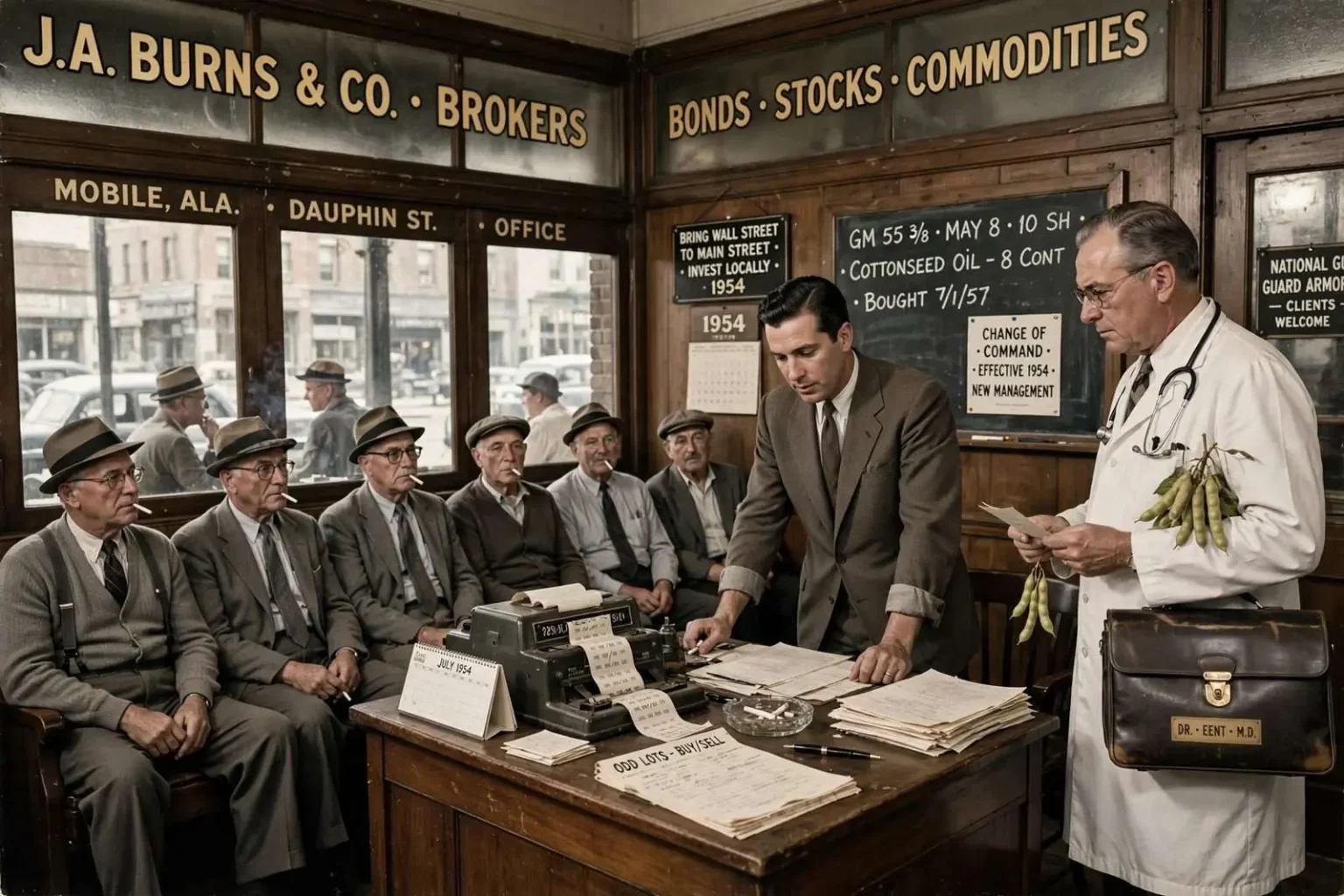
The fourth installment of a serialized memoir of a bygone Mobile is a portrait of a downtown that no longer exists — one in which enough people lived or worked near the center of the city that a brokerage office kept a standing audience. Every brokerage had its “sitters,” and in the 1950s there were far more of them, relative to the business actually done, than there would be later.
Most were retired. Spending the day at a brokerage office was simply their way of life.
They did very little business, but they gave the place the appearance of activity, which was useful when a stranger walked in to ask about opening an account. Occasionally a genuine “live one” turned up — a man who traded off the tape and could roll up commissions.
Such traders almost invariably came to grief, the memoirist writes, as the commissions ate the profits or deepened the losses. There would be one notable exception in his career.
Odd lots and Main Street
His own business in those years was built almost entirely on very small accounts. His mother steered a few his way.
He stayed late to catch stray newcomers. He picked up colleagues from the newspaper and fellow officers from the National Guard armory.
Roughly three-quarters of his trades were odd lots of fewer than 100 shares, and an order for 200 or 300 shares counted as a bonanza. The exchange in those days was promoting the slogan “Bring Wall Street to Main Street,” and that, he says, was exactly his philosophy.
He began investing a little himself. His first purchase was ten shares of General Motors on May 8, 1952, at 55 3/8.
He had been keeping his money in Series E bonds and savings and loan accounts paying about 4 percent; a stock at 55 paying $4 a year in dividends looked like a golden opportunity, and it was. Writing years later, he still held the stock, by then split three-for-one.
He might have plunged deeper, he admits, had the graybeards who sat with him each day not kept insisting that another depression was on the way — that a depression always follows a war and it was only a matter of time.
A shift at the tiller
The year 1954 brought a change of command in the Mobile office.
The founding manager and his co-manager both kept their titles, but the co-manager took over in fact. The change followed one of the semiannual visits from the firm’s New York partners, occasions marked by lavish suppers to which the junior man was not invited.
He suspects a scene was made. Whatever the cause, the founding manager seemed content to keep the title and shed the responsibility.
It was probably the right decision for the firm. The new de facto manager had a sense of direction and was willing to build for the future — mostly, the memoirist notes, his own.
He also, at last, provided the memoirist with a desk. He expanded the staff, hiring another broker in the summer of 1954.
And he lost the senior salesman, his own uncle, who detested him and left within a month or so to join an over-the-counter firm. The new hire’s insistence on $300 a month brought the memoirist’s salary up to the same figure.
He did not quite earn his 1954 pay of $3,650 including bonus, though he came within striking distance had the payout been the 40 percent it should have been. His production had tripled over the prior year.
In 1955 it nearly doubled again, and for the first time he could say he had earned his keep. That was also the year the founding manager left the firm for good, while the memoirist was traveling in Mexico.
He suspects the older man had been trading in customers’ accounts without authorization, and possibly guaranteeing them against loss — both very much against the rules — and that somebody blew the whistle.
The account nobody wanted
Bad for the departed manager, it was a break for everyone else, because his accounts were divided up.
The memoirist got what looked like the poorest end of the deal, and inside it was the great stroke of luck of his career. One of the dormant accounts was that of the biggest commodity trader in town: a German-born physician, an eye, ear, nose and throat specialist in an era when a city the size of Mobile had few specialists of any kind, and a man of commanding presence who had been one of the community’s outstanding doctors for a generation.
He had discounted his fees for poorer patients and performed countless operations for nothing at all. He had been out of the market for two or three years, and every indication was that he would not return.
The new manager, the memoirist believes, passed on the account both because he thought it would stay dormant and because the two men’s personalities would have collided within a week. The doctor came back to the market on July 1, 1957, buying eight contracts of cottonseed oil, worth $132 in commissions.
By year’s end he had accounted for $3,821, and the memoirist finished 1957 with a gross of $20,135 — in a year when the whole office grossed only $87,611. It did him less good than it should have.
His pay that year was cut to $5,000, some $3,000 short of what the industry’s payout ratios would have dictated. That, he writes, was simply the way the manager operated.
He did not go short himself.
Next in the series: An ugly Yankee comes my way, and it’s a lucky day.