West Virginia Retires Daphne Native Pat White’s No. 5 Before 31-24 Win Over Coastal Carolina
Former Daphne High standout Pat White had his No. 5 retired at West Virginia in a pregame ceremony Saturday, ahead of the Mountaineers' 31-24 win over Coastal Carolina. He is the seventh WVU player to have a number retired.
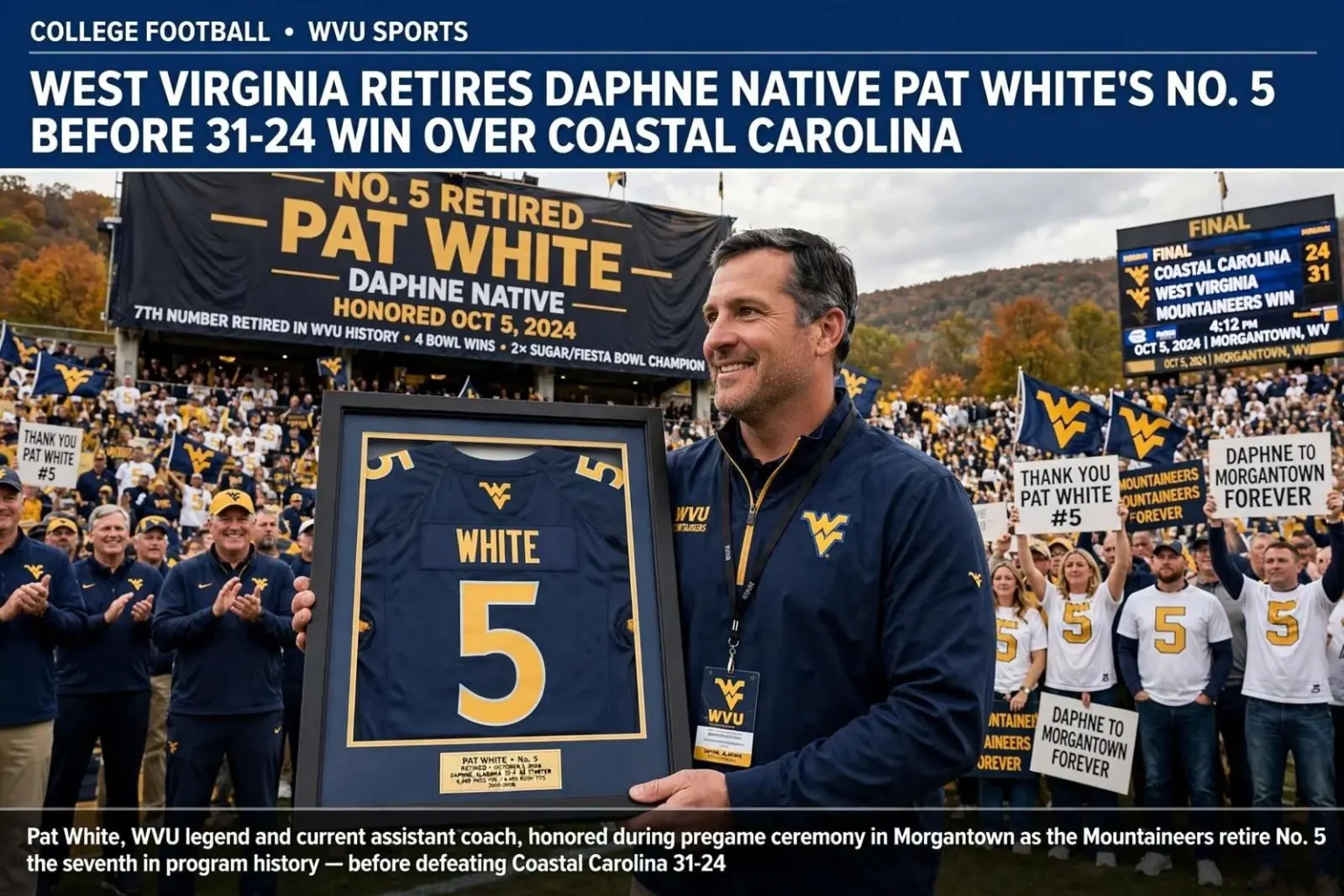
Before West Virginia kicked off against Coastal Carolina on Saturday, the Mountaineers stopped for a piece of housekeeping that no program does casually. They took a number out of circulation.
Pat White’s No. 5 was retired in a pregame ceremony, honoring a quarterback who arrived in Morgantown from Daphne two decades ago and left as one of the most productive players in the school’s history. West Virginia went on to beat Coastal Carolina 31-24.
Many in the crowd wore white T-shirts carrying White’s No. 5, and others turned up in replicas of his jersey. He is the seventh West Virginia player to have his number retired.
What a Retired Number Actually Means
Jersey retirement is the most permanent honor a college football program can hand out, and it is permanent in a very literal, logistical way. A roster has more than 100 players and a jersey pool that runs from 0 to 99. Every number a school withdraws is one fewer available to every recruiting class that follows, forever. That scarcity is why programs with more than a century of football history often have only a handful of retired numbers, and why West Virginia reaching seven is a meaningful marker rather than a routine ceremony.
It also explains the arrangement West Virginia has put in place for this season. Wide receiver Jaden Bray currently wears No. 5, and the senior will continue to wear it for the remainder of the year. After the season, no other West Virginia player will wear No. 5 unless White approves it.
That kind of transition is standard practice when a number is retired mid-career for a current player. The honoree gets the permanence; the player already wearing the number is not asked to change identities in the middle of a season. Leaving future exceptions to White’s approval is a version of the same courtesy running the other direction — the number belongs to him now, and anyone who wants to wear it goes through him.
An All-State Athlete in Two Sports Who Had to Pick One
White was an All-State quarterback and an All-State baseball player at Daphne, which is a rarer combination than it sounds. Being the best player in the state at one position in one sport is hard. Being recognized at that level in two sports, in the same graduating class, generally means a recruiting file with more offers than a teenager can reasonably evaluate.
That was the practical problem White faced. He was recruited by several other high-profile colleges, and each of them recruited him to play a different position. For a high school quarterback with elite athleticism, that is a familiar experience: programs see the speed first and the position second, and the pitch becomes a conversation about where a coach thinks the athlete fits rather than where the athlete wants to play.
West Virginia head coach Rich Rodriguez offered White the chance to play quarterback. He chose West Virginia.
The football decision was only half of it. White also chose West Virginia over a professional baseball career. He had been drafted by the Anaheim Angels in the fourth round of the 2004 draft, and a fourth-round selection is not a courtesy pick — it is a team telling a player it is prepared to invest in him. He turned it down for a college football scholarship.
Baseball did not stop asking. White was drafted again in 2007 by the L.A. Angels, in 2008 by the Reds and in 2009 by the Yankees. Because a drafted player who does not sign returns to the pool, teams can and do take repeated swings at an athlete whose talent they have already evaluated, and four organizations across six years came back to a player who had committed himself to football.
At Daphne, White was a pitcher and outfielder who helped lead the Trojans to a pair of state championships. In 2003 he led the football team to the Class 6A state championship game, where Daphne lost to Hoover.
For readers outside the state, that game carries more weight than the score suggests. Alabama High School Athletic Association championships are decided by enrollment classification, and in 2003 Class 6A was the largest classification in the state — the bracket containing the biggest schools with the deepest athletic programs. Reaching the final of that bracket meant beating a season’s worth of the state’s largest programs to get there.
Two baseball state championships and a football title-game appearance is an unusually complete high school career, and it is the reason the recruiting interest was as broad as it was.
The Freshman Who Never Gave the Job Back
White’s college career did not begin as a starter. In his seventh game as a freshman, he replaced injured starter Adam Bednarik and led the Mountaineers to a 46-44 win over No. 19-ranked Louisville. He was the team’s quarterback from that point forward.
That is the version of the story that gets retold, but the number that captures the whole of it is his record: White was 35-8 as West Virginia’s starting quarterback. Winning better than four of every five starts across a full career is the kind of mark that separates a great individual player from a player whose teams simply kept winning — and it is the reason a jersey retirement follows two decades later rather than a place on a statistical leaderboard alone.
Record-Book Numbers and Four Bowl Wins No One Else Has
White is sixth in West Virginia history in passing with 6,049 yards, second in rushing with 4,480 yards and second in rushing touchdowns with 47.
The rushing total is the one that travels beyond Morgantown. His 4,480 rushing yards are the third most ever for a Bowl Subdivision quarterback. He also accomplished the rare feat of topping 6,000 career passing yards and 4,000 rushing yards, a combination that requires a player to be trusted as a passer for four years while also carrying a running game.
Two other figures fill in the texture of how he did it. White compiled four 200-yard rushing games — single-game totals that would be notable for a running back and are extraordinary for a quarterback — and he averaged 6.5 yards per rush over his career.
That average deserves a note, because college football counts sack yardage against a quarterback’s rushing total. Every time White was dropped behind the line, the loss came out of the same column as his long runs. Sustaining 6.5 yards per carry across four seasons under that accounting is a different achievement than the same number posted by a tailback.
White is the only player in NCAA history to be the starting quarterback in four bowl victories.
Two of them anchor the record. The first was a 38-35 win over Georgia in the 2006 Sugar Bowl. The second was a win over Oklahoma in the Fiesta Bowl following the 2007 season. The Sugar Bowl and the Fiesta Bowl are two of the oldest and largest games on the postseason calendar, and winning both against opponents of that stature is what turned a productive quarterback into a national name.
Four bowl wins as a starter also says something quieter about durability. It means four seasons good enough to reach the postseason, four healthy Januaries and four teams that arrived prepared. Quarterbacks who play the way White played — carrying the ball dozens of times a game — do not always get four of those.
The Senior Bowl, the NFL and Two Halls of Fame
White played in the 2007 Senior Bowl and was named the game’s Most Valuable Player — an award earned about 45 minutes from where he grew up. The Senior Bowl is played each winter in Mobile, and it functions as the most heavily scouted all-star game in the sport, drawing coaches, general managers and personnel staffs from every NFL franchise for a week of practices that matter more to evaluators than the game itself. Being the best player on that field, in front of that audience, moves a draft grade.
White was selected in the second round of the NFL Draft, at No. 44 overall, by the Miami Dolphins.
The institutional honors followed later. He was inducted into West Virginia’s Sports Hall of Fame in 2018 and the Mobile Sports Hall of Fame in 2024. Saturday’s ceremony completes a set: recognition from the school he played for, from the region he came from, and now the retirement of the number he wore.
Rodriguez, Back Where It Started
The coach who recruited White as a quarterback when other schools wanted to move him was on the sideline for the ceremony.
“Twenty years later, they’re still talking about what he did and what his teammates did,” West Virginia coach Rich Rodriguez told reporters earlier in the week. “To this day he was always about the team first and what do I have to do to have West Virginia have success. So I’m really proud of him.”
Rodriguez left West Virginia to take the Michigan head coaching job and also had head coaching stints at Arizona and Jacksonville State. He returned as head coach at West Virginia last season, and he hired White as an assistant quarterbacks coach and assistant to the head coach.
The result is that White was not honored as a returning alumnus flown in for a ceremony. He was honored as a member of the current staff, working in the building, coaching the position he was recruited to play.
The Baldwin County Pipeline
The local hook here is not incidental. White is a product of Daphne High School and the Baldwin County school system — one of Alabama’s largest and fastest-growing public school districts, spread across a county that has added population and enrollment steadily for decades.
Growth of that kind changes high school athletics in specific ways. Larger enrollments push schools into the biggest classifications, which means tougher regular-season schedules and postseason brackets. Bigger programs attract more coaching staff, more facilities investment and more year-round development. And the Gulf Coast’s climate allows a longer outdoor calendar than most of the country, which is one reason multi-sport athletes remain common here — White’s own baseball career being the obvious example.
Recruiting attention follows all of that. Coastal Alabama sits within a short drive of programs across the Southeast, and the Senior Bowl brings the professional evaluation industry to Mobile every year. A player who develops in Baldwin County is not developing in an overlooked place.
What White’s career demonstrates to the players currently on those fields is narrower and more useful than a general story about talent. He was told by multiple programs that his future was at another position. He picked the school that agreed with his own read on himself, and the record book at that school now runs through him.
Several family members, friends and former teammates attended Saturday’s ceremony, including White’s parents. His wife, Cristina, and their children were also among the attendees: daughters Daphne and Clara, and sons Pat II and Dubois.
One of those names is worth sitting with. White’s daughter carries the name of the town where his career started, watching from the stands in Morgantown as her father’s number was taken out of circulation in West Virginia. The distance between Daphne, Alabama, and a retired jersey in the Big 12 is considerable. On Saturday, both ends of it were in the same building.