

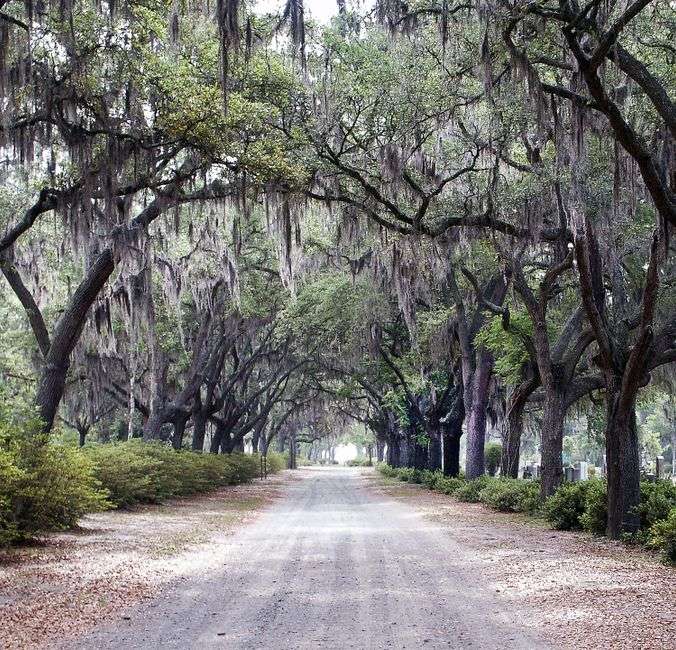
Some towns you visit. Magnolia Springs you drift into — down U.S. 98, over the glistening sweep of Weeks Bay, then right onto a shaded lane where the canopy closes overhead like a green roof and the Magnolia River slides quietly past the backyards. Baldwin County has grown explosively all around this corner of itself, but inside the town limits, the century seems to fold: live oaks arch over Oak Street, springs still feed the river that gave the town its name, and the mail still arrives by boat.
That last part is not a folk tale. The Magnolia Springs boat route is the only year-round water-based mail delivery route in the continental United States — a fact the U.S. Postal Service itself maintains on its facts page. A small contract mail boat works roughly 31 miles of the Magnolia River, Weeks Bay, and lower Fish River, stopping at around 176 dock-side mailboxes, a service that has run continuously since 1915, when the roads were sandy ruts and the river was simply the fastest way in. Today’s carrier follows the same waterway his great-uncle worked generations ago, and residents time their dock errands to his wake.
A town built around water and shade
The town’s name is literal. Natural freshwater springs bubble up along the riverbanks here, feeding the Magnolia River even in dry weather, and around the year 1900 chemical analyses reportedly declared the water among the purest in the world — a claim that put the little settlement on the map as a destination for health-seekers. The river still holds an “Outstanding Alabama Water” designation, one of the state’s cleanest and most ecologically significant waterways, flowing into Weeks Bay and on down to Mobile Bay.
The people arrived slowly and built carefully. Settlement here grew from Spanish land-grant days, when the spring-fed river made the spot a natural waystation, and by the late nineteenth century the community had its own stores, hotels, and steamboat traffic on the river. The Magnolia Springs Historic District contains roughly 119 contributing structures, most built between 1871 and 1962 in Bungalow and Craftsman styles — a streetscape so intact that walking it feels like paging through a well-kept photo album. Landmarks anchor the grid: St. Paul’s Episcopal Church, the Magnolia Springs Community Hall, Moore’s Grocery, and the old Sunnyside Hotel, now operating as a bed-and-breakfast. For most of its existence the community ran on volunteer energy rather than municipal machinery — it did not even incorporate until June 29, 2006, when residents voted 224-96 to become one of Baldwin County’s youngest towns. The 2020 Census counted 811 residents, a number that has barely moved.
The water that made the town also got formal protection. Weeks Bay, into which the Magnolia River drains, was designated a National Estuarine Research Reserve in 1986 — one of a small network of protected estuaries nationwide, used for research and education about how coastal watersheds work. The reserve’s staff and volunteers monitor water quality, restore shoreline habitat, and run the education center at the highway bridge, which means the town’s postcard view is also a living laboratory. The Magnolia River’s “Outstanding Alabama Water” status flows from the same logic: keep the springs and the river clean, and everything downstream — the oyster beds, the jubilees, the fishing charters — keeps working.
That stewardship streak is a point of pride in a county better known for rooftops than regulations. Magnolia Springs made state news when it became the first municipality in Alabama to ban single-use plastic bags and polystyrene foam within town limits, a 2014 move aimed squarely at keeping litter out of the river and bay. For a town of barely 800 people, it was a statement of values: the thing that makes Magnolia Springs worth protecting is the thing most likely to be loved to death.
Then there are the trees. Oak Street’s tunnel of live oaks is the town’s signature — a canopy so dense that locals repeat, only half as a joke, that you can walk the street in the rain without getting wet. During town celebrations the oaks are dressed with Spanish moss and ornaments, and in a community where every house is photogenic, it is the trees, residents will tell you, that are the real stars.
The day the town opened its doors
All of this was on display at the Magnolia Springs Community Association’s “Under the Canopy” Tour of Homes, an event that managed to feel like both a garden party and a master class in civic self-preservation. The town — named by Architectural Digest among the most beautiful small towns in America — drew what looked like a sell-out crowd to the Community Center, where hostesses greeted visitors, a photography exhibition covered the walls, and T-shirts, lemonade, and sweet treats kept the galleries busy before anyone set foot on a porch. The association’s events calendar through the year — concerts, festivals, and gatherings at the Community Hall — is the quiet engine of the town’s social life, run by the same volunteer instinct that keeps the historic district standing.
Book lovers arrive with a head start. Fannie Flagg’s “A Redbird Christmas,” published in 2004, reached bestseller lists and put the town’s borrowed name — “Lost River” — in living rooms across the country, and readers have been making the pilgrimage ever since. The novel’s portrait of a cranky, warm-hearted little community where strangers become family plays as gentle fiction until you spend an afternoon here and realize Flagg was working from life: the pharmacist who knows everyone, the church suppers, the bird with the personality all showed up in her pages because they show up on Oak Street.
The logistics were half the charm. A fleet of golf carts and their volunteer drivers ferried ticket-holders up and down Oak Street, one driver explaining his assignment with a grin: it was, he said, the only time his wife let him pick up women. The tours themselves ran along Oak Street and across the street along the water, where lawns slope down to the river and the homes are their own argument for preservation. Among the stops was the Redbird Cottage — a dream-cottage named for Flagg’s fictional bird, one of ten homes on the route, and a reminder that in this town even the addresses tell stories.
Proceeds from the tour flow to the community’s beloved landmarks — none more treasured than St. Paul’s Episcopal, a well-preserved piece of local history dating to 1902, whose fixtures include an antique cross made from magnolia leaves. The church and the Community Hall are the town’s civic heart, and keeping them standing is what the ticket sales are for.
Getting there, and what to do when you arrive
The drive from Fairhope is half the pleasure: south on 181, east on 98, slowing over the bridge at Weeks Bay — part of the Weeks Bay National Estuarine Research Reserve, one of the country’s protected estuary classrooms — before turning toward the river. Twenty minutes from Fairhope, the pace changes. Golf carts replace cars on tour days, and the pace of everything else follows.
Visitors come for the food as much as the scenery. Jesse’s Restaurant, in the town’s historic core, has built a regional reputation for its food, service, and atmosphere, and the town’s restaurant pedigree now extends toward Fort Morgan with the family’s waterfront follow-on. Anglers know the water, too — charter boats work Weeks Bay and the lower Mobile Bay system, and the public can watch the mail boat make its rounds from the banks or the bridge on most weekday mornings. That is the thing about Magnolia Springs: nothing is staged. The river mail is real, the springs are real, the canopy is real, and the community that built them has spent a hundred and fifty years deciding, one porch at a time, that they are worth keeping.
Tickets to the next Tour of Homes are typically sold at Page & Palette, Fairhope’s bookstore, which doubles as a clearinghouse for community events across the Eastern Shore. Go hungry, go slow, and if a gentleman in a golf cart offers you a ride — take it. It may be the only time his wife lets him.