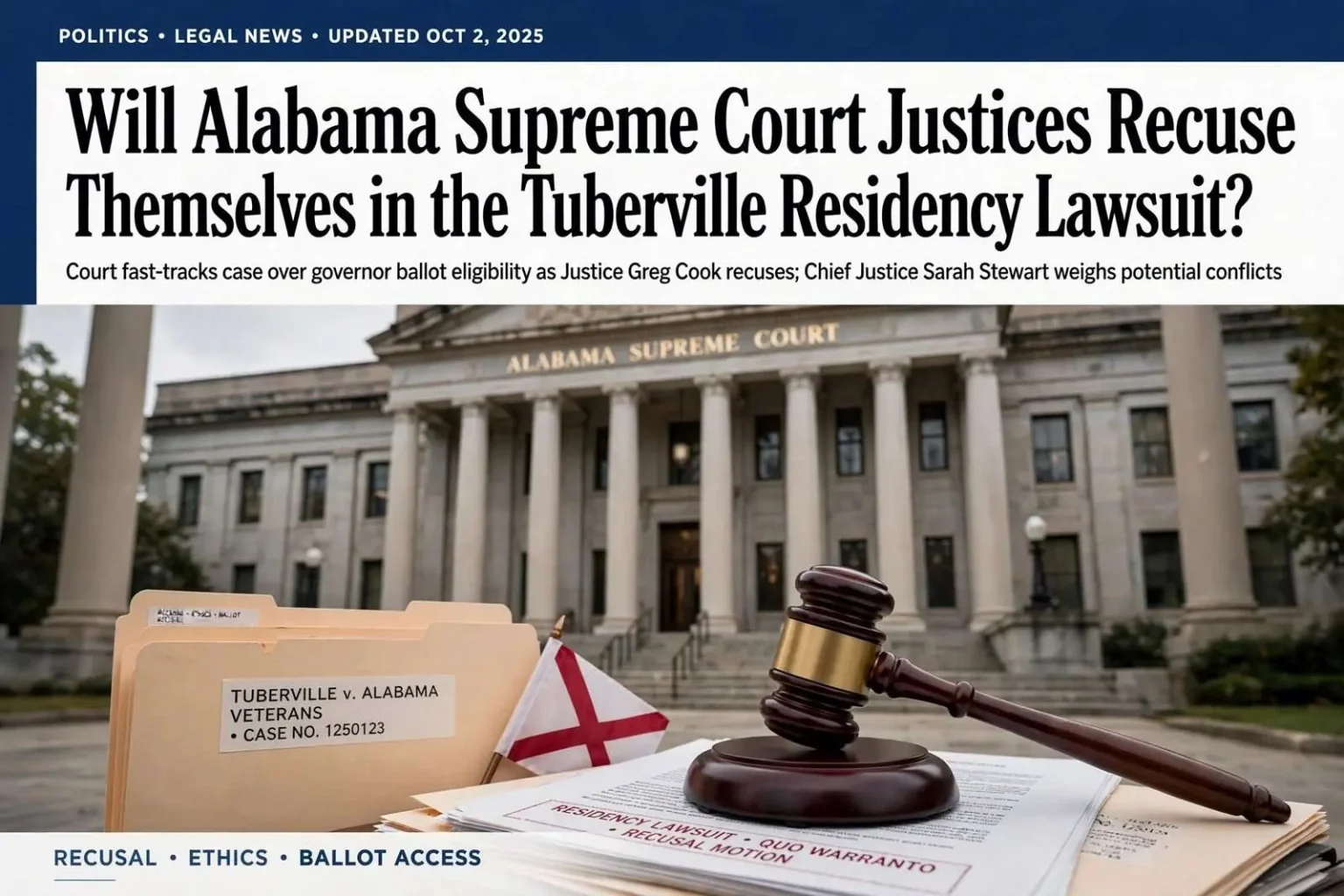
Will Alabama Supreme Court Justices Recuse Themselves in the Tuberville Residency Lawsuit?
The Alabama Supreme Court fast-tracked the Tuberville residency lawsuit. Here's which justices might recuse and what the judicial canons require.
The residency lawsuit seeking to knock Tommy Tuberville off Alabama’s gubernatorial ballot is being fast-tracked by the Alabama Supreme Court — but before the justices decide the case, they may have to decide something about themselves: who sits, and who steps aside.
The suit, brought by two Alabama veterans, claims Tuberville is constitutionally ineligible to serve as governor because of his continued ties to Florida, testing a seven-year residency requirement for the state’s highest office. The case landed on the Supreme Court’s docket after a Democratic Montgomery County circuit judge dismissed it, ruling that Alabama’s quo warranto statute — the mechanism that allows a public official’s eligibility to be tested — was unclear on whether a court could entertain the challenge. The state’s all-Republican high court agreed to expedite the appeal, placing a question of enormous political consequence in the hands of justices elected, like the defendant, through Republican primaries.
That arithmetic is the heart of the recusal debate. At least one justice has already begun sidelining himself, and the plaintiffs’ lawyer argues more of the court should follow.
Who Has Recused So Far
Justice Greg Cook stepped aside from the court’s last ruling in the case, the order agreeing to fast-track it. The court has not stated why — and judges are never obligated to explain a recusal on the record.
Cook’s Republican ties run deep. Before joining the Supreme Court, he spent roughly 15 years in Alabama Republican Party roles, including four years as the party’s general counsel. He served as a delegate to the 2020 Republican National Convention and spent 30 years at the law firm Balch & Bingham, whose offices also represent the ALGOP.
His recusal also carries a timeline wrinkle: less than a month before he stepped aside, President Donald Trump nominated Cook to a federal judgeship on the Northern District of Alabama — a lifetime appointment requiring confirmation by the U.S. Senate, where Tuberville currently serves and would be positioned to vote on his confirmation.
What the Ethics Rules Actually Require
Despite the pressure for a wholesale recusal, Alabama’s judicial ethics framework cuts against blanket disqualification. An advisory opinion from the state Judicial Inquiry Commission published in April 2001 sets the test this way: would a person of ordinary prudence, in the judge’s position and knowing everything the judge knows, find a reasonable basis for questioning the judge’s impartiality?
That same opinion is explicit that political party affiliation alone is not grounds for a justice to recuse. The commission previously found that a judge was not disqualified merely because the judge and an attorney were both Democrats, that the lawyer and his firm had each donated $100 to the judge’s campaign, and that both had attended the same law school — facts which, even combined, did not raise a reasonable question of impartiality.
Another JIC opinion went further still, holding that a judge was not automatically disqualified from a case involving a Democratic Party official even though the party had contributed $259,700 to the judge’s judicial campaign. Campaign money and endorsements, the commission concluded, do not require recusal by themselves unless “additional special circumstances” make a judge’s impartiality reasonably questionable.
The rules also impose a counterweight: the duty to sit. In Ex parte Hill, Alabama’s Court of Civil Appeals held that a judge who is not legally disqualified must hear assigned cases and cannot step aside simply because a case is politically charged or likely to draw criticism. But that duty must be balanced against the canons, which place on each judge the personal burden of deciding whether their own impartiality might reasonably be questioned.
The Plaintiffs’ Argument
Barry Ragsdale, the attorney handling the lawsuit for the plaintiffs, has argued the court’s unique position warrants special treatment. The justices are being asked to decide whether the Republican nominee for governor can remain on the ballot — while the justices themselves are elected statewide through Republican primaries.
“The truth is, I think the Supreme Court, sitting Supreme Court, ought to recuse themselves in this case and have a special court appointed,” Ragsdale has said.
The Tuberville case asks the court to decide whether the judicial branch even has jurisdiction to review the GOP nominee’s eligibility — an issue with institutional implications for a court whose members owe their seats to the same primary electorate Tuberville just won. Tuberville’s lawyers have argued that Alabama law assigns candidate vetting to the political parties during the nomination phase, and that post-election contests belong before the Alabama Legislature, not the courts.
The Chief Justice’s Role
Chief Justice Sarah Stewart, a former Mobile County circuit judge, said she is still weighing potential conflicts and has not decided whether she will recuse herself from the appeal. If she stays on the case, she would hold authority as chief justice to appoint substitute judges for any Supreme Court seats vacated by recusals.
That process would likely begin with retired Alabama Supreme Court justices and depend heavily on logistics, Stewart said — whether potential substitutes are practicing, and how burdened their calendars are. Supreme Court cases are brief-intensive and can demand significant time from substitute justices, she noted, though she estimated a dozen or more former justices could potentially step in.
Once a judge recuses, Alabama law treats the decision as final and strict. In Ex parte Jim Walter Homes, the Supreme Court held that a disqualified judge can take no further action in the case — not even selecting a replacement — because that act itself could raise questions of impartiality.
The Rest of the Bench
Apart from Cook, little in the publicly available backgrounds of the remaining justices presents an overt conflict with Tuberville beyond shared party. Chief Justice Sarah Stewart, a Republican from Mobile, joined the court as an associate justice in 2019 and became chief justice in 2025 after years as a Mobile County circuit judge.
Justices Greg Shaw, Kelli Wise and Tommy Bryan carry long judicial resumes with no immediately apparent direct tie to Tuberville. Shaw has served since 2009 after sitting on the Court of Criminal Appeals; Wise joined in 2011 after serving on that court, including as presiding judge; Bryan has served since 2013 following time on the Court of Civil Appeals.
Justices Brad Mendheim, Chris McCool and Will Parker came to the court from judicial, prosecutorial and state legal roles. Mendheim was appointed by Gov. Kay Ivey in 2018 after serving as a Houston County district judge, circuit judge and assistant district attorney. McCool joined in 2025 after serving on the Court of Criminal Appeals and as district attorney for the 24th Judicial Circuit. Parker was appointed in November 2025 after nearly six years as Ivey’s general counsel and almost 10 years in the attorney general’s Constitutional Defense Division.
Justice Jay Sellers has the most political background of the group, though not an obvious Tuberville-specific conflict: appointed by Ivey in 2017 and later elected, he practiced at Balch & Bingham, chaired two of Ivey’s campaigns for governor, and served repeatedly as a Republican presidential elector.
What Comes Next
The court’s fast-track order signals that Alabama’s highest bench understands the stakes: the winner of the residency question will likely be on the November ballot, and the window for deciding runs out fast. Whether the court rules on jurisdiction alone, as the circuit judge suggested, or reaches the eligibility question itself, the composition of the panel — and the optics of justices elected through Republican primaries deciding a Republican nominee’s fate — will shape how the public receives the answer.
Stewart’s decisions — whether to stay, whether to recuse, and how to fill any empty chairs — may be the first and most consequential rulings of the case.
Related coverage from South AL News
- Tuberville Residency Appeal Pits Alabama Courts Against Party and Legislature
- New Legal Challenge to Tuberville’s Residency Filed in Jefferson County Court
- One Hundred Days and Counting: Doug Jones Still Hasn't Released the Tax Returns He Promised
- This Week in Alabama Politics: Court Tests, Party Leadership and a Redrawn District