Gulf Shores Approves Plate-Based Resident Beach Parking, Adds Exemptions for Part-Time Property Owners
The Gulf Shores City Council approved Ordinance 2229 on Sept. 28, moving resident beach parking to plate-based exemptions and adding part-time property owners, who can register up to two vehicles. The rules take effect Jan. 1, 2027.
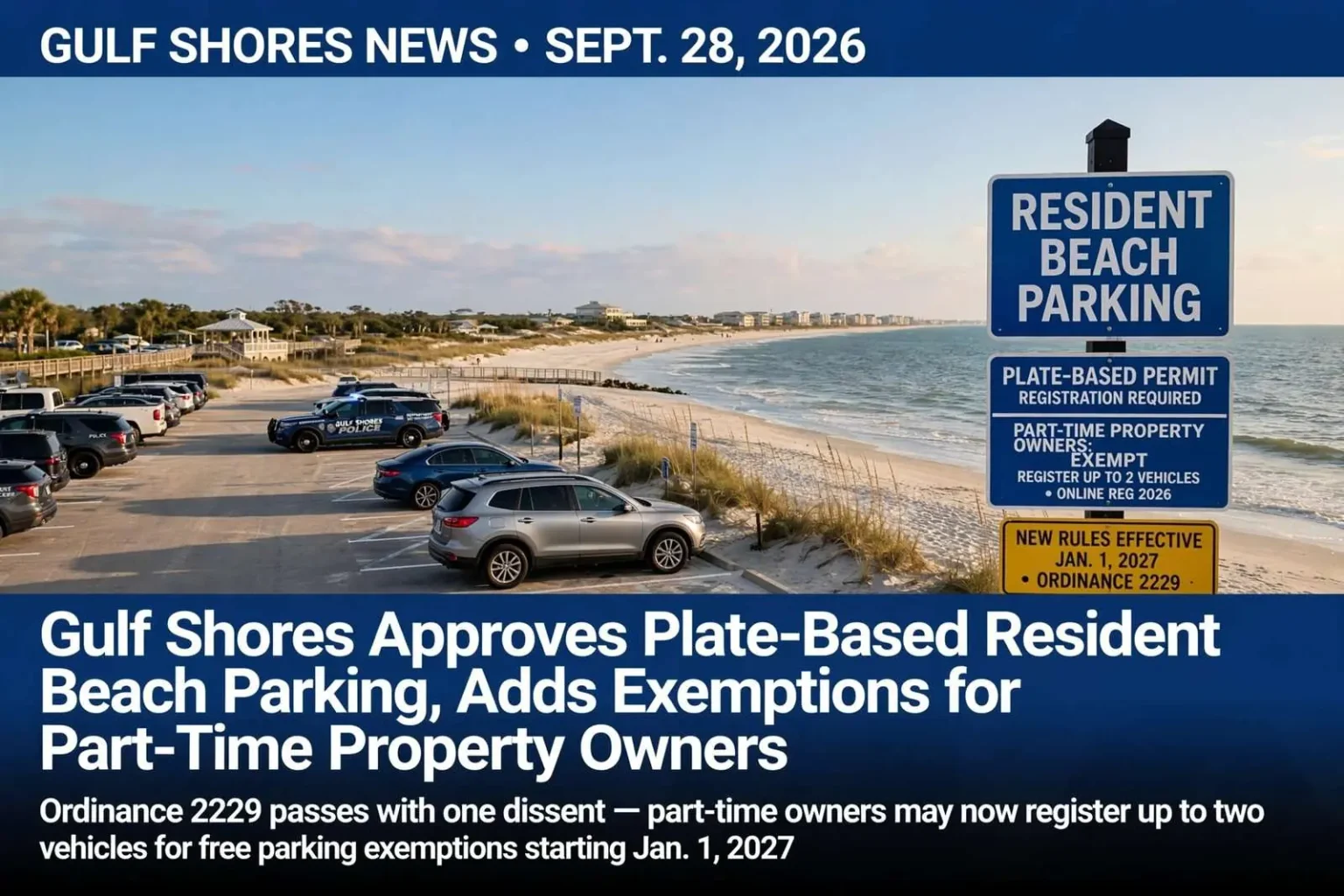
Update (Sept. 28, 2026): Council approves the ordinance, with a change for part-time owners. The Gulf Shores City Council on Monday approved the updated resident beach parking regulations, including an amendment that lets part-time residential property owners register up to two vehicles for free parking exemptions. The new rules take effect Jan. 1, 2027, and online exemption registration is expected to open in October 2026 once the city’s vendor agreement is approved. The measure, Ordinance 2229, passed with one dissenting vote. Details on what was approved are below, followed by the original report on the proposal.
Ordinance 2229 passes with one dissent
The measure the council adopted is Ordinance 2229. It passed after public comment and council debate, with Councilman Jason Dyken casting the only vote against it. Before the vote, council members weighed several scenarios in response to calls, emails and public comments, and residents at the meeting raised issues ranging from access for seniors and privacy concerns to fairness for property owners who do not live in Gulf Shores full time.
Under the adopted rules, full-time residents who register their vehicles are exempt from parking fees at public beach lots across the city and keep exclusive access to the dedicated resident lot. Approved part-time property owners may park free in the city’s paid beachfront areas, but the resident-only lot remains limited to full-time residents.
More ways to register, and a grace period for new signs
In addition to the online portal, the Justice Center and neighborhood visits, city officials said residents will be able to submit their driver’s licenses and vehicle registrations by scanning QR codes, at the police department and at designated community registration events. The city plans to have updated signage in place by Jan. 1, and officials said officers will use discretion during the implementation period to give drivers time to adjust to the new rules. Officials also said the program will be monitored and evaluated as it rolls out, including to address unusual property ownership arrangements and administrative issues.
What the council approved
The Gulf Shores City Council approved the new resident beach parking regulations at its meeting Monday, Sept. 28. City officials said the changes are meant to make parking easier and safer for locals and more efficient for police to enforce, and they respond directly to residents’ complaints about unauthorized use of parking decals and misuse of resident-only spaces.
Part-time property owners added
During the previous week’s work session, part-time property owners told the council they were worried the original proposal would leave them out of the parking exemption. Council members reviewed those concerns and suggested a change. Under the amendment presented by Police Chief Dan Netemeyer, part-time residential property owners can receive free parking exemptions if they meet these requirements:
- They must own residential property in Gulf Shores.
- They must present a property tax form or property deed.
- They may register up to two vehicles as exempt.
- The vehicles must be registered in the property owner’s name.
Vehicles registered by part-time property owners may not park in the East Gulf Place lot.
How full-time residents qualify
Residents can qualify for exemptions by presenting a valid driver’s license with a Gulf Shores address, a vehicle registration showing a Gulf Shores address, or verification of affiliation with a qualifying fleet vehicle associated with a Gulf Shores resident.
Where and when to register
Residents will soon be able to apply online through a new registration portal. Exemptions will also be available at City of Gulf Shores special events, during neighborhood visits by the Gulf Shores Police Department and at the Justice Center. Once approved, license plates are entered into the parking system automatically. Registration is expected to begin in October 2026 once the city’s vendor agreement is approved, and GSPD is still working with a third-party vendor to finalize the online system.
Key provisions at a glance
- Stickers phased out as parking passes: Hurricane re-entry decals remain valid for beach parking through Dec. 31, 2026. Starting Jan. 1, 2027, the decals will still be issued for emergency re-entry but will no longer work as parking permits.
- Two-year exemptions: Approved plate exemptions are valid for two years from the registration date.
- Temporary placards: Residents awaiting verification or needing immediate accommodation can get a 24-hour temporary placard at the Justice Center.
- Front-end-in parking: Vehicles must park front-end in throughout beach parking areas, except in designated parallel spaces.
- $50 boot removal fee: A formal fee now applies to vehicles immobilized for parking violations.
- Overnight limits remain: Resident-exempt vehicles are still subject to overnight parking restrictions from 2 a.m. to 6 a.m. in areas south of Highway 182.
Chief Netemeyer said the plate-based verification system gives officers more effective tools to manage the city’s high-demand beach parking areas. The updated regulations take effect Jan. 1, 2027.
Original report: What the council was reviewing
GULF SHORES, Ala. — Gulf Shores residents who park free at the city’s paid beach lots would soon be recognized by their license plates instead of a windshield sticker under beach parking ordinance changes the City Council is reviewing this week.
The proposed amendments are on the agenda for the council’s work session on Monday, Sept. 21. Along with the new plate-based exemption, the changes would require front-end-in parking in most spaces and set a $50 fee to remove a parking boot.
City staff has recommended approval. The changes would amend the beach parking rules the council adopted earlier this year.
Proposed beach parking ordinance changes at a glance
According to the agenda, the amendments would:
- Require front-end-in parking, except in areas where parallel parking is used.
- Establish a boot removal fee of $50.
- Replace the Hurricane Re-Entry sticker as a beach parking pass with exempted license plates and vehicles verified by Gulf Shores Police Department staff.
- Limit the parking use of current Hurricane Re-Entry stickers, which would be valid for parking only through Dec. 31, 2026.
The agenda lists the budget impact as minimal, limited mainly to additional signage.
How the plate exemption would work
Under the proposal, residents would register their vehicles with the Gulf Shores Police Department to receive a plate exemption. According to the agenda, drivers would need to show:
- A driver’s license listing a City of Gulf Shores address.
- A vehicle registration listing a City of Gulf Shores address, or proof of a fleet vehicle associated with a Gulf Shores resident.
Once a plate is registered, the exemption would be valid for two years. Plate exemptions would take effect Jan. 1, 2027, the day after current stickers stop working as parking passes.
The agenda also says short-term placards would be issued as temporary exemptions when necessary.
Where residents could register
The city plans to make registration available in several ways. According to the agenda, plate exemptions would be handled:
- At the Gulf Shores Justice Center.
- At scheduled times in neighborhoods around the city.
- At City of Gulf Shores special events.
The agenda says registration would begin soon, with police staff visiting neighborhoods and special events. Specific dates and times had not been announced as of the work session agenda.
What changes for current sticker holders
For years, the city’s Hurricane Re-Entry decal has done double duty. In an emergency evacuation, the decal identifies residents and property owners who should be allowed back into restricted areas when it is safe. It has also served as a pass for free parking at all of the city’s paid public beach lots and at the resident-only lot at East Gulf Place.
Under current rules, residents and property owners within the city limits receive two decals at no cost every two years, mailed to the billing address on file with Baldwin EMC. New residents can pick up two passes at City Hall, and up to three additional passes can be bought for $5 each with proof of residency. The decal must be permanently attached to the inside of the windshield on the driver’s side.
If the amendments are approved, current stickers would still be honored for beach parking through the end of 2026. Starting in 2027, free parking would depend on a registered plate rather than a sticker.
The listed requirements for a plate exemption are tied to a Gulf Shores address on both a driver’s license and a vehicle registration. The agenda summary does not specifically address property owners who live elsewhere, who have been eligible for decals under the current system.
Building on this summer’s beach parking overhaul
The proposal is the latest in a series of beach parking changes in Gulf Shores this year.
On June 8, the council approved an updated beach parking ordinance and fee schedule that took effect July 1. Those rules set non-resident rates at $2 an hour north of Beach Boulevard and $3 an hour south of Beach Boulevard from 6 a.m. to 11 p.m., with overnight parking at $4 an hour from 11 p.m. to 6 a.m. in designated areas.
The July rules also set a $75 fine for parking violations, with an additional $75 for every 24 hours a vehicle remains in violation. Vehicles can be towed or booted if parked illegally or if fines go unpaid, and overnight parking after 2 a.m. is prohibited in beachfront lots and at Lagoon Pass Park.
The paid parking areas include Gulf Place, West Gulf Place, Lagoon Pass Park, public parking north of Alabama 182 between East Third Street and West Second Street, and designated areas along West Fifth, Sixth, 10th and 13th streets. Paid parking runs from March 1 through Nov. 30 each year, and visitors can pay through the ParkMobile app, at pay stations or by scanning posted QR codes.
When the summer changes were announced, Mayor Robert Craft said the city worked with beach-area businesses to shape them. “Listening to our business community has been essential in shaping these updates,” Craft said. “Improving parking turnover helps support local shops and restaurants while creating a more efficient and user-friendly experience for everyone enjoying our beachfront.”
What the boot fee means for drivers
Booting, which locks a wheel so a vehicle cannot be driven, is already among the enforcement tools allowed under the city’s beach parking rules. The proposed $50 removal fee would add a set cost for getting a boot taken off.
The agenda summary does not say whether the boot fee would be charged in addition to any outstanding parking fines.
What happens next
The council will review the amendments during its Sept. 21 work session. Gulf Shores typically discusses items at a work session before taking formal action at a regular meeting, so a vote would come later.
Key dates in the proposal include:
- Soon: Plate exemption registration begins through the Gulf Shores Police Department.
- Dec. 31, 2026: Last day current Hurricane Re-Entry stickers are valid for beach parking.
- Jan. 1, 2027: Plate exemptions take effect.
- Two years: Length of time a registered plate exemption remains valid.
Residents with questions about beach parking can contact the Gulf Shores Police Department at 251-968-2431 or [email protected]. More information about current rules is available on the city’s beach parking webpage.
Latest Developments: Police Chief Outlines Online Portal, Part-Time Owners Raise Concerns
Gulf Shores Police Chief Dan Netemeyer presented the proposed beach parking changes to the City Council, framing them as a response to resident complaints about unauthorized use of parking decals and misuse of resident-only spaces. Resident beach parking will remain free under the proposal.
“Moving to a secure, plate-based system will help ensure that resident parking is reserved for actual residents, reduce misuse, and give our officers better tools to protect access in our high-demand beach areas,” Netemeyer said.
During the council discussion, several part-time property owners said the proposal as written would leave them out of the parking exemption. City officials said they will review those concerns and consider amending the proposal.
How Registration Would Work Online
If the changes are approved, residents would be able to use an online portal to upload their tag registration and a copy of their driver’s license for verification by the Gulf Shores Police Department. For residents still awaiting verification or who need to park right away, 24-hour temporary placards could be issued at the Justice Center.
GSPD is working with a third-party vendor to provide the online registration portal, though the city noted that its formal agreement with the vendor has not yet been finalized.
- Overnight rules still apply: Exempted resident vehicles would remain subject to existing overnight parking restrictions south of Highway 182 between 2 a.m. and 6 a.m.
- Council vote: The council is expected to consider approval on Monday, Sept. 28.
- Timeline if approved: Registration is expected to begin later this year, with the revised regulations taking effect Jan. 1, 2027.
Update: Work Session Details Plate Readers, Registration Options and Resident Concerns (Sept. 22, 2026)
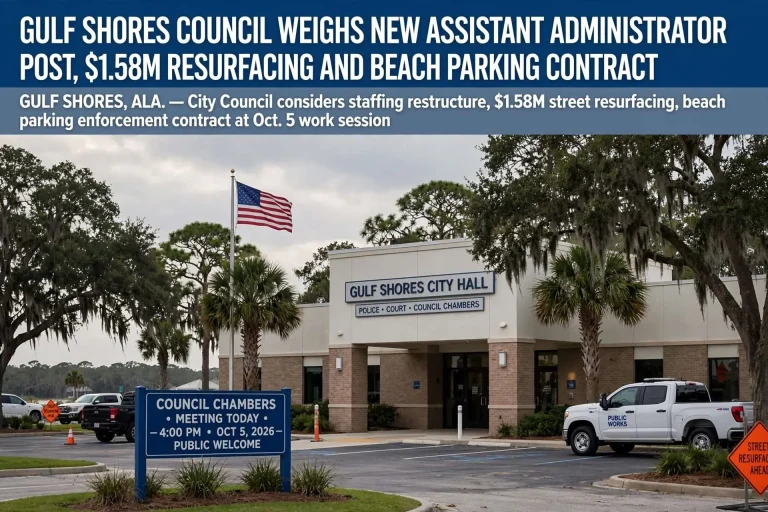
More details emerged from the City Council work session where the beach parking proposal was presented. Council member Jason Dyken presided as temporary chair because both the mayor and the mayor pro tem were absent.
Plate Readers and Outside Vendors
Under the plan presented by Police Chief Dan Netemeyer, the city would move from physical Hurricane Re-Entry stickers to a license plate exemption model enforced through third-party vendors and automated license plate readers. Resident exemptions would be tied directly to a vehicle’s plate and would remain valid for two years. Under the schedule in the council agenda, stickers would stop serving as beach parking passes after Dec. 31, 2026, with plate exemptions taking effect Jan. 1, 2027.
To support that enforcement, the proposed ordinance changes would require drivers to pull forward into beach parking spaces rather than back in, and would set formal fees for removing a vehicle boot.
Three Ways to Register
The city intends to offer several registration options. Residents would be able to upload a driver’s license and vehicle information through a digital portal, register in person at the Justice Center, or sign up at a mobile command bus the police department plans to bring to neighborhood events.
City officials said the goal is to make sure residents keep exclusive access to resident parking areas and receive full parking fee exemptions across the city. Council members said unauthorized parking by non-residents has been a persistent problem, noting that roughly 2,500 parking tickets had been issued as of March.
Part-Time Residents Push for Alternatives
Much of the public discussion centered on who should qualify. Resident exemptions are currently tied to a local driver’s license or vehicle registration. Part-time residents and property owners who live elsewhere asked the city for concessions or for other ways to prove their ties to Gulf Shores, such as tax records or utility bills, so they could use resident parking without paying daily fees.
City officials said the policy is aimed at full-time residents, but stressed that the work session format is intended to collect community feedback before any ordinance amendments are finalized.
Other Items Before the Council
- Police equipment: The council reviewed proposals for a Faro 3D camera system, at $75,300, for mapping crash and crime scenes, and an MVB 3x vehicle barrier system, at $205,000, for security at events.
- Kids Park reconstruction: Council members heard an update on a hybrid surfacing design that combines artificial turf with engineered wood fiber. Construction is planned for early 2027.
- Winter Entertainment Series: The series, marking its 40th anniversary, is moving to the city’s new Performing Arts Center.