

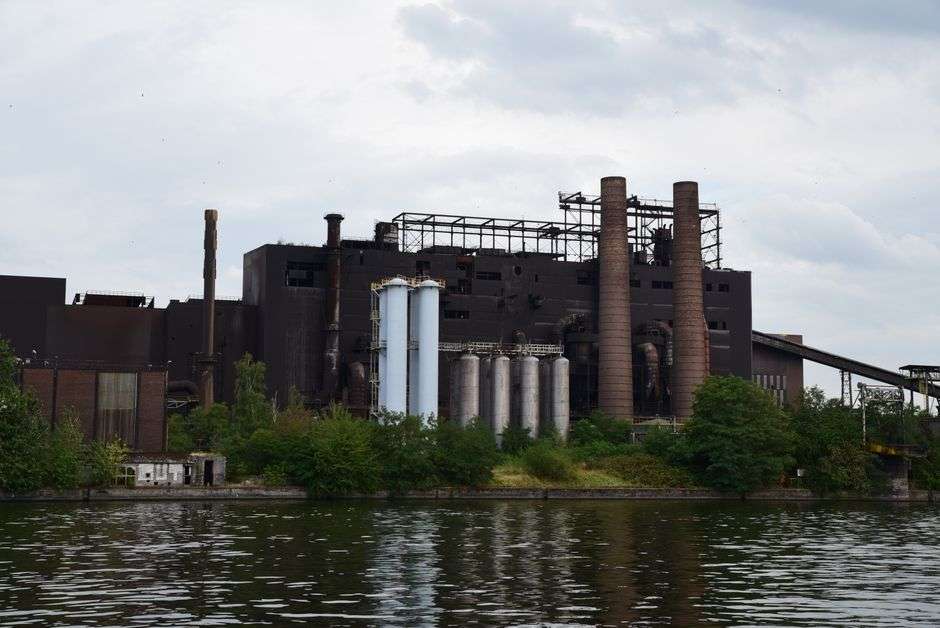
State regulators have set a public hearing later this month for residents to weigh in on Alabama Power’s plan to close the coal ash pond at Plant Barry, a sprawling earthen impoundment sitting in the Mobile River floodplain that holds more than 21 million tons of coal combustion waste.
The Alabama Department of Environmental Management will hold the hearing on Tuesday, March 30, at 6 p.m. at the Hampton Inn in Saraland.
Residents who cannot attend in person will also be able to submit written comments by mail or online during the public comment period, giving Mobile County residents multiple ways to weigh in on a decision that could shape the future of the site for decades.
What Alabama Power is proposing
At issue is how Alabama Power will permanently close the 600-acre pond, which sits along the Mobile River near Plant Barry. Under federal coal ash rules first put in place in 2015, utilities across the country have had to choose between excavating stored ash to lined, upland landfills or capping the material in place.
Alabama Power has applied to cap the ash where it sits, arguing that fully excavating and relocating the waste would take longer and cost significantly more than sealing it in place with modern safeguards.
Cap-in-place closure leaves the ash where it lies, covered with an engineered cap and monitored for groundwater contamination, while closure by excavation means digging out every ton of ash and hauling it to a lined landfill built on higher, drier ground. The federal rule permits both approaches, but each carries different long-term risks, and the choice has become the central fight in coal ash disputes across the Southeast.
The Mobile River floodplain setting makes Barry one of the highest-profile examples in the country. Few utility ash ponds anywhere sit on a floodplain of a major river in a hurricane-prone region, and the sheer volume stored at the site — more than 21 million tons — means the decision will define the landscape there for generations.
Opposition from Mobile Baykeeper
The plan has drawn sustained opposition from Mobile Baykeeper, a nonprofit focused on protecting local waterways, which has campaigned for months against leaving the ash along the riverbank.
The group points to the utility’s own groundwater monitoring data, which it says has repeatedly shown contamination exceeding legal limits, including arsenic readings far above the threshold allowed under state and federal standards.
Baykeeper has also raised concerns about the site’s exposure to flooding, noting that 2020 brought some of the highest river levels on record at Plant Barry, compounded by an unusually active Atlantic hurricane season that saw two storms make landfall along the Alabama coast.
The group argues that an unlined, riverside impoundment remains vulnerable in the event of a major flood or storm, and that the only sure protection for the Mobile River and Mobile Bay is to move the ash out of the floodplain altogether.
What the hearing will cover
The March 30 hearing at the Hampton Inn in Saraland is the formal opportunity for residents, environmental groups and other stakeholders to put their comments on the record before ADEM decides whether to approve Alabama Power’s closure plan.
Speakers at such hearings typically range from environmental advocates to neighboring property owners, fishermen and public officials, and the written comment period that runs alongside the hearing often draws hundreds of submissions. The record those comments create becomes part of the agency’s decision file, and it can matter in later legal challenges if opponents argue the agency failed to address their concerns.
For residents of Mobile County, the practical questions at stake include the safety of groundwater used near the site, the condition of the Mobile River and its tributaries, and the long-term stability of an impoundment holding one of the largest volumes of stored coal ash in the United States.
How coal ash closure rules work
The federal coal combustion residuals rule, adopted by the U.S. Environmental Protection Agency in 2015, set the first nationwide standards for ash ponds, requiring utilities to stop accepting new ash, close existing impoundments, install groundwater monitoring, and post compliance information publicly.
Under the rule, a utility may close a pond in place only if it installs a cap designed to keep water out, maintains the site after closure, and continues groundwater monitoring to detect any movement of contaminants. Closure by excavation, meanwhile, must move the ash to a permitted, lined landfill — a process that can take a decade or more at a site the size of Barry’s pond.
Utilities have generally chosen cap-in-place because it is faster and dramatically cheaper, while environmental advocates have pushed for excavation because it removes the material from contact with groundwater for good. Regulators in several Southeastern states have approved both approaches at different sites, and the resulting patchwork has left the question of which method is safest largely to public pressure, agency discretion and litigation.
Alabama’s own rules give ADEM authority to review and approve closure plans, and the agency’s decision on the Barry application will be based on the engineering details Alabama Power submitted — the cap design, the monitoring network, and the modeling of how groundwater behaves beneath and around the pond.
Plant Barry and the Mobile River
Plant Barry sits in north Mobile County near the Bucks community, on the banks of the Mobile River upstream of Mobile Bay. The plant is one of Alabama Power’s largest generating stations, and its ash pond is among the biggest coal ash impoundments in the nation, covering roughly 600 acres within sight of the river channel.
The Mobile River carries the flow of the Alabama, Tombigbee and Black Warrior river systems down to Mobile Bay, making it the drainage outlet for much of interior Alabama. Anything that reaches the river at Plant Barry moves downstream into the delta, the bay and, ultimately, the Gulf — a fact that underlies the concern environmental groups have expressed about leaving millions of tons of ash in that floodplain.
The 2020 flood season gave those concerns new force. Unusually heavy rainfall pushed river stages at Plant Barry to some of the highest levels on record, and the same year’s hurricane season delivered two landfalling storms on the Alabama coast, reminders of how quickly conditions at the site can change. Flooding of that kind does not necessarily damage an impoundment, but it tests the barriers between stored ash and the river, and it raises the cost of any failure.
The groundwater dispute
The sharpest disagreement between the utility and its critics concerns what the monitoring wells show. Utilities that own ash ponds are required to sample wells around the impoundment and report results for a set of indicator contaminants, including arsenic, boron, cobalt, lithium, molybdenum and sulfate.
Alabama Power’s data has, by Baykeeper’s account, shown repeated exceedances — readings above the thresholds that trigger corrective action requirements — with arsenic among the most serious. The utility has maintained that it is following the federal monitoring rules and that its closure plan addresses the conditions the data reveal.
That debate is precisely what the public comment process is designed to surface. ADEM’s engineers will review the monitoring record and the closure design together, and the agency’s approval or denial will turn on whether the proposed cap and monitoring program meet the state and federal standards in place when the application is decided.
What residents can do
The hearing on March 30 opens at 6 p.m. at the Hampton Inn in Saraland, and residents who wish to speak can register when they arrive. Comments made in person are recorded for the official file, and speakers are generally allotted a fixed amount of time each so the agency can hear from as many people as possible.
Residents who prefer not to attend can submit written comments by mail or through the agency’s online comment system during the public comment period. Written comments carry the same formal weight as testimony delivered in the room, and they allow residents to attach documents, studies and photographs they want the agency to consider.
For those who want to comment, useful points include specific concerns about flooding, groundwater quality, the proximity of the pond to the Mobile River, and any personal experience with the site. Comments that address the technical standards ADEM must apply carry more weight in the review than general expressions of support or opposition.
The decision and what follows
After the comment period closes, ADEM will evaluate the closure plan and issue a decision, a process that typically takes months. If the agency approves the cap-in-place application, opponents are expected to continue pressing the case through administrative appeals and litigation, as they have in other Southeastern states where similar plans were approved.
If the agency instead requires changes — a stronger cap, expanded monitoring, or conditions tied to flood protection — the utility would have to revise its plan before proceeding. Either outcome will be a landmark for the region, because no other Alabama ash pond approaches Barry’s size or its location on the Mobile River floodplain.
The long-term stakes are simple to state. More than 21 million tons of coal combustion waste will either remain in the floodplain behind an engineered cap, monitored for the rest of its existence, or be dug out and trucked to lined upland landfills over the course of many years. Mobile County residents have until the close of the comment period to tell the state which future they prefer.