

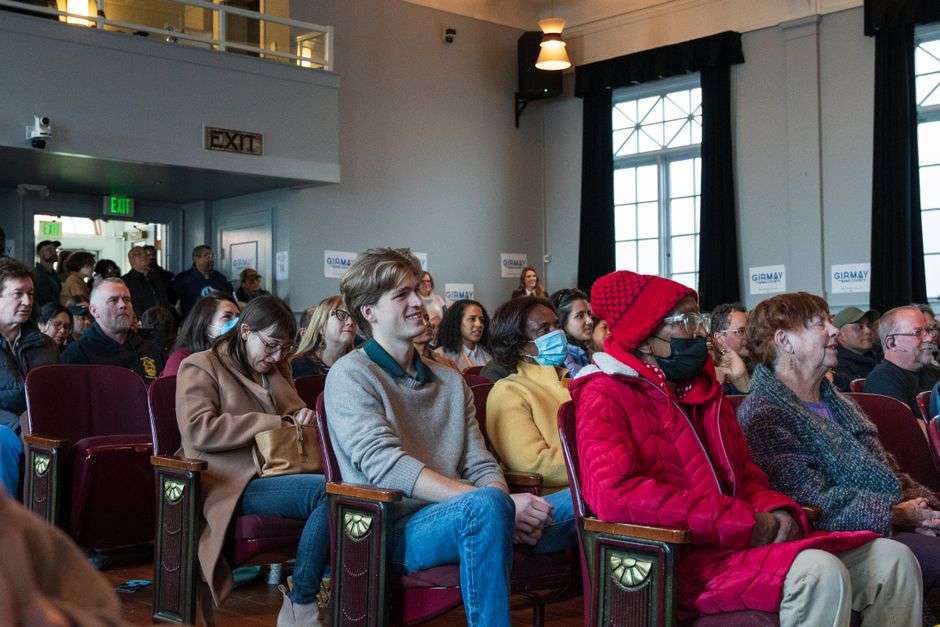
A state hearing on the future of one of the largest coal ash storage ponds in North America drew dozens of Mobile and Baldwin county residents to Saraland last week, where members of the public spent hours debating whether Alabama Power should be allowed to permanently cap the waste in place along the banks of the Mobile River. The Alabama Department of Environmental Management hosted the public hearing March 30 on Alabama Power's permit application to close its coal ash pond at Plant Barry using the cap-in-place method. Federal rules adopted by the Environmental Protection Agency in 2015 require utilities to remediate coal ash through one of two paths: capping the material where it sits or excavating it entirely and hauling it to a lined, upland landfill.
Roughly 21 million tons of coal ash sit in the pond at the North Mobile County plant, and Alabama Power has pursued the cap-in-place option at every one of its coal ash sites statewide. No elected officials attended the hearing to speak for or against the plan, leaving the debate to members of the public and representatives of community and industry groups. By the end of the evening, 33 speakers had voiced opposition to the application, 11 spoke in support, and four said they remained undecided. Supporters of the plan argued that capping the ash in place satisfies federal requirements and would ultimately prove safer for the surrounding community than digging up and trucking away the material.
Alabama Power has estimated that full excavation would require a daily convoy of roughly 200 trucks for 15 years, with much of that traffic passing through communities the company describes as already underserved. Opponents countered that ADEM has already fined Alabama Power over excessive groundwater contamination at the Plant Barry site and argued the utility has never conducted an independent analysis of whether the ash could feasibly be recycled or relocated. They also pointed to the company's coal ash pond at its former plant near Gadsden, which was capped in place in 2017 and has since shown continued leaching of arsenic and other toxic chemicals into groundwater.
Under the proposal now before regulators, Alabama Power would treat and dewater the existing 600-acre pond and consolidate the remaining ash into a smaller, 267-acre footprint, widening the buffer between the waste and the edge of the Mobile River. The plan also calls for a redundant dike system, additional flood-protection measures, a subsurface retaining wall around the consolidated ash, and new internal drainage and stormwater systems, with the entire footprint capped by a synthetic barrier. Statewide, Alabama Power's coal ash closure plans are projected to cost more than $3 billion, expenses the company has already begun passing on to ratepayers through rate increases, and the utility will be required to monitor groundwater at the site for at least three decades once closure is complete.
ADEM Director Lance LeFleur said in a statement announcing the hearing that state and federal rules leave the choice of closure method up to the utility, not the agency. "Federal and state rules leave that decision to the utility, and Alabama Power has chosen to cap in place," LeFleur said. "ADEM's role is to ensure those plans meet federal and state standards and provide the safeguards necessary to prevent spills and protect waterways and groundwater. The decision on whether to grant the permit will be driven by the data. We certainly welcome comments from the public, particularly as they relate to details of the plan. That's why we've extended the comment period to seven days past the public hearing.
Background and Context
We will evaluate all the comments and address all pertinent points." ADEM accepted written comments through 5 p.m. April 6, a week after the hearing. The agency said every comment received in person, by mail or by email will be reviewed and addressed as part of the official record before a final permit decision is made. Unlike many local government matters, the permit itself will not go before a public vote at a future meeting. Much of the opposition centered on the pond's location along an oxbow of the Mobile River, near the ecologically rich Mobile-Tensaw Delta. Casi Callaway of Mobile Baykeeper told the hearing that closing the pond while it remains in groundwater violates the federal Coal Combustion Residuals Rule.
"It cannot be done and there is no way to keep that coal ash from being re-wet because it is kept in groundwater," Callaway said. "We have an opportunity and responsibility to do the right thing." Cade Kistler, also with Mobile Baykeeper, argued the method has a poor track record. "Cap-in-place closure has thus far failed to stop ongoing groundwater pollution around the country and in Alabama," Kistler said. "In the best case, closure in place is not a solution — it's pushing the problem on someone else." Keith Johnston of the Southern Environmental Law Center told regulators the site should never have hosted a permanent waste facility in the first place. "This should never be the site of a permanent waste facility.
Especially one with known toxic pollution that Alabama Power cannot control," Johnston said. "ADEM would never permit a facility in an area like this today, but for the fact that the utility made the decision to put this there a long time ago." Several speakers connected the pond's location to broader concerns about equity and public health. Lella Lowe of the Mobile Environmental Justice Action Coalition said coal ash contamination of the river and nearby groundwater carries outsized risk for lower-income residents who rely on freshwater seafood and wild game. Luke Adams, a Mobile radiologist, told the hearing that in 22 years of practice he has seen numerous cancers he believes are linked to exposure from coal ash contamination.
Other Mobile County residents, including Arthur Gonzales, Jeremy Milling, Clint Martin, Glen Coffee, Benson O'Conner, Sam St. John and Jessie McDaniel, all urged ADEM to reject the application, citing the risk of a catastrophic spill into the Mobile River and Mobile Bay. Among the Mobile County residents who spoke against the plan was William T. Chambers, a minister and pastor in Creola who lives near the plant. Chambers told regulators he considers Alabama Power a good neighbor but still believes the ash needs to leave the site. "I think Plant Barry has been and is now a great corporate neighbor," Chambers said. "But that ash pond needs to be moved. We have a chance to avoid a catastrophic disaster before it happens.
We have an obligation to preserve the delta and the bay right now." Baldwin County residents also turned out in large numbers to oppose the plan, despite the hearing being held on the opposite side of Mobile Bay. Speakers including William Mitchell Cunningham Jr. of the Baldwin County Democratic Executive Committee, Tim Jones, James Pritchitt, Nicholas Williams, Lindsey Dixon of Spanish Fort, Scott Snyder of Daphne, Riva Fralik of the Fairhope Unitarian Fellowship Environmental Action Committee and Catherine Hastings of Fairhope Friends all raised concerns about the risk a spill would pose to the Mobile-Tensaw Delta, Mobile Bay's fishing and tourism economy, and the region's drinking water. Not every speaker took a side. Robert Kennedy Jr.
Background and Context
of Mobile asked ADEM to conduct additional analysis before finalizing a decision, saying he wanted to better understand both the cost to ratepayers and which option would truly minimize risk. Former Mobile County Commissioner Stephen Nodine noted the absence of elected officials at the hearing and said he hoped for a compromise, while Lee Barron III of the MOWA Band of Choctaw Indians and Rhoda Vanderhart of Mobile both said they had not yet settled on a position. Supporters of the cap-in-place plan largely represented business, labor and industry interests. Wiley Blankenship of the Coastal Alabama Partnership said his organization had studied the issue closely and backed the EPA-approved method, arguing removal would create greater risk through decades of trucking.
Patrick Cagle of the Alabama Mining Association and David Rodgers of the Mobile Area Chamber of Commerce both cited Alabama Power's long history in the region, while Blake Hardwich of the Energy Institute of Alabama said more than half of the coal ash closed in place across the South has been handled safely using the method. Rickey Kornegay of the Alabama AFL-CIO and Allen Henry of the Coosa-Alabama River Improvement Association both said they trusted the utility's engineering and safety record, and Jennifer Denson of Partners for Environmental Process, Jonathan Hale of Prospect Mining, Larry Marrihew of the Warrior Tombigbee Waterway Association and Seth Hammett of the Energy Institute of Alabama echoed similar support.
The Plant Barry hearing was one of several ADEM held around the state as the agency works through Alabama Power's coal ash closure applications at multiple sites. Because the permit will not go before a public vote, ADEM's written response to the comment period is expected to be the next public step in the process before a final determination is issued.
Local Context
Stories like this one reflect the everyday rhythms of life in coastal Alabama, where local government decisions and community developments tend to draw close attention from residents across Mobile, Baldwin and the surrounding counties. Public meetings, council work sessions and neighborhood gatherings often become the venues where the practical implications of these issues get worked out, with stakeholders ranging from city staff to ordinary residents weighing in on how decisions will affect their daily routines. Local news outlets play a critical role in tracking these conversations and ensuring that the public record reflects what is being said and decided. Continued coverage and community engagement are essential to keeping the conversation grounded in the lived experience of the people most directly affected by the outcomes.