Alabama Coastal Foundation Hiring Outreach Coordinator, Recruiting Water Festival Volunteers
The Alabama Coastal Foundation is hiring an outreach coordinator and seeking volunteers for its Mobile and Baldwin County Water Festivals.
The Alabama Coastal Foundation is looking to fill a new outreach coordinator position while also lining up volunteers for its annual Water Festivals in Mobile and Baldwin counties, events that give hundreds of local fourth-graders hands-on lessons in watershed science. The dual push — hiring for a permanent staff role and recruiting for a signature education program — marks a busy stretch for the coastal nonprofit, which has spent decades building volunteer networks to improve stewardship of Mobile Bay and the Gulf waters beyond it.
The coastal nonprofit’s new hire will take on both external affairs and volunteer management, overseeing recruitment, engagement and deployment of the organization’s volunteer base. In practice, that means the coordinator will be the connective tissue between the foundation and the hundreds of Coastal Alabama residents who show up for its cleanups, festivals and restoration events each year — recruiting them, keeping them engaged and putting their skills where the calendar needs them. The role also folds in the foundation’s public-facing communications, from website upkeep to social media outreach.
The foundation is looking for a candidate with a bachelor’s degree and at least five years of experience organizing volunteers, maintaining websites and managing social media accounts. The combined requirement reflects how a small nonprofit operates: at an organization the size of the Alabama Coastal Foundation, outreach, communications and volunteer coordination are one job, not three, and the person filling it moves between a planning meeting, a Facebook post and a festival site map in the same afternoon.
How to Apply
A full job description outlining additional requirements is available through the foundation. Interested applicants are asked to send a cover letter, resume and contact information for three professional references to the foundation’s executive director, Mark Berte, ahead of the application deadline. The process is deliberately straightforward — no portal, no login — and foundation staff have indicated they want candidates who can demonstrate real volunteer-management results rather than simply list them.
For job seekers on the Gulf Coast, the position sits at an intersection of growing regional importance. Environmental nonprofit work along the Alabama coast expanded substantially after the Deepwater Horizon disaster, when restoration funding flowed into organizations working on coastal habitat, water quality and community education. Organizations like the foundation now run year-round programs — oyster restoration, water quality monitoring, dune plantings and school outreach — that employ a professional class of coastal conservation staff and depend on trained volunteers for scale.
The outreach coordinator role carries particular weight because volunteers are the foundation’s operating muscle. Coastal cleanups, habitat plantings and education festivals are all labor events: a single festival morning takes dozens of station leaders and guides, and a large cleanup can involve hundreds of participants. Whoever fills the job will own the systems that keep those people returning — the emails, the schedules, the recognition and the follow-up that turn a one-time volunteer into a recurring one.
The Water Festivals
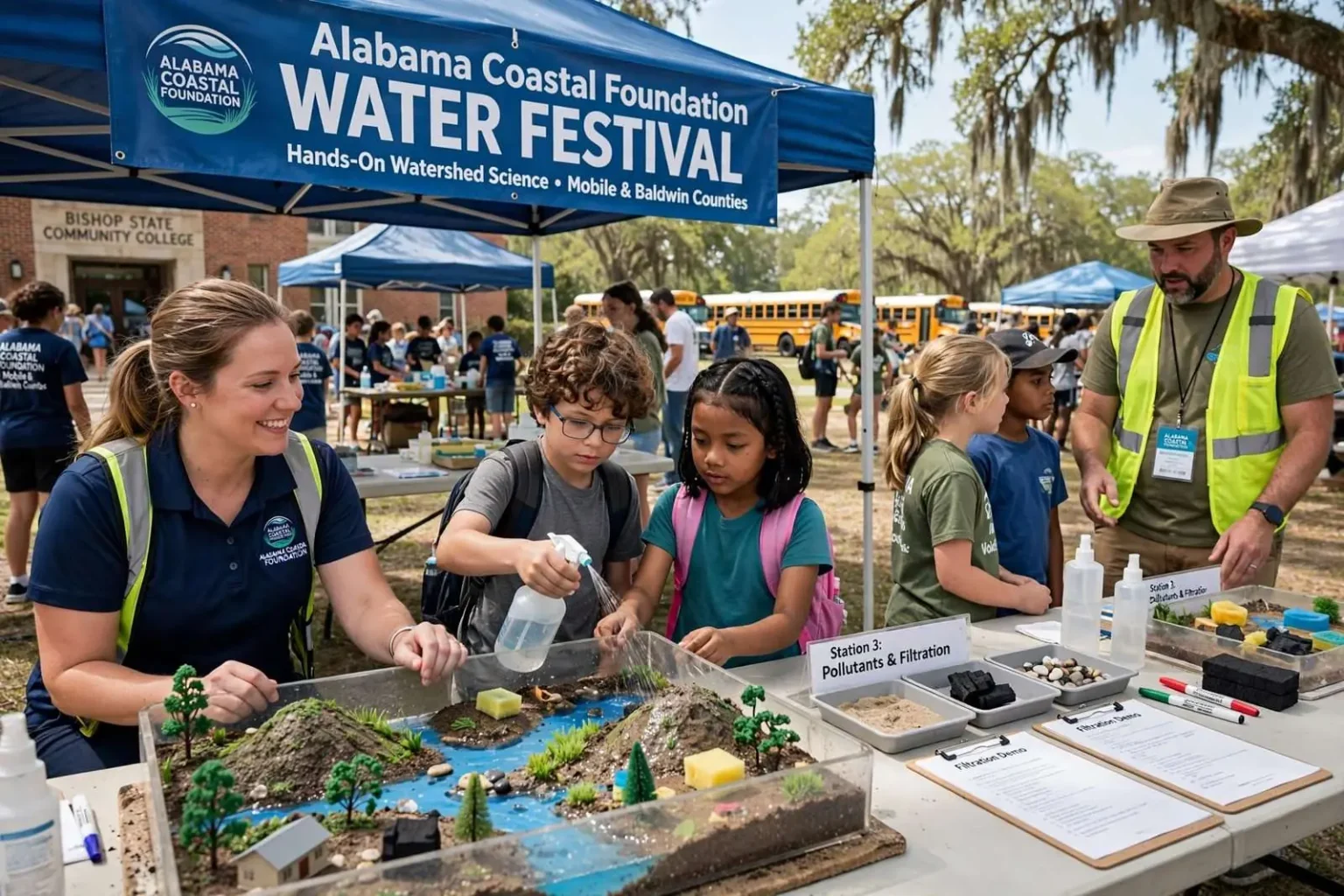
While the hiring search continues, the foundation is also recruiting volunteers for its upcoming Water Festivals, a longstanding educational program that brings local elementary students out for a day of interactive learning about coastal ecosystems. Fourth-graders from around the region rotate through stations where they build model watersheds and examine water pollutants and filtration processes firsthand. The festival model takes abstract textbook concepts — drainage, runoff, groundwater — and makes them physical, letting students shape a landscape out of spray bottles and sponges and watch where the water actually goes.
The timing and locations are set. The Mobile County festival is scheduled to run from 7:30 a.m. to 1 p.m. at Bishop State Community College on North Broad Street in Mobile. A day later, the Baldwin County festival will be held at the Robertsdale Coliseum on Fairgrounds Road, also running from 7:30 a.m. to 1 p.m. Both venues are established civic anchors — Bishop State’s campus sits in central Mobile, and the Robertsdale Coliseum anchors the central Baldwin County fairgrounds — with the indoor space and parking that a few hundred schoolchildren, buses and activity stations require.
Schools across both counties bus in their fourth-grade classes for the morning, and the festival’s early start is built around school schedules: students arrive at 7:30, rotate through stations with their groups, and are back on buses by early afternoon. Teachers receive materials that tie the festival’s activities to classroom science standards, which is a large part of why the program has endured — it counts as instruction, not just a field trip.
The Alabama Coastal Foundation relies heavily on community volunteers to staff the festival stations, guide student groups between activities and help set up and break down the events. Station volunteers get a script and training before the students arrive, so no science background is required — the program’s planners have learned that engaged adults who can run a demonstration matter more than experts who cannot manage a crowd of ten-year-olds. Setup and teardown crews handle the physical work of moving tables, tarps, water jugs and model materials between the two county venues on consecutive days.
Why Watershed Education Matters Here
The lessons the festivals teach have direct local stakes. The Mobile Bay watershed is among the largest river basins emptying into the Gulf of Mexico, drawing water from a vast share of Alabama and parts of neighboring states before it empties into the bay just south of the city. Everything that runs off a Mobile County street or a Baldwin County farm field ultimately moves through that system, which means water quality along the coast is decided far inland — and by the everyday choices of the people who live there. Teaching that connection to fourth-graders, before habits form, is the program’s underlying bet.
The festivals have become an annual rite of spring for many South Alabama elementary schools, giving students in Mobile and Baldwin counties an early introduction to coastal science that many go on to revisit in middle and high school programs. Organizers point to the festival’s reach: hundreds of students per county per year, and a generation of coastal residents who can trace their first watershed lesson to a station table at Bishop State or the Robertsdale Coliseum. For a region whose economy runs on fisheries, beaches and the bay, that early literacy in how water moves is not a luxury — it is the long game of coastal stewardship, played out one school morning at a time.
Volunteers interested in either the festivals or the foundation’s year-round programs can sign up through the organization, and no prior experience is required for most roles. The festivals’ consecutive-day, two-county format means volunteers can give one morning or both, and corporate groups from the coast’s banks, shipbuilders and tourism businesses have made festival staffing a recurring service day. For the foundation, every volunteer who signs up serves the same purpose the new outreach coordinator will institutionalize: a coastal community learning to take care of its own water, one class of fourth-graders and one Saturday morning at a time.
The Foundation’s Role on the Coast
The Alabama Coastal Foundation has grown from a small grassroots effort into one of the region’s most visible environmental organizations, with programs that span education, habitat restoration and community engagement across both coastal counties. Its annual calendar is crowded by design: oyster shell recycling and reef restoration work, coastal cleanups that mobilize hundreds of volunteers, business sustainability councils that bring the coast’s employers into conservation conversations, and the school programs that anchor its education mission. The through-line is the organization’s bet that coastal stewardship succeeds only when the people who live here see themselves as its owners.
That philosophy explains why the new coordinator position blends external affairs with volunteer management rather than separating them. The foundation’s model treats every volunteer, donor and festival attendee as a potential advocate, and communications are the tool that converts participation into commitment. Managing that pipeline — from a first cleanup signup to a regular who brings a boat to the next event — is exactly the work the position is designed to professionalize.
The nonprofit’s partners reflect the breadth of the coastal economy. Utilities, port interests, tourism businesses, shipbuilders and local governments all appear in its program support, because the health of Mobile Bay touches every one of their bottom lines. Water quality problems that begin inland show up as closures on the bay’s oyster beds, advisories on its swimming beaches and losses at its fish docks — costs that land on businesses and households that never touched a drop of the pollution themselves. Programs like the Water Festivals are the preventive end of that equation.
For prospective applicants, the position offers a rare combination on the Gulf Coast: a permanent staff role with genuine authority, a mission with visible local results, and a volunteer community already organized and waiting to be led. For the foundation, the hire closes a gap between the programs it runs and the people power they require — and for the fourth-graders cycling through stations at Bishop State and the Robertsdale Coliseum this year, the new coordinator’s work will be the reason the stations are staffed, the buses run on time and the water goes where the models say it should.