School Boards Challenge Later Start Date Tied to Beach Tourism
Alabama school board leaders pushed back on proposals to delay the school start date to late August as a tourism boost, arguing the underlying revenue study was unreliable, especially with the Gulf oil spill battering the coast.
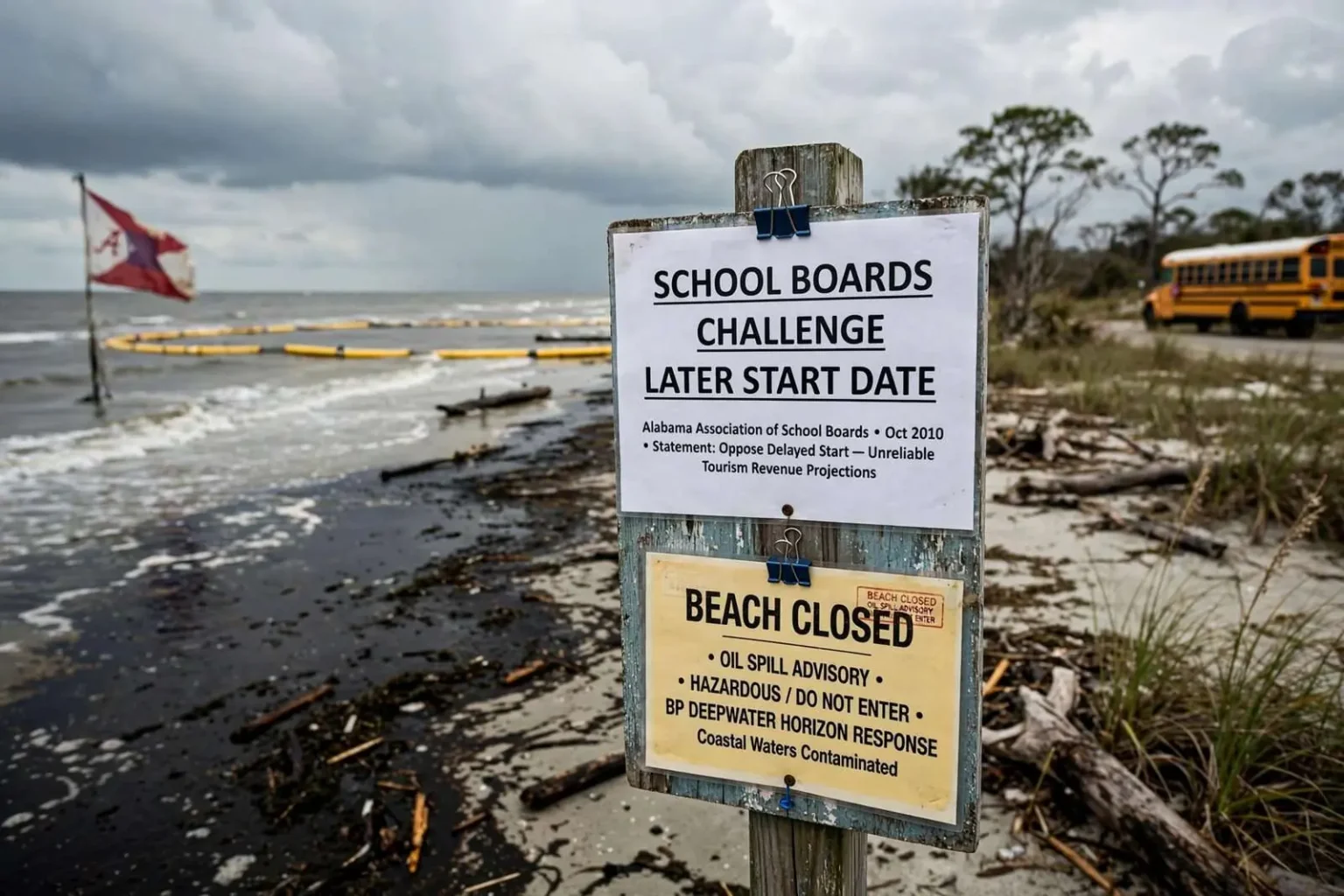
School board leaders across Alabama pushed back this week on proposals to delay the start of the school year until late August as a way to generate additional tourism revenue for education, arguing that the numbers behind the idea were unreliable, especially with the Gulf oil spill hammering the coast. The dispute placed the state’s education establishment against a tourism industry-backed study, and it unfolded against the backdrop of the worst environmental disaster in American history washing onto Alabama’s beaches.
A study under fire
Sally Howell, executive director of the Alabama Association of School Boards, took direct aim at a 2009 study that claimed the state could reap millions of dollars by pushing the school calendar later so families and visitors could spend more of August at the beach.
“The 2009 study claiming Alabama could reap millions by starting school later reads a lot like BP’s disaster recovery plan,” Howell said. “It is full of gaps, guesses and errors, not to mention its assumptions were made before the economic downturn and largest environmental disaster in U.S. history. Those assumptions are as damaged as Alabama’s waters and coastlines. If we go down this path and budget phantom numbers, we’ll be in proration. That’s the last thing schools can afford.”
Howell urged legislative leaders to replace the outdated, tourism-sponsored study with a reliable, thorough and current cost-benefit analysis before any calendar mandate moved forward. “We need to look at all revenue options and the educational impact on students and families,” she said, “but the premise that we can get more people to our ravaged beaches than came when they were in optimal condition is faulty at best.”
The oil spill factor
The timing of the debate was impossible to separate from the crisis unfolding in the Gulf of Mexico. The Deepwater Horizon spill had fouled beaches and scared off visitors through the height of the summer season, and tourism officials were already reporting declines along the coast. Yet the tourism study claimed revenue gains premised on an increase in beachgoers — a premise that the summer of 2010 had decisively undercut.
Howell warned that schools were facing an economic crisis expected to intensify in 2011 and 2012, and that the disaster had only made matters worse. “The BP situation has served only to hasten and deepen that crisis,” she said. She added that she hoped and prayed the Gulf Coast would recover quickly and tourism would rebound, separating her disagreement over the calendar from any wish for the coast’s economy to fail.
The stakes for school budgets were concrete. Alabama’s education funding had already been squeezed by the recession, with proration — the state’s mechanism for mid-year budget cuts — familiar to every superintendent in the state. A calendar change built on revenue projections that collapsed with the tourism season would leave school systems planning around dollars that never arrived, a scenario Howell characterized as budgeting phantom numbers.
The calendar math
Beyond the revenue questions, Howell pointed to a practical flaw in the logic of a later start: schools that begin later also end later. “What you gain in August, you lose in June,” she said, noting that regardless of start and stop dates, students are required to spend 180 days in school each year. The total instructional calendar does not expand with a later start date; it simply shifts across the summer months, moving classroom time from June — when Alabama’s beaches are warm and crowded — into August, when families are already shopping for school supplies and adjusting to earlier bedtimes.
“We aren’t creating more time for more vacations,” Howell said. “Families fortunate to enjoy a beach vacation usually can only afford one per year. Most folks don’t take a second vacation just because school starts later in August.” The argument cut at the study’s core assumption that a longer August would translate into additional tourist trips rather than simply reshuffling the timing of vacations families were already taking.
An old campaign in new clothes
She characterized the renewed push as an old campaign dressed in new clothes. “It is unfortunate and ill-conceived that the tourism and summer camp industries are using the current crisis to repackage their age-old attempt to set the school calendar based on purported benefits to schools,” Howell remarked. The fight over Alabama’s school start date had flared repeatedly over the preceding years, with tourism interests arguing that a post-Labor Day start would extend the summer season, and education leaders countering that the decision belonged to local school boards weighing instructional priorities.
For South Alabama, the stakes were especially close to home. The region’s schools depended on the same state education budget that the calendar proposal claimed to bolster, and its beaches were the very shores the spill had put at risk. Baldwin County’s school system — one of the largest in the state, sprawling across the county that includes Gulf Shores, Orange Beach and the eastern shore of Mobile Bay — lived at the intersection of both sides of the debate: its classrooms served the coast’s children, and its economy served the coast’s visitors.
Howell’s argument, in essence, was that betting the school calendar on a tourism rebound that had not materialized, and might not for some time, risked leaving classrooms shortchanged. She called instead for a clear-eyed accounting of the costs and benefits before any change was written into law, including the effects on students, teachers and families who structured their lives around the school year.
What a later start would actually change
The debate over school start dates has a long footprint across the South, where coastal and theme-park states have periodically revisited their calendars under pressure from the tourism industry. Supporters of later starts argue that August beach visits represent tourism revenue currently lost to the classroom, and that families would extend summer trips if school resumed after Labor Day. Opponents answer with the instructional argument Howell pressed: the 180-day requirement is fixed, so a later start compresses the spring semester, pushes semester exams past the winter holidays or into late May, and complicates dual-enrollment schedules, athletics calendars and summer employment for older students.
School boards in Alabama had historically guarded the authority to set their own calendars, and any statewide mandate on the start date would remove that local control. For the Alabama Association of School Boards, that made the revenue argument doubly objectionable — not only were the projections unreliable, but the mechanism would override the judgment of locally elected boards on behalf of an industry-sponsored study.
The oil spill added an element no calendar could fix. Even a post-Labor Day start in 2010 could not conjure visitors to beaches that had been closed by oil advisories for weeks of the traditional summer season, and businesses along the coast were seeking compensation and recovery support rather than calendar adjustments. Howell’s comment about “ravaged beaches” pointed directly at that reality: the study’s growth assumptions predated both the recession and the spill, and neither force had finished working its way through the regional economy by the time the debate resumed.
Proration and the education budget squeeze
The backdrop to Howell’s warning was a state education budget in retreat. Alabama funds its schools primarily through the Education Trust Fund, fed by sales tax and income tax collections that track the economy closely, and the recession that began in 2008 had already forced mid-year cuts across multiple fiscal years. Proration — the across-the-board reduction of allocated funds when revenues fall short — had become a recurring headache for superintendents, forcing late-year trims to staffing, transportation and instructional budgets after systems had already committed their spending plans.
Against that reality, the promise of new tourism tax revenue carried a double appeal and a double risk. If the projections were right, a longer beach season could send additional lodging and sales tax dollars into the Education Trust Fund and ease the pressure. If the projections were wrong — as Howell argued they were — the state would have traded local calendar control for a revenue stream that existed only on paper, while schools absorbed yet another round of proration without the political cover of knowing why.
Her reference to “phantom numbers” went to that point directly. Budgeting on projections that predated both the downturn and the spill meant the Legislature would be writing checks against assumptions that had been overtaken by events. The 2009 study’s models could not have accounted for images of oil-tinged surf on national news, beach advisories closing swimming areas, or the cancellation of charter fishing trips that anchor much of the coastal economy.
The coast’s recovery question
Howell was careful to separate her argument from the coast’s fortunes. She hoped and prayed, she said, for a quick recovery and a tourism rebound — and the distinction mattered politically, because school boards along the coast were themselves among the region’s largest employers and depended on a healthy local economy. The dispute was never about whether tourism mattered to Alabama; it was about whether a school calendar built on a disputed study could deliver the promised gains.
The summer of 2010 offered a natural experiment of sorts, and it pointed the other way. With beaches fouled or feared fouled, coastal communities saw visitors cancel reservations across the season, and state tourism officials pivoted to marketing campaigns urging travelers to return. The idea that a later school start would have meaningfully offset that collapse — that families deterred by oil advisories would have been drawn back by an extra three weeks of August — strained credulity, and Howell pressed that point repeatedly.
For school leaders, the episode became a case study in how education policy gets made under pressure. A study sponsored by the industry that stands to benefit, deployed during a crisis that its assumptions could not survive, and aimed at a mandate that would strip calendar decisions from locally elected boards — that combination, in Howell’s telling, deserved scrutiny rather than passage. Her call for a current, independent cost-benefit analysis remained the association’s position: if the case for a later start could be made honestly, with reliable numbers and full accounting of the educational effects, then legislators and school boards could weigh it. What schools could not afford, in a season of proration and disaster, was to budget on guesses.