Alabama Supreme Court Ruling Shields Police Body Camera Footage in Baldwin County Shooting Case
A new Alabama Supreme Court ruling allows police body camera footage to be withheld as "investigative materials," a decision rooted in a Baldwin County deputy's 2017 shooting of an unarmed man and Chief Justice Tom Parker's sharp dissent.
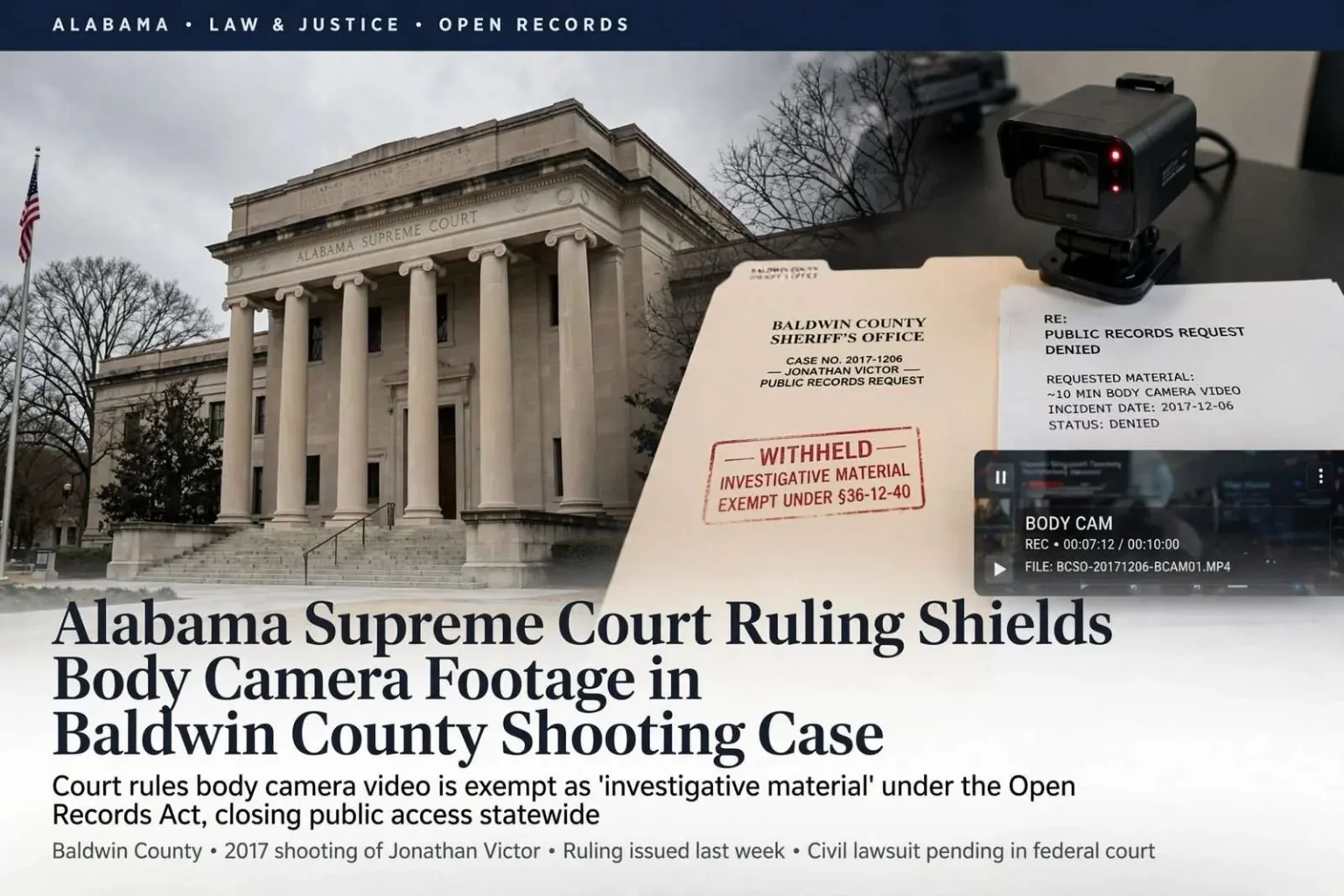
A ruling from the Alabama Supreme Court has closed off public access to police body camera footage statewide, stemming from a records fight tied to a 2017 shooting by a Baldwin County Sheriff’s Office deputy. The decision, issued last week, found that body camera video can be withheld under the state’s Open Records Act as “investigative materials,” a category previously understood to cover the work product of an investigation rather than the underlying recordings themselves.
The case traces back to the shooting of Jonathan Victor, an unarmed man who had run off Interstate 10 in 2017 before being shot multiple times by Baldwin County Sheriff’s Deputy Matt Hunady. A public records request seeking roughly ten minutes of body camera footage from the moments leading up to the shooting was denied by the Baldwin County Sheriff’s Office, touching off a legal battle that ultimately reached the state’s highest court.
In its 52-page opinion, the majority concluded that body camera recordings fall within the Open Records Act’s exemption for investigative materials, reasoning that the footage was used by the Baldwin County Major Crimes Unit in its review that cleared Hunady of wrongdoing. Under the prior understanding of that exemption, investigative materials referred to work generated by investigators, such as reports and analysis, rather than the raw evidence being examined. Critics of the ruling say the court’s interpretation effectively extends that exemption to cover nearly anything captured by law enforcement cameras, since departments can point to almost any recording as having been reviewed as part of some investigation.
Chief Justice Tom Parker dissented from the majority, warning that the decision would gut the practical value of the state’s public records law as applied to law enforcement agencies. In his dissent, Parker wrote that “the sweep of these pronouncements is breathtaking,” adding that “all evidence in the possession of law enforcement agencies, whether created by the agency or received from others, is now exempt from citizens’ statutory right to access public records.” He went on to write that, as to law enforcement records connected to an investigation, “the statute might as well be titled the Closed Records Act.”
Parker’s own record on public records requests is mixed. His office has previously denied requests seeking contractual and financial information detailing the relationship between the state and ALACOURT, the private vendor that operates Alabama’s online court records system. That history has left some records advocates skeptical that the dissent signals a broader shift on the court toward greater openness, even as they welcomed his objection in the body camera case.
The footage and other records from the Victor shooting did eventually surface, not through the state’s open records process but after they were entered as evidence in a federal civil rights lawsuit filed by Victor’s family against Sheriff Huey “Hoss” Mack and Deputy Hunady. That footage showed confusion among 911 dispatchers and responding officers over whether Victor was armed. According to the video, Hunady exited his vehicle, retrieved his rifle and took a position behind a fire truck, and he and other deputies waited several minutes without confirming whether Victor actually had a weapon before the shooting occurred.
U.S. District Court Judge William Cassady, in denying Mack and Hunady’s request for qualified immunity in the federal case earlier this year, wrote that “a reasonable finder of fact could conclude from this video that Victor did not take aggressive action toward Deputy Hunady or anyone else, and that he did not punch out his arms in a shooter stance.” Cassady also noted that no witness had reported Victor was definitively armed, only that he was “possibly” armed.
Questions have also been raised about how the shooting was characterized publicly in its aftermath. When Sheriff Mack, District Attorney Bob Wilters and the Major Crimes Unit held a press conference months after the shooting to announce that Hunady had been cleared, they showed only a limited, curated portion of the body camera video. Investigators at that briefing also told reporters that Victor had ketamine in his system at the time of the shooting, a detail that left the impression the drug played a role in his behavior. The ketamine, however, had been administered by paramedics attempting to save Victor’s life after he was shot, not before.
The ruling arrives at a moment when law enforcement agencies across Alabama, including in Baldwin County, have spent significant public funds equipping officers with body cameras, often citing accountability and transparency as the justification. Open government advocates argue the decision undercuts that rationale by ensuring footage of controversial encounters, including shootings, can be withheld from the public indefinitely, regardless of what it might show.
The decision does not affect footage that becomes part of the public record through other means, such as evidence introduced in open court or civil litigation, as occurred in the Victor case. But absent a change to the Open Records Act by the Alabama Legislature, records advocates say the ruling leaves few avenues for the public or media to routinely obtain body camera footage of police encounters with civilians, particularly in the immediate aftermath of an incident when public scrutiny tends to be highest.
The civil lawsuit filed by Victor’s family against Mack and Hunady remains pending in federal court following the denial of qualified immunity.
About the Open Records Act
Alabama’s Open Records Act, Section 36-12-40 of the state code, gives every citizen the right to inspect and take a copy of any public writing of the state unless a statute expressly provides otherwise. Many of the exceptions applied to law enforcement records, including the one for investigative materials, were developed by Alabama courts rather than written into the statute itself.