Alabama Is Growing Timber Faster Than It Cuts It, Retired Foresters Tell Clarke County Historical Society
Two retired foresters told the Clarke County Historical Society that softwood and hardwood growth still outpace harvesting statewide — even as an oversupply has triggered a painful market collapse.
GROVE HILL — Clarke County and the rest of Alabama are growing timber faster than it is being cut, thanks to the state’s long investment in forestry, two retired foresters told the Clarke County Historical Society on Sunday.
That is the good news. The complication is that the same abundance has helped trigger a serious market collapse.
An Oversupply With Consequences
In March, the major Domtar mill in Talladega County closed after 75 years, eliminating 285 jobs. The mill produced newsprint in recent years and carried an estimated economic impact of $569 million.
That closure illustrates the paradox at the center of the presentation. A forest resource that regenerates faster than it is consumed is a long-term asset, but in the short term an oversupply depresses prices for landowners and squeezes the mills that buy from them. When a mill closes, the landowners within its haul radius lose a buyer, and the local timber market weakens further.
Thirteen Buyers Within 70 Miles
Steve Crowley, formerly with Scotch Land Management, recapped the importance of the forestry industry in the Clarke County area, noting that there are 13 major consumers of timber within a 70-mile radius of Grove Hill — including sawmills, paper mills and other wood products manufacturers.
That concentration is what makes Clarke County a genuine timber economy rather than simply a place where trees grow. Timber is heavy and low-value per ton relative to its bulk, which means hauling distance is one of the primary determinants of whether a stand is economical to harvest at all. A landowner with a dozen buyers inside a 70-mile radius is in a fundamentally different position than one with a single mill at the edge of a haul range.
Crowley stressed that the industry has been the main economic driver and the biggest provider of jobs in both the county and the state.
How the Industry Came South
Crowley credited both the physical environment and the political environment as conducive to the success of Alabama’s timber industry.
In the early to mid 1800s, timber was the main source of wood for homebuilding. As forests in the Northeast and Midwest were depleted, timbermen turned their attention to the South, where sawmills were constructed and logging began on a commercial scale.
The state’s formal response came in 1923, when Alabama created a commission of forestry. The vision even then was long-range: to plant, and to “leave the land in better shape than we found it,” said Benji Elmore, formerly of the Alabama Forestry Commission.
The Numbers on Growth
Crowley and Elmore closed their presentation with graphs showing that both softwood and hardwood growth continue to outpace harvesting.
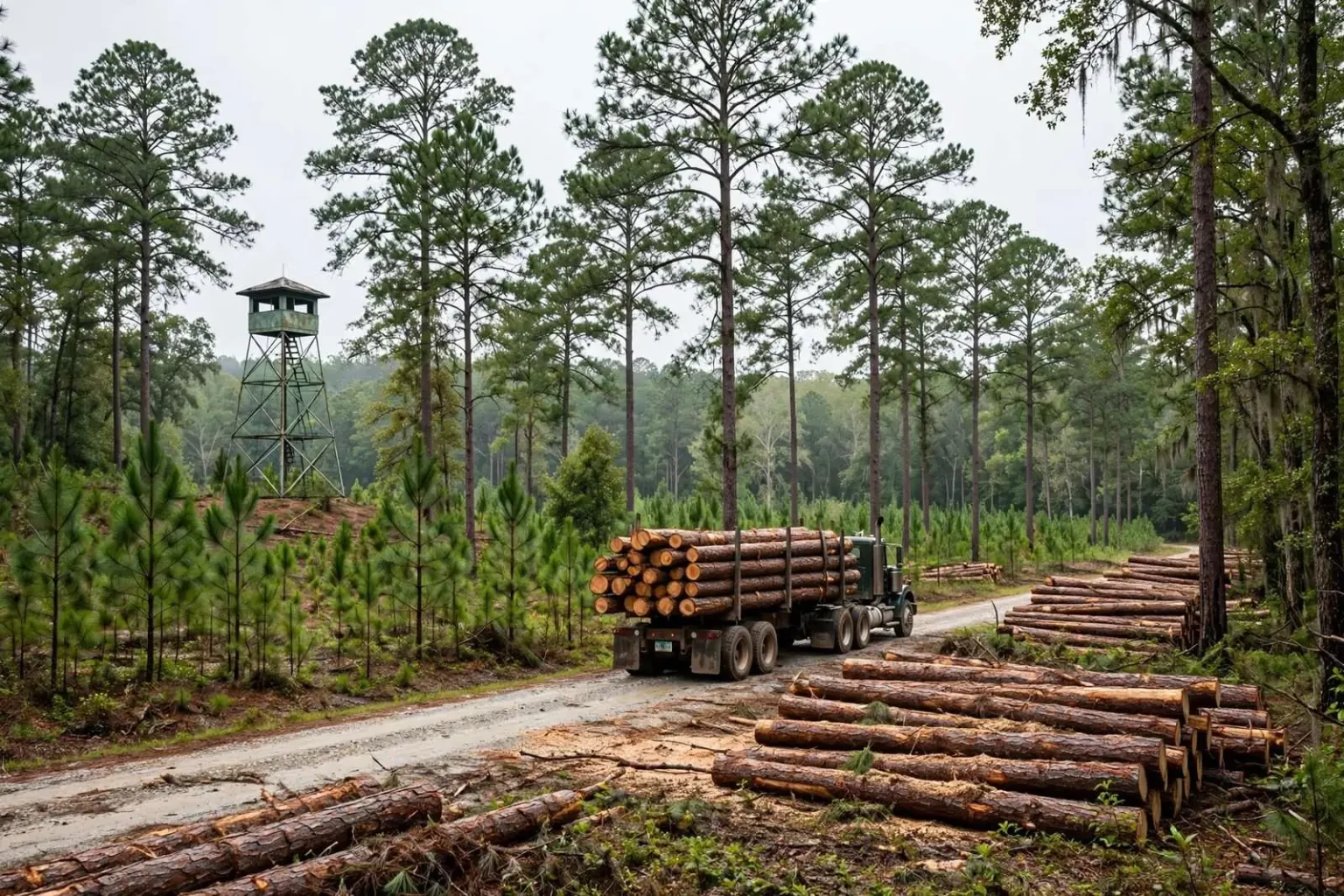
Elmore said the visual evidence people encounter on the road tends to point them toward the opposite conclusion. Residents see loaded log trucks running up and down the highway and worry that all the timber is being cut.
“We are still growing a lot more than we are cutting,” he said.
The disconnect is a matter of what is visible. Harvesting is concentrated, loud and moves on public roads. Growth is diffuse, silent and happens on private land out of public view. A person can watch dozens of log trucks pass in a week and never see the far larger volume of standing timber putting on wood across the same landscape.
Fire Prevention as the Other Half of the Story
One of the Alabama Forestry Commission’s main focuses is fire prevention, and Elmore presented figures that show the scale of the change.
In 1923 — the year the commission was created — more than 12,000 fires destroyed eight million acres in the state. By 2018, that had fallen to 967 fires and 11,312 acres burned.
“It shows how (the AFC) has made an impact getting the fires put out,” Elmore said.
The magnitude of that reduction is easy to skim past. Eight million acres burned in a single year is a landscape-scale loss; 11,312 acres is a rounding error by comparison. Fire suppression is a substantial part of why Alabama has a growing timber inventory at all — trees that are not lost to wildfire keep accumulating volume year after year.
Fire Towers and the Osborne Fire Finder
Fire towers were one of the primary methods of detecting forest fires in the early years. At one time, towers stood on the Scotch preserve in New Prospect, and at Grove Hill, Thomasville, Perry’s Chapel and McVay, according to Elmore.
Elmore and Crowley showed and explained an Osborne fire finder — a sighting device dating to about 1911 that allowed fires to be pinpointed from towers in the era before satellite imaging and other technologies. The instrument works by letting an observer sight a smoke column and read off a precise bearing; readings from two towers, cross-referenced, locate the fire.
A Personal Memory From the Towers
Virginia Harrigan, the widow of Scotch Lumber Co. co-owner Dwight Harrigan, grew up near Natchez, Miss., and remembered her grandmother staffing a tower.
Harrigan would take her toys and a lunch and trudge with her grandmother to the top of a tower, spending the day looking for fires.
The detail captures what tower duty actually was: long, largely uneventful hours of watching a horizon, staffed by ordinary people in rural communities, for the sake of catching a smoke column early enough to matter.
What the Presentation Adds Up To
Taken together, the two foresters described an industry with a strong long-term resource position and an immediate market problem. The forests are healthier and larger than they have been in generations, and the systems built to protect them — planting, professional management and fire suppression — have worked.
The pressure now is on the demand side. A mill closure of Domtar’s scale removes a substantial buyer from the state’s market, and it is the buyers, not the trees, that determine what a Clarke County landowner receives for a stand of pine.