Ameri’ca Tickle’s Fairhope: Public Art, Welded Steel and a Childhood on Mobile Bay
Fairhope artist Ameri'ca Tickle welds, paints and prints Mobile Bay memories into public art, murals and textiles. Meet the fifth-generation coastal artist.
The name on the door is unusual; the family history behind it is not unusual at all — for coastal Alabama. Ameri’ca Tickle is a fifth-generation member of the Allegri family, which settled in the Daphne area in the late 1800s. The first of them, Cipriano, came from Italy and worked as a produce broker in Chicago, saving enough to sail home, gather his family, and bring them to America. Their firstborn son was named Americo, for the country that took them in; the feminine Italian form, Ameri’ca, went to her.
That’s about as grounded as a coastal artist’s origin story gets — and Tickle’s art has spent her whole career turning that grounding into metal, clay, paint, fabric and public art across the Eastern Shore.
From Bayside to SCAD, by Way of a Welding Machine
Tickle grew up on the bay, the daughter of a father who worked in shipping and made regular trips to the ADDSCO yards — the Alabama Drydock and Shipbuilding Company — where the scale of the place left a mark. As a senior at Bayside Academy, she loved art but planned to study marine biology, and was considering a college near the Chesapeake. Then a state arts council competition changed the plan: her pottery won an award from the Alabama State Council on the Arts, and at the Montgomery ceremony, when the Savannah College of Art and Design announced its scholarship winners from the stage, her name was among the ten called. She hadn’t known she was entered; a teacher had to nudge her out of her seat.
At SCAD she made the decision that still defines her practice: large-scale sculpture. She asked her father for a welding machine for Christmas — “he was floored,” she says — and since SCAD offered no welding courses at the time, she enrolled at night at Savannah Tech to learn the trade. The following year, SCAD introduced a welding program that has since built a strong reputation; Tickle had simply started teaching herself early.
After graduation she spent two years teaching art in Annapolis, then came home. “I decided to come back home where I could sit on my own pier and catch crabs,” she says. From a studio in downtown Fairhope she spent 15 years producing commission work and building a coastal lifestyle brand, “Gotta Be by the Water,” whose shirts, home goods and jewelry reached more than 26 retailers from Texas to Maine.
Public Art With a Local Accent
Tickle’s deepest commitment has always been to art in public. She founded the BayArt Project, an arts nonprofit whose mission was art education through the creation of public art, with annual fundraisers — including the Mullet Run in Fairhope — paying for installations along the Eastern Shore.
Two Fairhope landmarks carry her work. The mural on the old Fairhope Hardware store at the corner of Fairhope Avenue and Church Street, commissioned by the Fairhope Educational Enrichment Foundation, is called Aboriginal Sea Life, a design inspired by Australian Aboriginal patterns and line work — a style she encountered in art history classes and never let go of. She has since translated the pattern into textiles, including bedding sold at her shop in Point Clear.
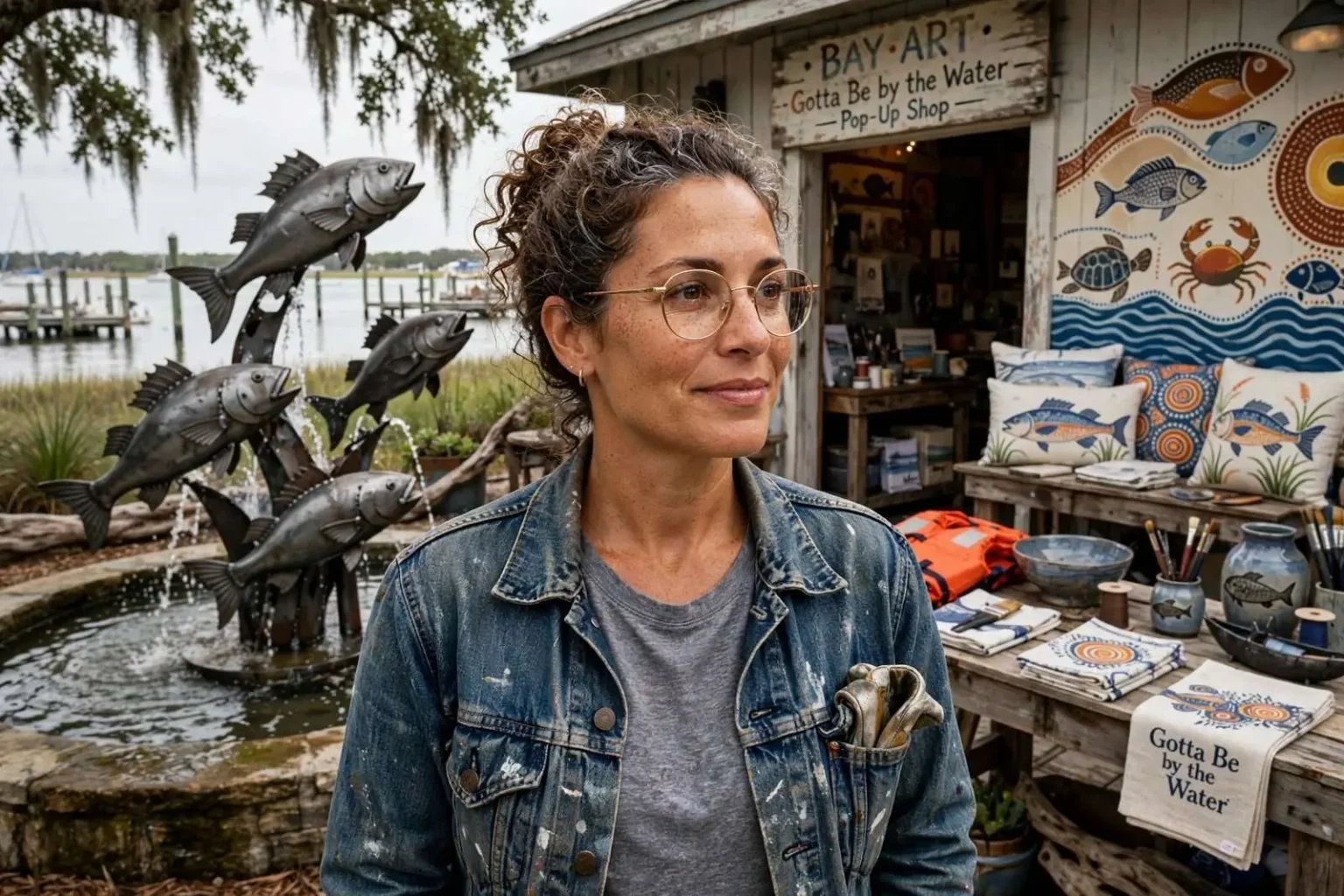
And in 2009, after two years of research and fabrication, she completed the fountain behind the Fairhope Museum of History — her take on the international “Cows on Parade” movement, commissioned through the Committee on Public Art after her design won a public competition. It is called Mullet Run, and it features sculpted mullet at play in the water. Anyone who has stood at the fountain has seen Tickle’s sense of humor rendered in bronze-scale permanence.
The Pop-Up at Battles Wharf
Her most recent chapter is a small building at the corner of Twin Beach and Battles Road in Battles Wharf, converted into a pop-up shop. “It didn’t want to be an art studio as I first envisioned — it wanted to be retail,” she says. She cleaned and brightened the space and built display tables from old wharf boards, filling the room with her art translated into pillows, linens, napkins and towels, alongside original paintings, metal ornaments shaped like wharves, and ceramics. Mobile Bay’s iconic environment runs through everything — a theme drawn straight from her childhood on the water.
“I need to physically manifest my creative thinking. I channel my thoughts of growing up on the Bay into my art,” she says — the swimming under wharves, the view through the gaps in the boards, the barnacles, the crab on a piling. Her repeated orange life jacket motif may be the purest distillation: “When you saw that old, stinky, moldy thing, but you put it around your neck, it meant a boat ride!” For anyone who grew up on the water, it is an instant, fond memory — which is precisely the product. A neighbor, walking in and surveying the room, put the brand positioning better than any consultant could: “This is not the beach, it’s the Bay.”
Art, Development and Giving Back
Tickle’s husband, Jason, shares the creative streak from a different direction. The couple has been involved in local development, and she describes his approach as a studied one — informed by the Congress for the New Urbanism and a mindful-development ethos that aims to enhance a community rather than merely expand it. “We believe in a proactive approach to development. One that aims to protect the beauty of our area,” she says. “Change is hard, but we love learning better ways to do things.” The couple has also talked about ways to fold local traditions into philanthropy, including housing that is affordable without being generic.
Her honors track the career: induction into Bayside Academy’s Hall of Fame, numerous art awards, and a SCAD degree carrying two distinguished honors. Her work appears in collections and public spaces from Daphne and Fairhope to Orange Beach, and her Ameri’ca Art and Design work can be followed on Facebook and Instagram. She has also begun seeking collaborations with other artists she has admired over the years — “There is a brotherhood and sisterhood among artists,” she says, “and integrating art with friends is one of my goals.”
Asked to reflect on the whole arc, from a babysitting job on the Eastern Shore to murals, fountains and a shop of Bay-flavored linens, she keeps it simple: “It’s been happy, amazing, and curious. I appreciate the beauty of my childhood, and it’s still stuck in my brain. That’s been the inspiration for a lot of my work.” And if she ever disappears from view? “I’m probably on a shrimp boat somewhere on the water.”
Related coverage from South AL News
- Follow the Color: The Alabama Mural Trail Turns Small-Town Walls Into Destinations
- Old Salt of Point Clear: Jimbo Meador on a Life at Sea and a Warning for Mobile Bay
- City of Mobile, Mobile Arts Council Launch Interactive Map of Downtown Public Art
- Foley Main Street Launches Membership Program to Fund Murals, Public Art and Live Music Downtown