Baldwin County Pre-K Programs Set to Expand to 25 Sites With New Grant Funding
Baldwin County pre-K programs grew to 25 sites in 2015 with new state grant funding, including a first-ever classroom at Orange Beach Elementary.
BAY MINETTE, Ala. — While Baldwin County’s K-12 public schools navigated a period of budget uncertainty in 2015, the county’s pre-kindergarten program continued expanding, buoyed by a fresh round of state grant funding that pushed the number of local pre-K sites to a new high.
Alabama’s voluntary First Class Pre-K program has for years been recognized nationally for meeting quality benchmarks covering teacher training, staffing ratios and support services, and the state was also selected as one of 18 recipients of a competitive federal Preschool Development Grant.
The national recognition mattered because early-childhood researchers have repeatedly found that the benefits of pre-kindergarten depend heavily on quality. Programs with well-trained teachers, small class sizes and family support services produce measurable gains in school readiness; low-quality programs do not. Alabama’s decision to hold its program to those benchmarks — even as it expanded rapidly — put the state near the top of national quality rankings while its enrollment climbed, a combination few states achieved.
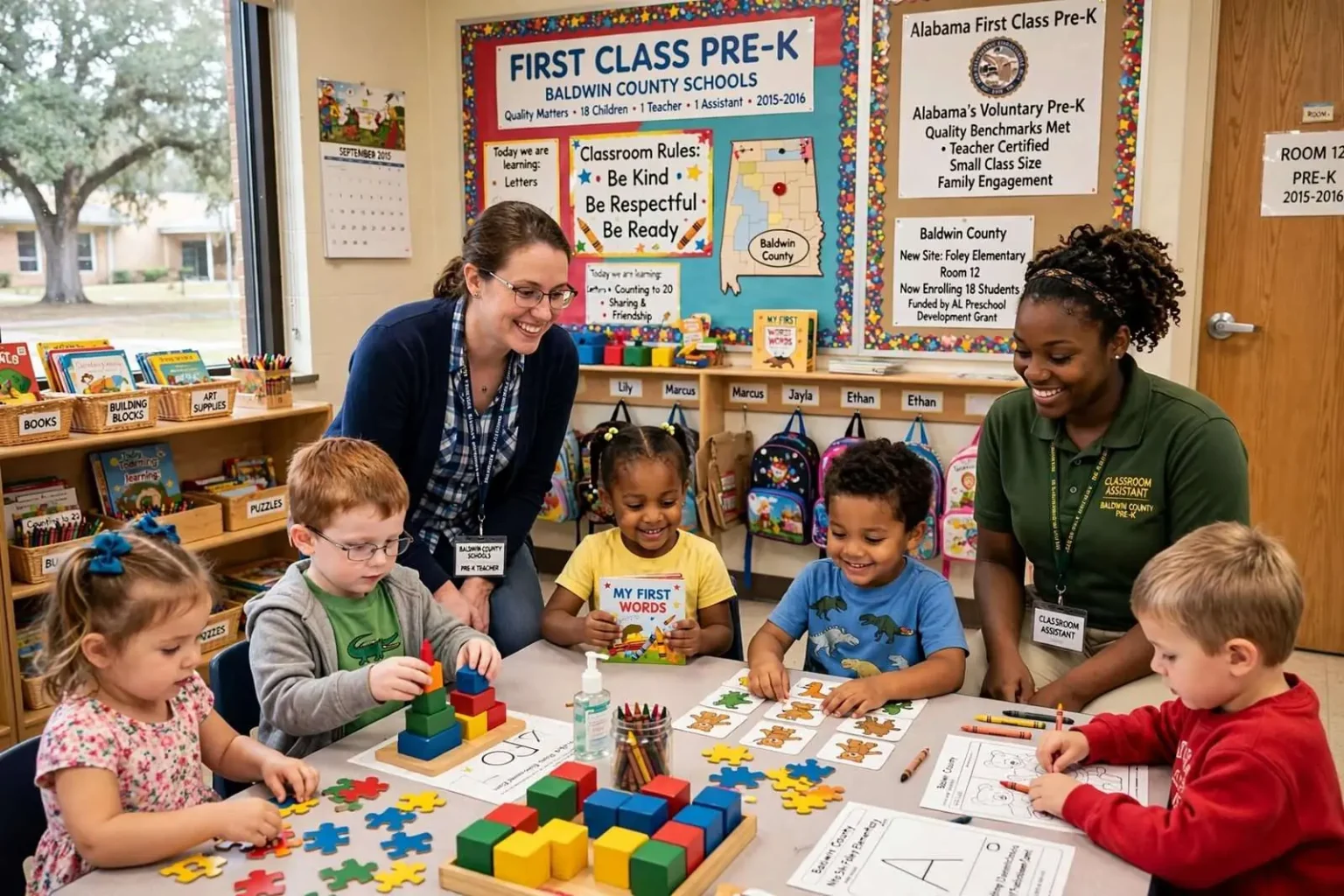
That momentum translated locally: Baldwin County grew from just six pre-K sites nine years earlier to 25 heading into the 2015-2016 school year, according to the district’s federal programs coordinator. Each site serves 18 children and is staffed by one teacher and one assistant funded through the grants.
The 18-child cap was not arbitrary. It reflects the staffing ratios at the heart of the program’s quality standards — one lead teacher and one assistant for every classroom, small enough for the individualized attention early learners need and for the coaching and assessment the state program requires. Every new site meant two more trained staff positions and a classroom equipped to the program’s specifications.
State Money in a Tight Budget Year
In May, state lawmakers added $10 million to Alabama’s pre-K budget despite tight finances elsewhere, and Baldwin County’s share topped $400,000. Two non-public-school sites in Foley each received $120,000, while more than $80,000 apiece went toward an additional pre-K classroom at Foley Elementary and the first-ever pre-K program at Orange Beach Elementary.
The $10 million increase came in a legislative session defined by fiscal strain, when general fund debates dominated Montgomery and most state agencies were bracing for flat or reduced budgets. The pre-K line item’s growth was the product of a years-long advocacy campaign by business leaders, educators and children’s advocates who argued that early education was economic development — that every dollar spent preparing four-year-olds for school saved multiples of that in remediation, dropout prevention and workforce readiness down the line.
Pre-K programs in the Mobile and Chickasaw areas also received a combined $450,000 in the same funding round, spreading the expansion across county lines and underscoring how broadly the state was pushing access in its largest metro region.
Orange Beach’s Patchwork Solution
Orange Beach’s new program required extra creativity to get off the ground. Because the school doesn’t qualify for federal Title I funding, backers had to assemble support piece by piece, including a required $35,000 playground on top of the $80,100 grant. A state lawmaker and a local charitable fund together covered the playground costs, according to a parent volunteer who serves as the city’s liaison to the Baldwin County Education Coalition.
She described the new classroom as a rare bright spot after voters had recently rejected a property tax increase that would have generated significant long-term funding for county schools.
The Title I distinction explained much of the patchwork. Title I directs federal aid to schools serving concentrations of students from low-income households, and Orange Beach Elementary’s comparatively affluent enrollment left it outside that safety net even as local families joined statewide waiting lists for pre-K seats. Without the federal stream that helps fund programs at higher-poverty schools, the Orange Beach effort depended on the state grant plus whatever local partners could be recruited — a lawmaker who championed the cause and a charitable fund willing to write the playground check that turned a classroom into a full early-learning environment.
The failed property tax vote shadowed the whole enterprise. Baldwin County’s school system — one of the largest geographically in the nation, sprawling from Mobile Bay to the Florida line — had long argued that its tax base had not kept pace with its enrollment growth, and the referendum was the attempt to fix that structurally. Its defeat left school officials searching for state grants, philanthropy and program-by-program funding to keep expansions like pre-K moving, which made each new site a small negotiation of partners rather than a simple budget line.
Demand Still Outpacing Seats
Demand remained the defining feature of the program’s rollout. Even at 25 sites, the number of four-year-olds in Baldwin County far exceeded the available seats, and families registered through a lottery system that left most applicants on waiting lists. Statewide, the First Class Pre-K program served a fraction of eligible children despite its quality reputation — the central tension of Alabama early-childhood policy being that the state had built one of the nation’s best programs while funding only a portion of the demand for it.
Educators in the district pointed to what a pre-K year does for children who get one: exposure to structured learning, early literacy and numeracy foundations, speech and social development screening, and the routines of school itself. For children from households without access to private preschool, the difference shows up in kindergarten readiness assessments and echoes through the early grades.
The grants also funneled resources into the local economy. Each site’s teacher and assistant represented a paid professional position, many of them in the communities where the classrooms sat, and the non-public-school sites in Foley demonstrated the program’s flexibility — partnering with private and church-affiliated providers to reach families wherever four-year-olds already were, rather than confining expansion to public school buildings.
What Came Next
Education leaders said the trajectory pointed upward: another round of grant applications, another push in Montgomery for continued funding growth, and a long-term goal of universal access that Alabama had formally embraced but not yet funded. In Baldwin County, that ambition ran alongside the unresolved school funding question, leaving programs like pre-K to grow the way the 2015 expansion had — grant by grant, partner by partner, classroom by classroom.
For the families who won seats in the 25-site program, the expansion’s meaning was immediate. Their four-year-olds would enter kindergarten the following year alongside teachers and assistants whose positions existed because the state, a few local philanthropists and a persistent coalition of parents kept finding ways to grow the program even in the county’s leanest budget years.
Inside the First Class Model
The program’s quality framework deserves attention because it is what separates Alabama’s approach from the day-care models many residents picture when they hear “pre-K.” First Class classrooms follow a state-approved curriculum, teachers must hold early-childhood credentials and receive ongoing coaching from the Office of School Readiness, and every classroom is evaluated against benchmarks covering everything from teacher-child interaction to health and family engagement. Lead teachers earn state supplemental pay on top of local salaries, which helps recruit trained professionals into classrooms serving four-year-olds.
The federal Preschool Development Grant that Alabama won put the state among a small cohort chosen through a competitive federal review, and the award accelerated exactly the kind of expansion Baldwin County experienced. Federal dollars flowed through the state to local grantees, paying for new classrooms in communities that had the space and the will but not the local money — a description that fit several Baldwin County communities where school enrollment was booming and classroom wings were already crowded.
The coordinator’s count — six sites to 25 in nine years — traced the arc of that effort. In the program’s early years in the county, pre-K existed in a handful of high-poverty attendance zones funded through Title I and a few pilot grants. The middle years brought the first state expansion dollars. By 2015, with the state increase and the federal grant running together, the county was adding sites in fast-growing communities like Foley and Orange Beach that the original poverty-based model would never have reached.
The non-public partnerships in Foley illustrated the pragmatic streak in Alabama’s program. Rather than insisting that every seat sit inside a public school, the state allowed community-based providers meeting its quality standards to compete for the same grants. The two Foley sites at $120,000 each represented full early-learning operations — staff, materials, family services — delivered in settings chosen for their convenience to families rather than their institutional affiliation.
Behind all of it stood the county Education Coalition and its network of parent volunteers like the Orange Beach liaison, who between them supplied the local matchmaking that state money requires: identifying a classroom, recruiting a charitable partner for the gap costs, and persuading a legislator to champion the application. The pre-K expansion was, in that sense, built twice — once in Montgomery’s budget process and once in Baldwin County’s school gymnasiums and civic clubs.