Coast Guard Searches Gulf Waters Off Fort Morgan for Missing Jet-Skier
The Coast Guard launched a search near Fort Morgan after a jet-skier was reported struck by lightning and dragged behind the watercraft into open Gulf waters.
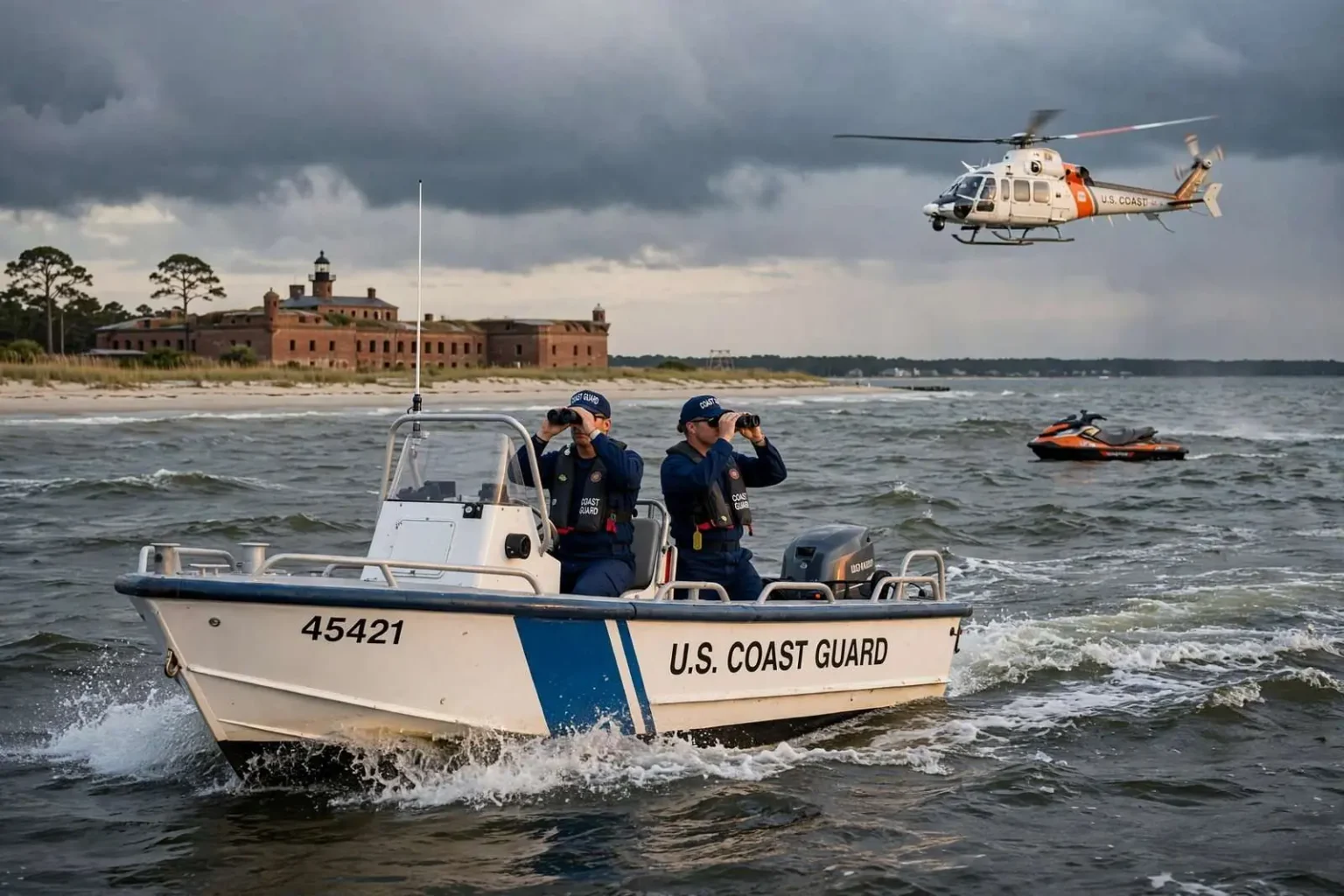
The U.S. Coast Guard launched a search off Fort Morgan for a missing jet-skier after receiving a report that the rider had been struck by lightning during a storm on the water. The search unfolded along the Gulf coastline near the historic fort, at the mouth of Mobile Bay, as crews worked against changing weather and fading daylight to locate the rider.
Baldwin County 911 dispatchers alerted the Coast Guard Sector Mobile command center Sunday afternoon after receiving a call reporting that a jet-skier had apparently been struck by lightning and was then dragged behind the still-moving personal watercraft. The call came in at approximately 3:40 p.m., setting in motion the standard sequence of a maritime search and rescue case on the Alabama coast.
According to the Coast Guard, the missing rider is described as a white male with dark hair who was last seen heading in a southwesterly direction in the waters near Fort Morgan. A person in the water and a drifting personal watercraft both move with wind and current, and search planners use those forces to project drift patterns — a calculation that grows more difficult with every hour that passes.
How the Search Was Organized
Coast Guard crews from Sector Mobile coordinated the search effort along the stretch of Gulf coastline near the historic fort, an area popular with boaters, anglers and personal watercraft riders during the summer months. Sector Mobile, headquartered on Mobile Bay, directs search and rescue operations across a broad area of responsibility that includes coastal Alabama, portions of Mississippi and Florida, and the Gulf waters between them.
Search efforts in the Gulf can involve a combination of Coast Guard cutters, small boats and aircraft depending on conditions and the size of the search area. Small boats launched from stations along the coast can sweep close to shore, while aircraft cover wide swaths of open water quickly and can spot debris or a person in the water from altitude. Cutters take on the offshore portions of a search and can remain on scene for extended periods when a case stretches past a single day.
In a case involving a personal watercraft, searchers also look for the machine itself. A riderless jet ski that is still running, as described in the initial report, leaves a distinctive trail — an unoccupied vessel circling or running in a straight line — and finding it gives searchers a critical data point for recalculating where the rider may have gone into the water.
Authorities did not immediately release additional details on the search’s progress. The identity of the missing rider was not disclosed, and officials had not said whether others on the water witnessed the strike or only the aftermath. Anyone with information about the missing jet-skier was asked to contact the Coast Guard Sector Mobile Command Center.
The Danger of Lightning on Open Water
Severe thunderstorms are common along coastal Baldwin County during the summer, and lightning strikes on open water pose a serious hazard to boaters and jet-skiers who have little shelter once a storm develops. Summer afternoons along the northern Gulf Coast regularly produce fast-building thunderstorms that can develop from a clear horizon to heavy weather in less than an hour, driven by the collision of sea breezes with the region’s heat and humidity.
A person on a personal watercraft is among the most exposed anyone can be to a lightning strike — sitting at or near the highest point on the water, in contact with it, with no enclosure and no lightning protection system of the kind larger vessels may carry. Unlike a boat with a cabin, a jet ski offers nothing to reduce the risk once a storm is overhead.
Safety officials routinely urge anyone on the water to head to shore immediately at the first signs of an approaching storm, since lightning can strike well ahead of visible rain or thunder. The standard guidance is the “30-30 rule”: if the time between a lightning flash and its thunder is 30 seconds or less, the storm is close enough to be dangerous, and wait 30 minutes after the last thunder before returning to the water.
The Fort Morgan Peninsula
The Fort Morgan peninsula sits at the western tip of Baldwin County’s Gulf shoreline, across the mouth of Mobile Bay from Dauphin Island, and is a popular destination for fishing, boating and beachgoing throughout the summer season. The narrow strip of sand extends roughly 20 miles from Gulf Shores toward the bay’s mouth, and its population swells in summer as vacation rentals and campgrounds fill with visitors from across the Southeast.
Historic Fort Morgan itself, a masonry fortification completed in 1834, guards the eastern side of the bay’s entrance and draws visitors year-round. The waters around the fort are a crossover point between Gulf and bay environments: anglers fish the surf and the pass, pleasure boats run between the Gulf Intracoastal Waterway and open water, and personal watercraft riders use the comparatively protected waters near the fort before heading out the pass.
That geography makes the area busy but exposed. A rider heading southwest from the fort is moving into open Gulf with no nearby harbor, and the sea conditions on that stretch can change quickly when summer storms push through. Mobile Bay’s own weather patterns compound the risk — the bay and its approaches funnel both storms and the winds that accompany them.
The stretch also sits within reach of several response assets, which is why searches there can be mounted quickly. Coast Guard boats from the area, Baldwin County Sheriff’s Office marine units and volunteer rescue organizations can all be on the water near the fort within a short time of a distress report, and Coast Guard aircraft staging from the region can begin overhead sweeps the same afternoon.
When a Rider Goes Missing
The account in the initial report — a rider struck by lightning and then dragged behind a still-moving watercraft — describes one of the most dangerous scenarios a jet ski can produce. Personal watercraft are designed to return to idle when the rider releases the throttle, but if the machine’s controls are damaged or the throttle sticks, an unconscious or incapacitated rider can be pulled through the water at speed, with no way to shut the engine down.
A person dragged behind a moving craft faces drowning risk on top of the original injury, and the machine’s continuing movement also carries it away from the strike location, complicating the drift calculations searchers rely on. Search planners treat both the rider and the craft as drifting objects, each moving differently with wind and current.
Witnesses and callers play a central role in cases like this. The information in the initial 911 call — the direction of travel, the description of the rider, the behavior of the watercraft — becomes the starting dataset for the entire search, and Coast Guard investigators typically work to re-interview witnesses as the search continues to refine the last known position.
Coast Guard Sector Mobile handles hundreds of search and rescue cases a year across its area of responsibility, ranging from disabled vessels to swimmers caught in currents. Summer is the busiest season, when recreational traffic on the bay and the Gulf reaches its peak and afternoon thunderstorms arrive with regularity.
Storm Safety on Baldwin County Waters
For the boating public along coastal Baldwin County, the case underscores guidance that safety agencies repeat every summer. Weather forecasts for the Gulf Coast during the warm months regularly carry some chance of thunderstorms each afternoon, and the standard advice is to check radar before launching, to keep a marine radio or charged phone accessible, and to treat building clouds to the west — the typical direction from which summer storms arrive — as a signal to head in.
Personal watercraft riders face particular challenges in storm avoidance. The machines are fast enough to outrun weather in open stretches, but their riders are exposed, often far from launch points, and many ride in groups that spread out. Safety courses offered through the Alabama Marine Police Division and boating organizations cover storm awareness alongside the state’s requirements for personal watercraft operation, which include life jacket requirements and age restrictions for operators.
Life jackets add a critical margin in any person-in-the-water case. A rider struck by lightning or knocked from a machine who is wearing a flotation device remains at the surface and visible to searchers; one who is not may submerge quickly, shrinking the search from a surface visual sweep to an underwater one. Coast Guard statistics consistently identify life jacket use as the single strongest factor in recreational boating survival.
How Maritime Searches Progress
Coast Guard search and rescue cases follow a structured sequence: receipt of the initial report, verification, determination of the last known position, drift modeling, assignment of assets and active searching, with the search effort adjusted as new information arrives. Command decisions about expanding, narrowing or suspending a search rest with the Sector Mobile command center, which consults weather, tide and current data throughout the case.
Suspension, when it comes, is among the hardest decisions in maritime rescue. Coast Guard policy directs crews to search until there is no reasonable probability of finding a survivor, weighing survival times in the water temperature and conditions, the quality of the initial information and the elapsed time. Cases in the warm Gulf waters generally allow longer survival windows than northern waters, but exposure, injury and storm conditions all shorten them.
Local agencies play a supporting role in cases close to shore. Baldwin County’s marine patrol deputies know the waters around the fort and the pass, and the county’s 911 system serves as the first point of contact for most civilian distress calls, as it did in this case — the 3:40 p.m. call to dispatchers was the event that started the Coast Guard’s clock.
As of the latest report, the search for the missing jet-skier remained active, and authorities asked that anyone who was on the water near Fort Morgan that afternoon and saw a rider, an unoccupied personal watercraft or debris contact the Sector Mobile Command Center. Even small details — the time a machine was seen, the direction it was running — can materially reshape a drifting search that is racing the clock.