

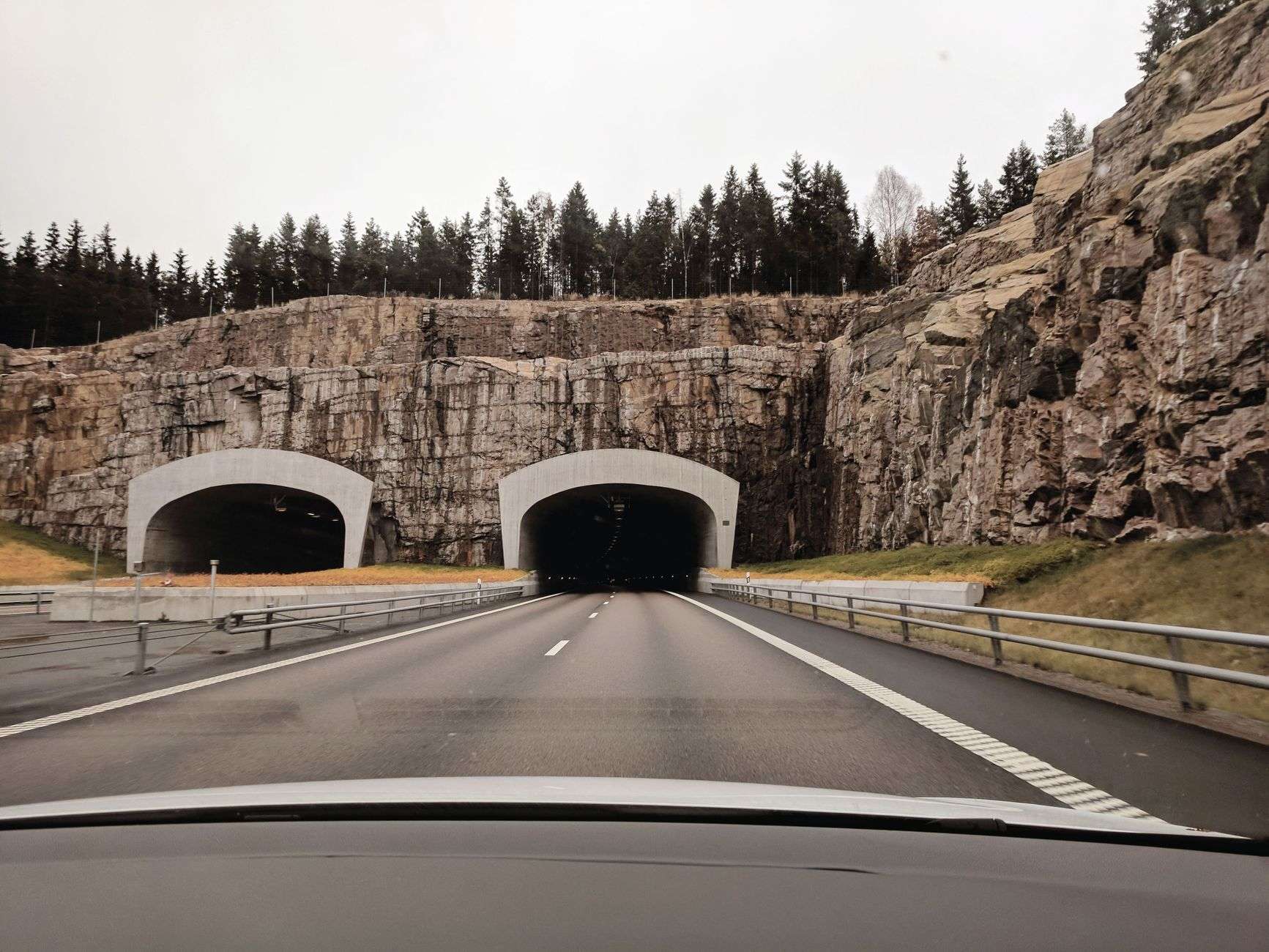
The Alabama Department of Transportation closed the Bankhead Tunnel in downtown Mobile on Thursday to allow crews to make emergency utility repairs, the agency said. The closure began Thursday and will last for an undetermined amount of time while crews address the underlying problem. Drivers were advised to seek alternate routes while the tunnel is shut down.
ALDOT public information officer James Gordon said the closure was prompted by a water main break that caused a minor sinkhole inside the tunnel. He said the sinkhole was discovered during a routine inspection.
“It’s underneath the asphalt on the main road and it’s a pipe that belongs to MAWSS,” Gordon said, referring to the Mobile Area Water and Sewer System. “So, you know, there’s all kinds of utilities that run alongside the tunnel. One of those is water.”
After the sinkhole was found, ALDOT contacted MAWSS, which is responsible for the water line, to respond to the site. Crews were working Thursday on a temporary fix, and Gordon said the tunnel is expected to remain closed overnight. A permanent repair to the water line will be scheduled for a later date.
Gordon said the tunnel itself has no structural issues tied to the sinkhole or the water main break, an important distinction for a facility that carries thousands of vehicles beneath the Mobile River every day. The concern, he indicated, is the utility infrastructure running alongside and beneath the roadway rather than the tunnel tube itself.
What Happened Inside the Tunnel
The discovery of the sinkhole illustrates the hidden network of pipes and conduits that share the corridor with the Bankhead Tunnel’s roadway. Decades of urban infrastructure have grown up around the crossing, and water, sewer, telecommunications and electrical lines all run through the same constrained space along the riverfront.
When a pressurized water main fails near a roadway, the escaping water can undermine the asphalt above it, carving out voids that are not always visible from the surface. That is what inspectors found during what Gordon described as a routine examination of the facility. A minor sinkhole forming under the travel lanes of an enclosed tunnel is treated as an emergency because the space offers no shoulder for stranded vehicles and no easy detour once a driver has entered.
Because the failed pipe belongs to MAWSS rather than to the state, the repair required coordination between two agencies. ALDOT controls the tunnel and its roadway, while MAWSS owns and maintains the water line that ruptured. That division of responsibility is common on Alabama roadways, where municipal utilities frequently hold easements within state rights-of-way, but it means closure decisions and repair timelines must be worked out jointly.
Crews focused first on a temporary fix that would stabilize the area and allow the water service to function while engineers assessed the full extent of the damage. The permanent repair to the water line will follow on a schedule to be determined, and ALDOT has not committed to a reopening date beyond confirming that the shutdown would extend at least overnight.
A Key Downtown Crossing Goes Quiet
The Bankhead Tunnel carries traffic beneath the Mobile River, connecting downtown Mobile to the Africatown and Blakeley Island areas on the eastern shore side of the river. It is a heavily used commuter route for drivers moving between downtown and areas east of the river, and its loss — even temporarily — reshapes daily travel patterns for a significant share of Mobile commuters.
The tunnel is one of two road crossings beneath the Mobile River in the downtown area, the other being the larger George Wallace Tunnel on Interstate 10. Together the two tubes funnel harbor-area traffic between the city’s western business districts and the industrial and residential areas clustered along the river’s eastern edge. When either tube closes, the other absorbs the overflow, and congestion builds quickly at the approaches.
For drivers heading from downtown toward Africatown, the historic community founded by the survivors of the Clotilda, or toward the port facilities and industrial tracts around Blakeley Island, the Bankhead Tunnel is often the most direct route. Its entrances sit just blocks from Government Street and the heart of the central business district, which makes it a natural choice for errands, shift changes and deliveries that never touch the interstate.
Commercial traffic feels the closure as keenly as commuters do. Port-related businesses, shipyard workers and truck operators moving between downtown and the east bank of the river must either shift to the interstate crossing or loop around through surface streets, adding time and fuel to every trip. Local delivery routes that relied on the tunnel’s quick hop across the river have had to be redrawn for the duration of the repair work.
A Crossing With Deep Roots in Mobile
The Bankhead Tunnel has been part of Mobile’s streetscape since the early 1940s, when it opened as one of the city’s signature public works projects. Named for Alabama’s longtime Bankhead political family, the tube was engineered to carry vehicles beneath the river in an era when the city’s growth was spilling toward the waterfront and beyond. Its distinctive arched portals and art-deco detailing remain familiar landmarks for generations of Mobilians who have driven through it on the way to work, school or the causeway.
Like any structure of its age, the tunnel requires constant upkeep. Its roadway deck, ventilation systems, drainage pumps and lighting all operate in a corrosive, humid environment just above the waterline, and the corridor also carries the buried utilities that serve surrounding neighborhoods. Routine inspections are a core part of keeping the facility safe, and it was precisely such an inspection that turned up the sinkhole this week.
This is not the first time the tunnel has closed in recent weeks. It was shut down last month for planned overnight maintenance work, though Thursday’s closure was unplanned and tied specifically to the emergency utility repair. The back-to-back disruptions have tested the patience of regular users, who now face a second stretch of detours in a matter of weeks.
Planning Around the Closure
ALDOT is urging motorists to plan for alternate routes while the tunnel remains closed and to check the ALGO app for real-time updates on when the tunnel reopens. The app, maintained by the state transportation department, provides live traffic conditions, construction alerts and camera views across Alabama’s roadways, and it has become the agency’s primary channel for pushing time-sensitive information to drivers.
For most eastbound and westbound trips across the river, the practical alternative is the George Wallace Tunnel on I-10, which handles the heavy through-traffic that would otherwise clog surface streets. Drivers coming from west Mobile or the downtown core can also reach the eastern shore via the Cochrane-Africatown USA Bridge to the north, which connects the Africatown community across the river and offers a bypass for trips between the northern downtown districts and the east bank.
Residents of Africatown and the communities along the river’s eastern edge who commute into downtown for work are among the most affected. A trip that once took minutes through the tunnel can double in length when the crossing is unavailable, particularly during morning and afternoon peak periods when the alternate routes are already near capacity.
Business owners on both sides of the river have learned from past closures to adjust delivery windows and appointment schedules. With the closure expected to last at least through the night and possibly longer, the coming days will test how well the corridor’s alternate network absorbs the diverted traffic.
The Water System Behind the Break
The Mobile Area Water and Sewer System, the utility responsible for the failed line, provides water and sewer service to the city of Mobile and much of Mobile County. Its network includes hundreds of miles of water mains, some of them decades old, running beneath streets and through utility corridors across the city. Breaks on mains of any size are a routine part of the utility’s work, but a break adjacent to a state-owned tunnel elevates the job from a street repair to a coordinated emergency response.
Water main failures are not uncommon in older Southern cities, where aging cast-iron and ductile-iron pipes can fail under shifts in ground conditions, temperature swings or simple age. When the break happened to occur beside a structure as sensitive as an underwater road tunnel, ALDOT had little choice but to shut the facility while the utility worked, since a continued flow of water into the tunnel environment could undermine the roadway or interfere with the tunnel’s drainage systems.
The temporary fix crews pursued Thursday is intended to restore service and secure the area so that engineers can evaluate the pipe’s condition in detail. Permanent repairs to an underground main typically involve either replacing a failed segment or relining the existing pipe, work that requires excavation, parts procurement and scheduling around traffic impacts. Until that work is done, the tunnel’s reopening timetable remains open-ended, hinging on what inspectors find once the immediate hazard is contained.
What Comes Next for Drivers
For now, ALDOT’s guidance is straightforward: avoid the Bankhead Tunnel, use alternate crossings, and monitor the ALGO app for updates. The agency has not announced a reopening date, and the duration of the closure will depend on how quickly MAWSS crews can complete the temporary fix and how extensive the permanent repair proves to be.
Drivers who must cross the Mobile River during the closure should build extra time into their trips, particularly during rush hours when the George Wallace Tunnel and the Cochrane-Africatown USA Bridge carry the combined load of two corridors. Signage and navigation apps will continue to route traffic around the closed tube, and the state will update the public as the repair progresses.
The episode is a reminder of how interconnected the region’s infrastructure really is. A single water main failure, in a pipe belonging to the city’s water utility, was enough to halt traffic through a state-owned crossing built more than eight decades ago. As Mobile continues to grow along both banks of the river, the reliability of these older crossings — and the aging utilities that share their corridors — will remain a recurring test for the agencies responsible for keeping the city moving.
ALDOT has said it will share additional information as the repair work advances, and drivers with questions about the closure can find updates through the agency’s traffic information channels. Until the all-clear comes, downtown Mobile’s quietest highway — the one that dips beneath the river without a toll booth or a traffic light — will sit empty while crews work in the dark below.