Hybrid Auto Plant Proposal Drew Attention in Bay Minette in 2009
A proposed hybrid-vehicle plant in northeast Bay Minette drew attention in September 2009, though questions remained about financing for the multibillion-dollar project.
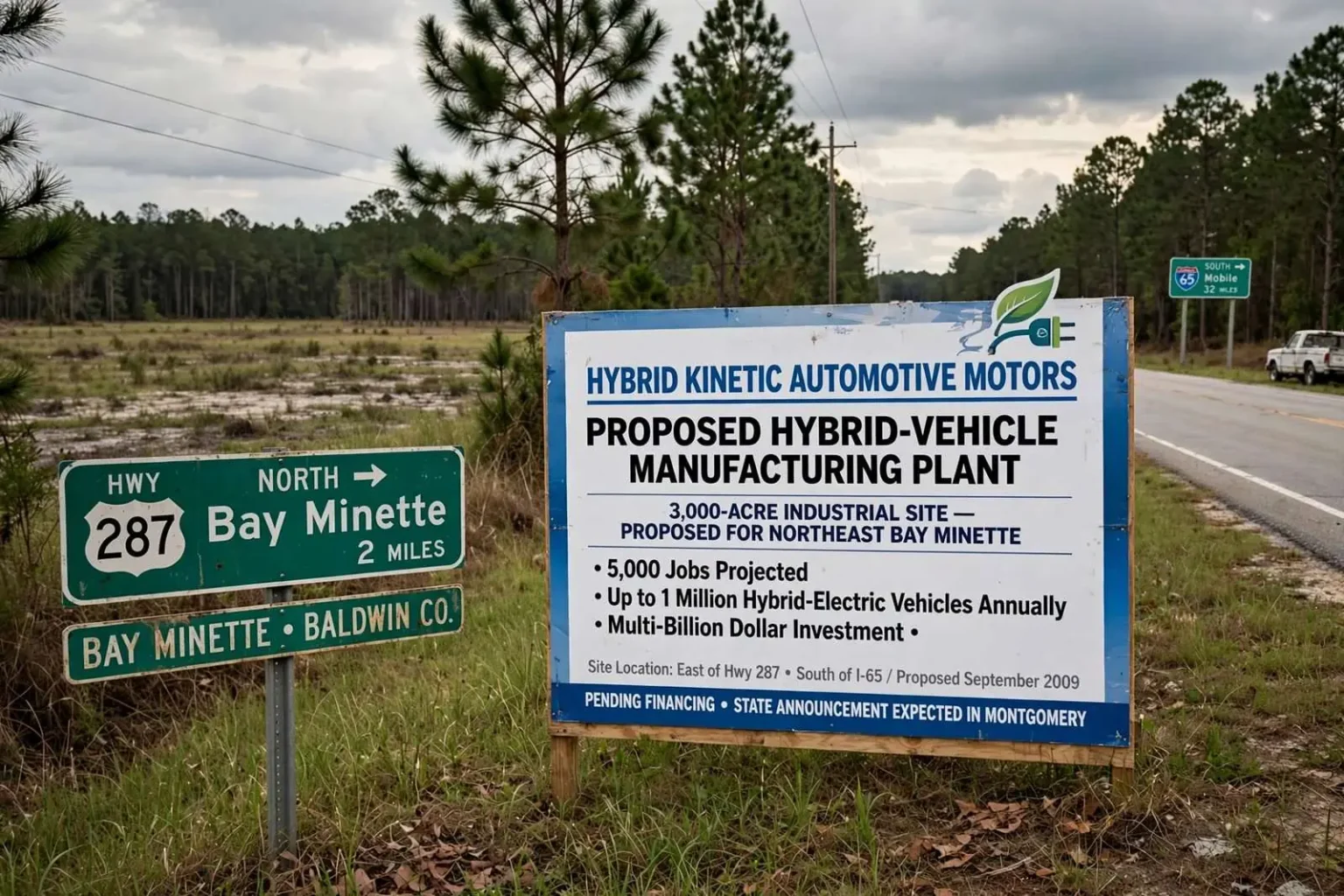
A proposed hybrid-vehicle manufacturing plant in Baldwin County generated significant interest in September 2009, with backers describing a possible multibillion-dollar investment and thousands of jobs near Bay Minette. Hybrid Kinetic Automotive Motors was identified as the company connected to the proposal. At a moment when Alabama’s economy, like the nation’s, was still reeling from the recession, the prospect of a futuristic hybrid plant rising in rural Baldwin County landed like a bolt of possibility — the kind of industrial recruitment story that reshapes a region if it comes true.
Plans described a 3,000-acre site in northeast Bay Minette, east of Highway 287 and south of Interstate 65. The location mattered as much as the scale: Bay Minette sits at the northern gateway to Baldwin County, a crossroads community positioned between Mobile’s port economy and the fast-growing beach corridor to the south. A 3,000-acre industrial tract there would have been among the largest potential manufacturing sites in the state, with interstate frontage offering direct access to the freight corridors that link Alabama’s Gulf Coast to the rest of the Southeast.
The scale of the vision
The company’s concept was to produce a range of affordable hybrid-electric vehicles. Published plans at the time projected a facility that could eventually employ about 5,000 people and produce up to 1 million hybrid vehicles annually. Both figures were extraordinary. Five thousand direct jobs would have placed the plant among Alabama’s largest employers, and a million-vehicle annual capacity would have rivaled the output of established assembly complexes — a stunning target for a startup company with no manufacturing track record in the United States.
The affordable-hybrid pitch aligned with the moment. The late-2000s hybrid market was dominated by a handful of foreign models, gas prices had spiked the year before, and American consumers were newly attentive to fuel economy. A domestic plant building hybrids for the mass market — and doing it in Alabama, a state that had already attracted Mercedes, Honda and Hyundai assembly operations — fit the story Alabama economic developers had been telling for a decade about the state’s rise as an automotive center.
The proposal was associated with Yong “Benjamin” Yeung, a Chinese auto executive. Yeung’s involvement connected the project to a wave of Chinese industrial investment interests circling American opportunities at the time, and it gave the plan both its financing ambitions and, ultimately, much of the skepticism that trailed it.
Anticipation in Montgomery
State officials were expected to make a formal announcement in Montgomery, heightening local interest in the potential economic impact for Bay Minette and surrounding Baldwin County communities. In Alabama’s economic development culture, the Montgomery announcement is the payoff moment — the press conference where a project stops being a rumor and becomes a commitment, usually with incentives, site details and hiring projections attached. Communities that have chased auto plants know the sequence well, and Bay Minette residents watched for it the way other Alabama towns had during the Hyundai and Mercedes recruitments that transformed their host cities.
The financing question
Despite the scale of the announcement, the project faced skepticism. Although a site had been identified, financing for construction of the large facility had not yet been secured. That single unresolved fact sat at the center of the story. An assembly plant of the magnitude described — thousands of jobs, a million vehicles a year — represents one of the largest capital commitments in manufacturing, and no amount of site identification or announced intent substitutes for the billions in committed capital required to break ground. In 2009, with global credit markets still damaged by the financial crisis, the absence of secured financing was not a technicality; it was the whole ballgame.
The skepticism was sharpened by the company’s profile. Hybrid Kinetic was not an established automaker with existing plants and model lines; it was a venture assembling the elements of a car company — technology ambitions, executive leadership, site plans — in the middle of the worst economy in a generation. Veterans of Alabama’s automotive recruitment watched the Bay Minette proposal and noted the difference between the state’s earlier successes, each anchored by a global manufacturer with deep pockets, and a project whose central asset was its own announcement.
For local leaders and residents, the promise of a major automotive employer carried obvious appeal during a period when job creation and industrial recruitment were prominent regional concerns. Baldwin County in 2009 was growing along its coast while its northern communities worked to diversify beyond small industry and commuting economies. A plant of the size described could have affected suppliers, construction activity and the broader economy along the Interstate 65 corridor — spinoff effects that economists routinely estimate at multiples of the direct payroll, as parts makers, logistics firms and service businesses cluster around a major assembly operation.
What the moment captured
The 2009 report captured an early stage of the proposal: a high-profile vision for hybrid manufacturing in Bay Minette, accompanied by ambitious job and production projections but unresolved questions about the capital required to build it. History would prove the caution justified — the plant as described never rose from the 3,000 acres east of Highway 287 — but the episode itself became part of the region’s industrial lore, a case study in the difference between a project announcement and a project.
The story also illustrated how automotive recruitment works in Alabama, where the arrival of Mercedes in Tuscaloosa County in the 1990s, followed by Honda and Hyundai, established a template: identify a mega-site, court a manufacturer, assemble incentives, and watch the supplier network follow. Bay Minette’s pursuit of Hybrid Kinetic followed that template faithfully — the land identified, the state engaged, the Montgomery announcement anticipated — and demonstrated how much of the model depends on factors entirely outside a community’s control: the credibility of the company, the availability of capital, and the global economics of the auto industry.
Bay Minette and the I-65 corridor
To understand why the proposal generated the attention it did, it helps to picture Bay Minette’s position in 2009. The county seat of Baldwin County sat at a crossroads of ambition: Highway 287 running through town, Interstate 65 framing the landscape to the south and east, and the explosive growth of Baldwin’s beach communities surging past to the south. Northern Baldwin County had watched decades of development concentrate along the coast — Gulf Shores, Orange Beach, the Highway 59 corridor — while its own economy leaned on timber heritage, agriculture, small manufacturing and the steady traffic of travelers passing through on the way to somewhere else.
A 3,000-acre manufacturing complex northeast of town would have inverted that geography, anchoring growth at the county’s northern end and tying it directly into the interstate economy. The site’s position south of I-65 and east of Highway 287 placed it within easy reach of the Port of Mobile, the rail lines that serve it, and the labor pools of both Baldwin and Mobile counties. Those are precisely the attributes that economic developers put on the pitch page for any automotive mega-site — and why the mere identification of the land made headlines before anyone committed a dollar.
The potential supplier effect deserves particular emphasis. Modern assembly plants do not operate alone; they anchor a halo of Tier 1 and Tier 2 suppliers — seat makers, stampers, plastics processors, logistics providers — that locate within an hour’s drive of the customer they serve. Alabama’s existing automotive regions grew their employment several times over through that supplier network beyond the assembly plant itself. Five thousand direct jobs at Hybrid Kinetic, if the projections held, would have implied thousands more in surrounding facilities, with hiring and construction waves that would have reshaped the labor market from Bay Minette to the state line.
The recession’s shadow
Timing shaped every dimension of the story. September 2009 sat in the trough of the worst American recession since the 1930s, with unemployment elevated across Alabama and industrial recruitment nearly frozen nationwide. Into that environment arrived a proposal promising thousands of jobs and billions in investment — precisely what every community craved and precisely what few could verify. The hunger for good economic news made the region receptive to the Hybrid Kinetic story; the same conditions made the financing environment for a multibillion-dollar startup plant treacherous.
The hybrid angle added another layer of timeliness. Gasoline prices had retreated from their 2008 spike, but consumer interest in fuel efficiency remained elevated, federal policy was steering the industry toward electrification, and every major automaker was repositioning. A startup promising affordable hybrids — the segment’s most competitive frontier — was proposing to enter the hardest part of the market with no track record, which is why industry observers treated the production projections with more caution than the job numbers.
For Bay Minette, the episode ended as a lesson rather than a transformation: the announcement never matured into a plant, the 3,000 acres awaited other futures, and the community’s pursuit of industrial development continued by other means. But the 2009 moment remains a revealing snapshot — of a region’s aspirations at the depth of a recession, of Alabama’s automotive ambitions extending into a new technological era, and of the enduring gap between a project announced and a project built.