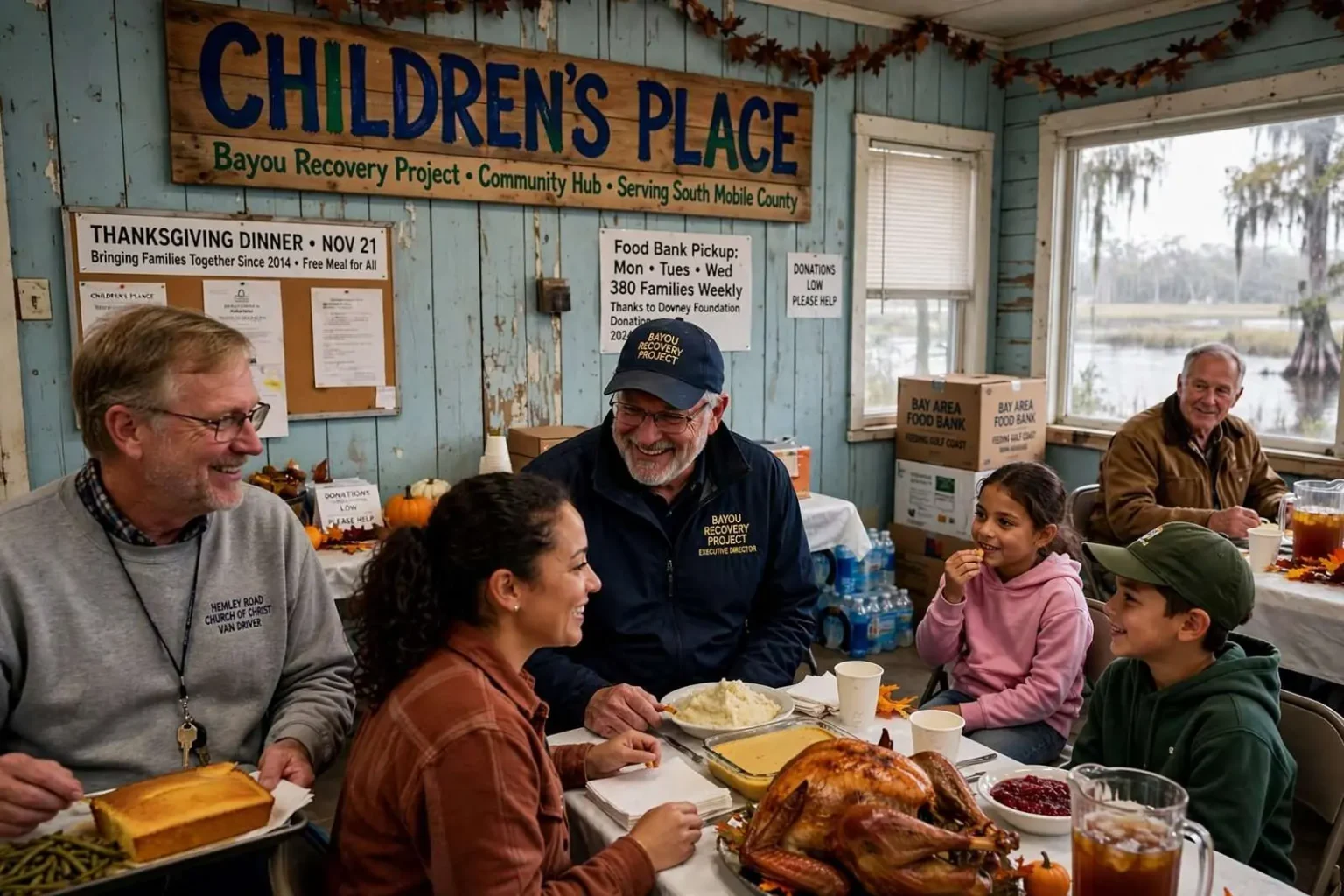
Volunteers serve Thanksgiving dinner at Bayou La Batre's Children's PlaceThe Bayou Recovery Project hosted its first Thanksgiving dinner at its new Children's Place building in Bayou La Batre.
Nearly a decade after Hurricane Katrina and years after the Deepwater Horizon oil spill, a Bayou La Batre nonprofit is still working to feed families in south Mobile County who have never fully recovered from those twin disasters.

The Bayou Recovery Project hosted its first community Thanksgiving dinner Thursday inside a newly acquired building the organization calls “Children’s Place,” bringing together families the nonprofit has served since its founding roughly nine years ago. John Michael Evans, who drives a 16-passenger van for the Hemley Road Church of Christ in Bayou La Batre, ferried a group of children to the dinner.

“It’s rewarding,” Evans said. “It’s more rewarding than a job you get paid for. I learn a lot from the kids. There is a lot adults can learn from children.”

William Spaulding, executive director of the Bayou Recovery Project, said the need in the community remains real even years after the 2010 oil spill faded from national headlines.

“A lot of people think the oil spill is gone and out of the way, but it’s not,” Spaulding said. “This is what we have to do. We love the children, it’s what we do.”

The Children’s Place building, more than 50 years old, was donated to the organization about nine months ago by the Downey Foundation. Beyond hosting children’s activities, the space has become a hub for feeding people in need throughout the week. From Monday through Wednesday, as many as 380 families visit for hot meals purchased with the help of volunteers who shop at the Bay Area Food Bank. On Fridays, the Recovery Project delivers food to roughly 300 families across the south Mobile County area, with driver Roosevelt Harris – who was featured in Margaret Brown’s documentary “The Great Invisible” about the oil spill’s lingering economic toll – among those making deliveries. On Saturdays, the building hosts games and cookouts for 60 to 70 children and teenagers.

Despite the growing demand, Spaulding said funding for the effort is getting tighter. Support has come primarily from churches in Brewton and in El Campo, Texas, but the Texas congregation is expected to scale back its giving soon as it redirects resources closer to home.

Spaulding, who is retired, said a single trip to the food bank can cost as much as $80, while total monthly donations run around $400 – a gap he said he sometimes covers out of his own pocket.

As the holiday season begins, Bayou Recovery Project volunteers say the Children’s Place building represents a rare bright spot for families in a stretch of coastal Alabama still working to rebuild years after back-to-back disasters upended the local economy.

See also  Mobile Man Who Killed Young Father in 1998 Denied Parole Chance Again

Mobile is the county seat of Mobile County in southwest Alabama and the state’s only saltwater port. Situated where the Mobile River meets Mobile Bay near the northern Gulf of Mexico, the city has long served as a commercial and cultural gateway between Alabama and the wider Gulf Coast. Founded in 1702 as Fort Louis de la Louisiane and ruled in turn by France, Britain, and Spain before joining the United States in 1813, Mobile carries a layered heritage distinct from the rest of the state.

Today Mobile anchors a metropolitan area spanning Mobile County and neighboring Baldwin County, and it remains a center for shipping, aerospace, healthcare, and higher education in the region. Its downtown and waterfront have seen sustained revitalization, while historic neighborhoods preserve architecture from its colonial and antebellum past. The city’s identity is shaped as much by its working port and industrial base as by its festivals and food culture, making it a frequent focal point for news about growth and change in southern Alabama.

Alabama is a state in the southeastern United States bordered by Tennessee, Georgia, Florida, the Gulf of Mexico, and Mississippi. Often called the Heart of Dixie, it spans Appalachian foothills in the north and flat coastal plains in the south. Its largest cities include Birmingham, Montgomery, Huntsville, and Mobile.

Alabama’s history encompasses Indigenous roots, Spanish and French colonial settlement, a cotton-plantation economy, the Civil War and Reconstruction, and the Civil Rights Movement of the 1950s and 1960s, followed by a shift toward manufacturing, aerospace, and technology. Local news across the state frequently reflects this mix of tradition and change.

The natural environment is central to life on the Gulf Coast, where barrier islands, bays, rivers, and wetlands support fisheries, recreation, and storm protection. Coastal Alabama faces challenges common to low-lying regions, including hurricane exposure, erosion, and the management of fragile ecosystems.

The Mobile-Tensaw Delta, one of the largest river deltas in the country, is a particularly significant natural asset. Conservation efforts, fisheries regulation, and shoreline restoration are frequent points of collaboration among state agencies, federal bodies like the Army Corps of Engineers, and environmental groups.

How the region plans for growth while protecting its natural assets is a recurring theme in local reporting. The tension between development pressure and ecological stewardship plays out in zoning fights, infrastructure projects, and disaster-recovery decisions that shape the coast for generations.

See also  Mobile County School Board Weighs Property Sales for Two Former School Sites

Charitable and nonprofit organizations form a vital safety net across South Alabama, addressing needs from hunger and homelessness to disaster relief and holiday assistance. Groups such as The Salvation Army operate local corps that provide shelter, food, and seasonal programs funded largely by community donations.

The generosity of Gulf Coast residents, often mobilized after hurricanes and economic hardship, underscores how tightly knit many of these communities are. Local philanthropy also relies on volunteers and corporate partners, and the progress of fundraising efforts is a recurring subject of regional news because it reflects the community’s capacity to care for its most vulnerable members.

Holiday campaigns in particular reveal the scale of need and the reach of volunteer networks. The rhythm of annual giving, from food drives to toy distributions, is woven into the regional calendar and into the coverage that keeps residents informed about how to help and where support is most needed.

Local government in the Mobile area operates through a combination of mayor-council or commission structures at the municipal level and a county commission in Mobile County, with elected officials handling budgets, public safety, infrastructure, and zoning. Baldwin County has its own commission and a collection of incorporated municipalities.

Decisions made in council chambers and commission meetings affect roads, school funding, economic development, and quality of life, which is why coverage of local government is a staple of regional journalism. The interplay between city, county, and state authorities often determines how effectively the area can address shared challenges.

Because many services residents rely on are delivered at the local level, the choices of elected officials have direct, everyday consequences. Budget priorities, in particular, reveal a community’s values and shape the trajectory of growth and public welfare for years to come.

The economy of the Mobile region is diversified across shipping and logistics, aerospace and shipbuilding, healthcare, tourism, and manufacturing. The Port of Mobile is one of the nation’s busiest seaports and a cornerstone of the local and state economy.

Major employers in aviation and defense contribute to a skilled workforce, while economic-development organizations aim to attract investment and jobs through incentives and infrastructure improvements. Small businesses, from restaurants to professional services, form the backbone of neighborhood commerce.

The health of the regional economy is a frequent subject of public discussion and reporting. Workforce development, recruitment of industry, and the fortunes of local retailers all feed into a broader picture of how the Gulf Coast competes and adapts in a changing national economy.

See also  Creola Residents Weigh Proposed Merger That Would Fold the City Into Satsuma

Collegiate athletics are a major part of life in southern Alabama, where the University of South Alabama in Mobile fields the Jaguars across a range of sports. The university’s football program, which began competition in the 2000s, has become a rallying point for students, alumni, and residents and a source of regional pride.

Beyond the campus, youth, high-school, and recreational leagues across Mobile and Baldwin counties sustain a deep local sports culture, and tailgating and game-day traditions reflect the social fabric of the community. Coverage of local teams regularly intersects with broader themes of economic impact, community engagement, and the role of athletics in mid-sized Southern cities.

Sports also serve as a lens on community investment. Stadium construction, scheduling, and the success of local programs ripple into nearby businesses and neighborhoods, making them a recurring and widely followed subject in regional reporting.

Baldwin County sits directly east of Mobile County across Mobile Bay and is the largest county in Alabama by land area. It encompasses the Eastern Shore communities of Daphne, Fairhope, Spanish Fort, and Foley and stretches south to the beaches of Gulf Shores and Orange Beach along the Gulf of Mexico.

Long among the fastest-growing counties in the state, Baldwin blends suburban development near the bay with tourism-driven coastal economies. Its proximity to Mobile and its position on the Eastern Shore make it a recurring subject of regional news covering growth, infrastructure, schools, and the balance between development and coastal preservation.

Mobile Bay is a shallow estuary in southern Alabama where freshwater from the Mobile, Tensaw, and other rivers mixes with saltwater from the Gulf of Mexico. It is among the largest estuarine systems in the United States and supports commercial and recreational fishing, shipping through the Port of Mobile, and wetlands that buffer the coastline from storms.