Free Breakfast Awaits Downtown Mobile Cyclists for Bike to Work Day
Downtown Mobile cyclists can grab a free breakfast for National Bike to Work Day, with a Crepe Myrtle Trail group ride planned for the following day.
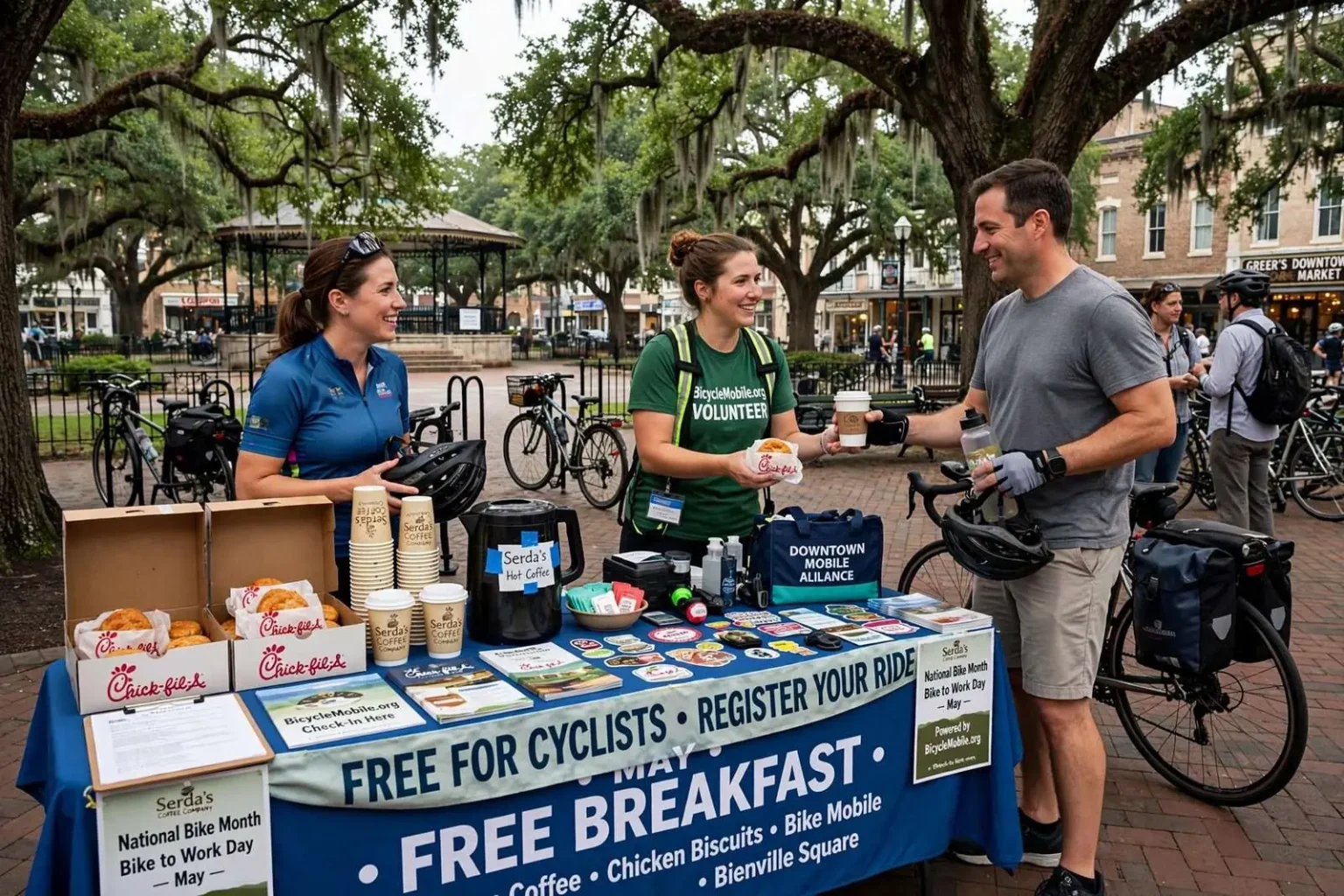
Cyclists commuting into downtown Mobile this Friday morning can pick up a free breakfast as part of National Bike to Work Day, one of several events planned across the city during National Bike Month. The annual observance gives commuters who already ride a reason to celebrate, and gives everyone else a low-stakes opportunity to try bicycle commuting for a day with support waiting at the destination. Organizers hope the single-day experiment will convert some curious drivers into regular two-wheeled commuters as the city’s cycling infrastructure and community continue to grow.
Official recognition from the top
The May observance, aimed at promoting bicycling and cycling safety, has drawn formal recognition from both Alabama Gov. Robert Bentley and Mobile Mayor Sandy Stimpson, who issued proclamations supporting the monthlong push. Proclamations from the governor’s office and City Hall carry practical weight beyond ceremony, signaling to departments and employers that cycling events have official backing. May has been nationally recognized as National Bike Month for decades, and communities across the country fill its calendar with rides, safety classes, and commuter challenges designed to build momentum for better cycling conditions.
Locally, the effort is being coordinated by cycling advocates associated with BicycleMobile.org, who plan to staff a check-in station in Bienville Square from early morning into the evening. The downtown park, one of Mobile’s oldest public squares, will serve as the hub where commuters can register their rides, meet fellow cyclists, and collect their rewards for choosing two wheels over four. Staffing the station through the evening catches commuters on both ends of the workday, including those who ride to work in the morning and return after dark.
Free breakfast for commuters
Bicycle commuters who register at the station will receive chicken biscuits courtesy of Chick-fil-A and coffee from Serda’s Coffee Company, along with additional giveaways organizers say will include items from other downtown businesses such as Greer’s Downtown Market and support from the Downtown Mobile Alliance. The business support reflects the growing recognition among downtown merchants that cyclists are customers too, and that events bringing riders into the core benefit shops, restaurants, and services throughout the business district. Serda’s, a fixture in the downtown coffee scene, has been a repeat supporter of local cycling events.
Anyone unsure of the safest route into downtown can email the organizing group directly for a personalized route recommendation ahead of the ride. Route advice from experienced local cyclists can spare newcomers the intimidating experience of stumbling onto a high-traffic arterial, and advocates stress that a well-chosen route makes the difference between a stressful first commute and an enjoyable one. Many of Mobile’s quieter neighborhood streets connect to the downtown core with only brief stretches on busier roads.
Businesses invited to join
Organizers are also encouraging local businesses to get involved by inviting employees to bike to work that day, with participating businesses set to be highlighted on BicycleMobile.org and across the group’s social media channels as part of the promotion. Employers who participate gain more than a mention on a website; workplace cycling events are associated with healthier employees, reduced parking demand, and a visible commitment to the quality-of-life factors that help downtown employers recruit young workers. Organizers suggest simple first steps, such as hosting a group ride from a convenient meeting point or offering flexibility for employees arriving by bicycle on Friday.
The single-day event is designed to be accessible even to riders who have never commuted by bicycle before. Advocates recommend a trial run over the weekend, a packed change of clothes, and a modest pace, noting that most commutes within the city take less time by bicycle than new riders expect. Flat terrain across much of Mobile’s core keeps the physical demands manageable for riders of ordinary fitness.
Next up: the Crepe Myrtle Trail ride
The push around cycling doesn’t end with Friday’s event. The following day, cyclists are invited to take part in the second annual Crepe Myrtle Trail ride, a free, beginner-friendly group ride exploring the proposed route of a future pathway along Mobile Bay’s western shore. Group rides like this one serve a dual purpose for advocates, giving new cyclists a supportive environment to build confidence while demonstrating to planners and elected officials that substantial public demand exists for the infrastructure being proposed.
The roughly 11-mile ride begins at Arlington Park at 9 a.m., with on-site registration opening a half hour earlier and online registration available in advance through Mobile United’s website. The distance is manageable for casual riders and families, and the group format keeps slower riders comfortable with experienced cyclists sweeping the route. Riders are advised to bring helmets, water, and sunscreen for a morning that will stretch into the middle of the day.
Previewing a future bayshore greenway
Organizers describe the Crepe Myrtle ride as an opportunity for the public to preview a proposed greenway corridor that would eventually connect several points along the bay’s western shoreline, giving residents a firsthand look at a project still in the planning stages. The proposed pathway takes its name from the crepe myrtle trees that line portions of the route, and planners have envisioned it as both a recreational amenity and a functional transportation link connecting waterfront neighborhoods, parks, and destinations along the bay. Riding the proposed corridor lets participants judge for themselves where the route would run, which neighborhoods it would serve, and what gaps would need to be bridged.
Greenway projects of this type typically advance through years of planning, public input, and phased funding before any pavement is poured, which is why advocates treat public engagement rides as a critical part of the process. Each rider who experiences the corridor firsthand becomes a potential voice for the project at public meetings, and the photographs and stories riders share help the wider community imagine what a completed pathway would mean for the city. Communities across the country that built similar waterfront greenways have reported gains in property values, tourism, and everyday quality of life along their routes.
More details on the ride, including updates and route information, have been shared through a dedicated event page on Facebook. Riders planning to attend are encouraged to check the page in the days before the event for any changes to the route or schedule, particularly in the event of weather. The page also serves as a meeting point for cyclists looking to coordinate carpools or meet up with riding partners before the 9 a.m. start.
Building a cycling community
Together, the two events reflect a broader, ongoing effort among Mobile’s cycling community and city leadership to build support for bike infrastructure and encourage more residents to consider cycling as a practical way to get around downtown and along the bay. Every additional rider on the street during events like Bike to Work Day makes the case for better lanes, more racks, and safer connections, and every new rider who sticks with commuting after the event strengthens the community that advocates have spent years building. The back-to-back weekend — a commuter celebration on Friday and a family-friendly ride on Saturday — gives Mobile residents two very different entry points into that community, and organizers are betting that many of the same faces will show up at both.
Why Bike to Work Day matters locally
National Bike to Work Day lands each May as the flagship event of National Bike Month, which the League of American Bicyclists has organized since 1956 to promote cycling for transportation rather than recreation alone. The observance gives cities a ready-made framework for showcasing their cycling communities, and the most successful participating cities use the day to announce infrastructure improvements, launch bike-share programs, and recruit new commuters. Mobile’s participation places it in a national conversation about what mid-sized Southern cities can do to make cycling a practical option, not just a hobby for the avid few.
The timing in May works in the riders’ favor on the Gulf Coast, arriving after the worst of the winter chill but before the deep heat and humidity of summer make morning rides a sweat-soaked proposition. Mornings in mid-May offer some of the most pleasant riding weather the region sees all year, with early sunrise giving commuters plenty of daylight for the trip downtown. Organizers have learned to build the local calendar around that window, when newcomers are most likely to enjoy their first ride rather than merely survive it.
Safety reminders for new riders
Advocates taking part in the weekend’s events consistently pair their promotion with safety fundamentals, and the staffed check-in station gives them a natural venue to share them. Riders are reminded to obey all traffic signals, ride with the flow of traffic, use hand signals for turns, and equip bicycles with front and rear lights for early morning and evening visibility. Helmets are strongly encouraged for every rider, and Alabama law requires them for cyclists under a certain age in many jurisdictions, though advocates recommend them universally.
Drivers, too, have a role in the day’s success. Alabama law requires motorists to give cyclists at least three feet of clearance when passing, and police departments across the state use Bike Month to remind drivers of that requirement. Advocates note that most cyclist-motorist conflicts stem from impatience and poor visibility rather than hostility, and that a week of heightened awareness — with more bikes on the road than usual — tends to leave both groups more attentive afterward.
For organizers, the measure of success for the weekend will be visible months from now, in the riders who keep commuting and in the public support the Crepe Myrtle Trail proposal carries into its next round of planning meetings. Friday’s free breakfast and Saturday’s bayshore preview are the invitation; the growth of Mobile’s cycling community is the response they are hoping to see.