Bird Banding at Fort Morgan: Where Exhausted Migrants Land and Alabama Audubon Catches Its Breath
Each spring Alabama Audubon bands migratory birds at Fort Morgan Historic Site, one of the few public banding sites in the country, drawing crowds and.
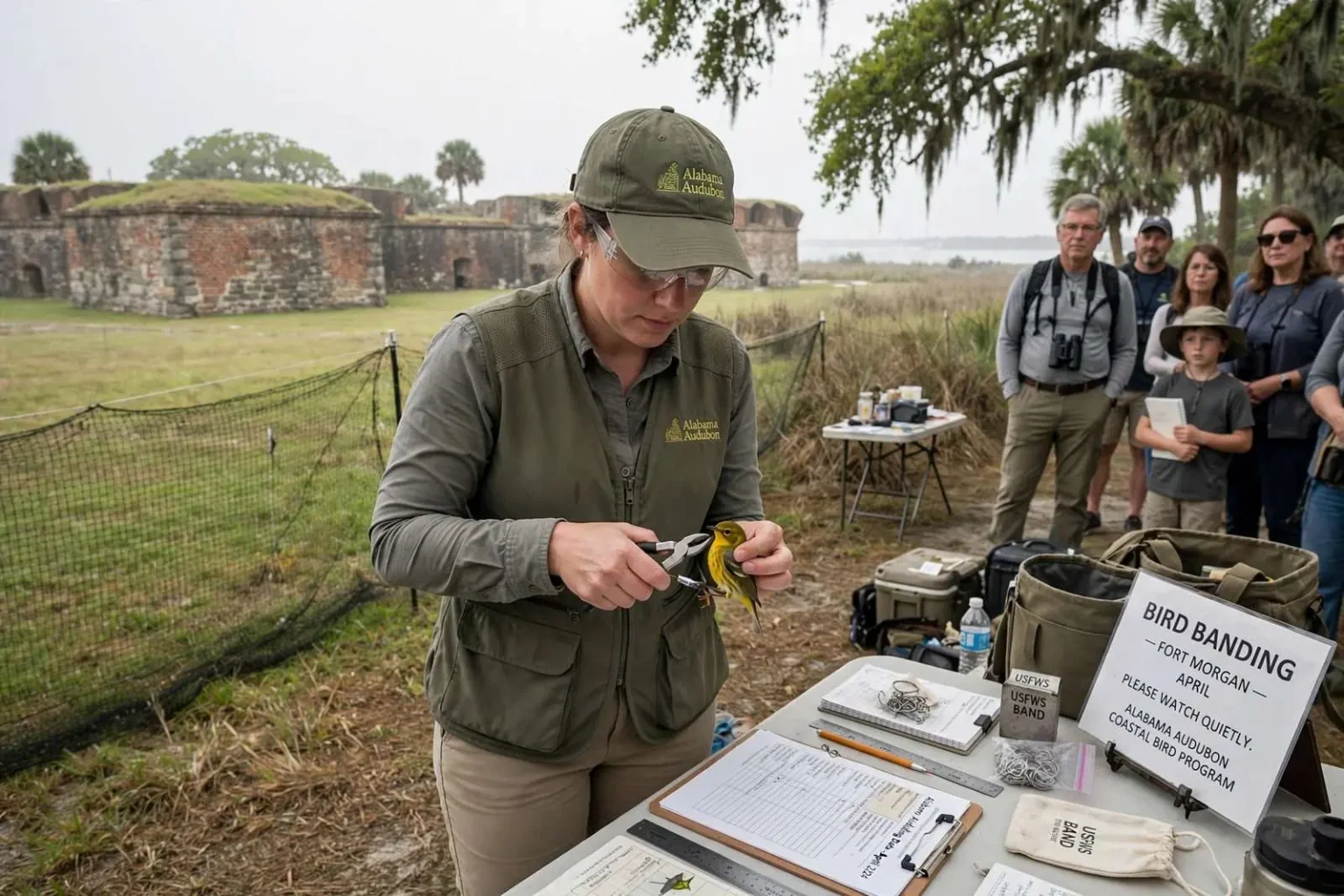
Every spring, millions of migratory birds lift off from the Yucatán and other points south and begin an eighteen-hour, nonstop flight across the Gulf of Mexico. When they finally make land, exhausted and hungry, one of their first chances to rest and refuel is a narrow strip of Alabama coastline — Dauphin Island and Fort Morgan. And for five days each April, the fields of Fort Morgan Historic Site fill with fine mist nets, experienced banders and crowds of visitors who have come to watch the migrants up close.
The Man Behind the Program’s Return
Alabama Audubon’s coastal operation is led on the ground by people like Cortney Weatherby, the organization’s coastal outreach manager, whose own route to the Gulf Coast ran through an unlikely door: Northwest Missouri State University, in her hometown of Murray, Nebraska, happens to have a marine biology department that partners with the University of Southern Mississippi, letting students spend college summers studying on the Gulf. She earned her degree in Ocean Springs, Mississippi, then built a career of coastal education stops — the Florida Keys, Charleston, Homer, Alaska, and the Chincoteague Bay Field Station on Virginia’s Eastern Shore, where she taught families to pull a seine net and put sea life in visitors’ hands. “That’s the stuff that sticks with them,” she says. She joined Alabama Audubon in February 2022.
Alabama Audubon itself dates to 1946 and is headquartered in Birmingham; its coastal office in Daphne opened in 2017. The coastal team — Weatherby, two coastal biologists and an intern — splits its time between the spring banding event and the summerlong monitoring of Alabama’s beach-nesting birds, thirteen species of which lay their camouflaged eggs directly on the sand from Dauphin Island and Fort Morgan to Perdido Key between May and August. The biologists locate and track nests, determine what happened when they fail, and monitor chicks for the 22-to-28-day incubation and roughly 25 more days until the young birds can fly. The Coastal Bird Stewardship Program is funded with Deepwater Horizon natural resource damage settlement funds provided by the Alabama Trustee Implementation Group, with further support from the National Audubon Society through funding from the Alabama Department of Conservation and Natural Resources.
How Banding Works
The banding itself is fast and gentle. Alabama Audubon and its partners — including the Alabama Department of Conservation and Natural Resources, Mississippi State University, the U.S. Fish and Wildlife Service and Fort Morgan State Historic Site — set up fine mist nets into which the returning birds fly. Four or five experienced banders fit each bird with a small metal band carrying a unique number-and-letter combination; the whole process takes fifteen minutes at most, and the birds are released immediately to minimize stress.
Fort Morgan’s site is one of the very few banding operations in the country open to the public, and that is the point. “It is so, so cool,” Weatherby says. “This is an observation and awareness event.” Visitors are welcome to watch and ask questions; volunteer docents encourage learning but not interference. The program’s roots reach back to 1989, when Martha and Bob Sargent started banding at Fort Morgan and ran the event through 2014; Alabama Audubon and its partners picked it up in 2017.
Why It Matters
The bird banding event draws about as many people as it does birds — birders who have attended since the Sargents’ first seasons, curious travelers passing through, and families seeing a warbler at arm’s length for the first time. Weatherby’s hope is simple: good birds and good conversations, and a crop of new bird advocates. Some visitors, she says, have been coming for thirty-plus years; others are just passing through.
Her broader message reaches beyond the event. Alabama Audubon encourages everyone — hardcore birders and backyard watchers alike — to plant native, since native plants attract the insects that attract the birds. And the most telling feedback she gets is from people who have lived on the coast their whole lives without knowing that birds nest on Alabama’s beaches. “I want everyone to know about these birds and why they are worth protecting,” she says. “I love what I do.”
If you find yourself on the Fort Morgan peninsula on a mid-April morning, follow the nets. You’ll walk away knowing something about the Gulf you didn’t know before — and maybe looking at the tiny birds in your own backyard a little differently.
Related coverage from South AL News
- Fort Morgan Bird Banding Returns Oct. 3-10, Offering a Close Look at Fall Migrants
- Alabama Coastal BirdFest: Two Decades of Celebrating the Gulf Coast's Great Birding Region
- Growing Oysters Where the Gulf Meets the Bay: Inside Admiral Shellfish Company at Fort Morgan
- Free 'Coastal Wings & Waves' Class Teaches Orange Beach Adults to Identify Gulf Birds