

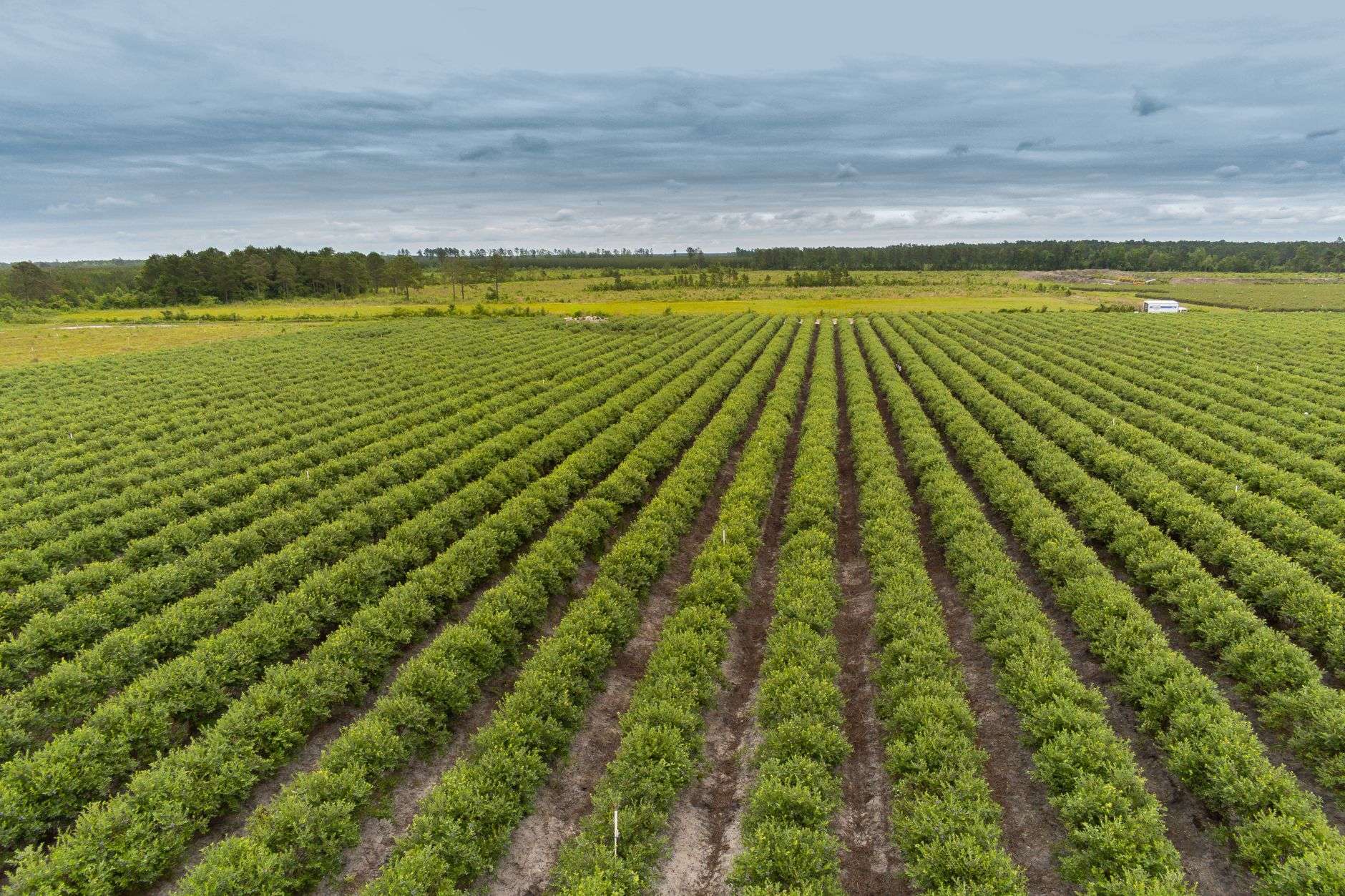
Anyone who turns off U.S. 98 expecting to find a white-columned antebellum mansion at Weeks Bay Plantation is in for a surprise. The scenic property just west of Magnolia Springs has never really been a plantation in the traditional sense. Instead, over the past quarter-century it has been a tree farm, a berry farm, a concert venue, a set of vacation rentals and, above all, the private water-ski paradise of owner Tynes Stringfellow. Now the property is on the market, though its owners plan to hang on to a piece of it.
Drawn South by the Rivers
Stringfellow, a native of Mountain Brook, Alabama, took ownership of the land in 2000, and one of the reasons was his lifelong love of water skiing. Along with acres of farmland, the property holds a 10-acre spring-fed lake that he says is ideal for the sport he has pursued since he was a teenager more than half a century ago.
Skiing is what first brought him to Baldwin County in the late 1970s, long before he found the acreage next to the Weeks Bay National Estuarine Research Reserve. In those days, the Magnolia and Fish rivers, which both empty into Weeks Bay, were nearly empty of development.
“I came down with some friends, and I skied with them, and we went up and down these rivers, and there wasn’t anybody,” Stringfellow recalls. “There were only two houses on the Magnolia River, and there were about four or five on the Fish River. You could ski from one end to the other, buck naked at night, barefoot if you wanted to.”
A Landscaping Business That Put Down Roots
After relocating, Stringfellow founded Jubilee Landscape, Inc., which has continued to prosper for 46 years. When he started, he says, there was just one other landscaping company in the area, owned by Wayne Lambert, and becoming a licensed landscape contractor in Baldwin County required only five dollars and a driver’s license. He figures only a small handful of area landscapers have never worked for him at some point.
The company’s name nods to one of the Eastern Shore’s most famous natural phenomena, the jubilee, when crabs, shrimp and flounder crowd the shallows of Mobile Bay in the early morning hours, a rare event found in only a few places in the world.
Many Names, One Property
The land has gone through several identities since Stringfellow bought it. At the time of purchase, it covered 112 acres, and he has downsized over the years through a series of transitions.
“First, it was Red Roof Landing Farms, which was a tree farm, and then we survived three hurricanes in the same year, and then we started L.A. Berry Farm,” he says. “Then it was in 2011 or 2012 that it became Weeks Bay Plantation. That’s when we planted 20 acres of blueberries, which were 13,870 plants, and now there are about 3,000.”
The farm grew tons of organic blueberries for years and shipped them to retailers around the state. That changed, Stringfellow says, when grocers and other buyers began sourcing cheaper organic berries grown in Mexico. The farm has tried other crops, including tomatoes and organic hemp, but kept 1,500 blueberry bushes for the public to pick on a pick-your-own basis.
The Great Bird Takeover
The customers with the biggest appetite for those berries, however, have wings. Stringfellow’s wife, Heather Rothstein, says birds have devastated the crop in recent seasons.
“It’s been like an apocalyptic bird takeover the last few seasons,” she says. “It started with the cedar waxwings, and then came the crows.”
Cedar waxwings are known for traveling in large flocks and feasting on fruit, and a flock can strip bushes quickly. The couple has tried nearly every deterrent available:
- A loudspeaker system playing the calls of eagles and hawks, which worked until the birds grew used to it.
- Kites flown over the fields.
- Mannequins dressed in bright colors.
- A motion-detecting sprinkler system.
“We’ve tried everything,” Rothstein says. “I’ve even been out there at 4 a.m. with my dogs trying to run the birds off. I can’t describe what it’s like to get so many phone calls and have to tell people I’m really sorry I can’t open up for business because the birds have eaten our crops. For two to three years, I’ve had to do this. It’s devastating.”
A Natural Amphitheater for Live Music
Beyond blueberries, Weeks Bay Plantation has become known for music. With the lake as a backdrop, a wooden stage faces a grassy slope that works as a natural amphitheater in a pastoral setting. In spring 2026, the property hosted the Blooms & Brews Spring Fest in April, followed in mid-May by the two-day Essential Rhythms Music Festival, an event designed to raise awareness of mental health issues.
The Essential Rhythms lineup included The Krickets, Paw Paw’s Medicine Cabinet, Nerf the World, John Hart Project, Destiny Inbound, Chris Spies & Quantum Mechanics, Brynnevere, Matthew Jacquette, Molly Thomas and the Rare Birds, Tensaw Jones and East L.A. Fadeaway.
Hosting concerts is one of the couple’s favorite ways to share the property. “We’re both kind of live music junkies,” Rothstein says. “We chase the Red Clay Strays everywhere, and whoever’s playing within a two-hour radius, we’ll jump in the car and go see them.”
Music runs in her family. Though she grew up in Louisiana and Texas, Rothstein descends on her mother’s side from the Normand family of musicians, who performed regularly at the Grand Hotel in Point Clear from 1941 to 2000. A singer herself, she performed often in New Orleans with the band Category 5 and other acts at venues including Famous Door, Bourbon Street Blues Company and Razoo.
Silos, Cabins and a Frog Symphony
The property’s farm structures have found new uses. A two-story grain silo serves as the couple’s office, and a smaller silo holds laundry facilities for guests staying at the four Airbnb rentals on site:
- A recently renovated, converted Airstream trailer.
- Two quaint cabins.
- A two-bedroom rental called the Lake House.
“It offers a birds-eye view of the lake, and when it hasn’t rained for a while, it’s crystal clear, and you can see so many fish,” Rothstein says of the Lake House. The lake holds plenty of largemouth bass and some crappie, plus a tarpon that Stringfellow believes was accidentally stocked by an osprey or eagle passing overhead.
“At night, you can hear what I call the frog symphony,” Rothstein says. “We’ve actually had people come out and record them because of all of the different species that you can hear.”
Still Skiing, Still Winning
Guests often notice jump ramps in the water and the buoys marking a slalom course. Stringfellow never lost his passion for skiing and continues to compete in regional championship tournaments, frequently bringing home trophies, ribbons and medals. He believes his lake beats even the quiet rivers that first drew him from the Birmingham area.
“The pH in this water, for some reason, is perfect for skiing,” he says. “It’s so fast behind the boat, yet in the turns it’s slow.”
For Sale, With a Few Acres Held Back
Drivers on U.S. 98 near Mary Ann Beach Road often spot the sign for Weeks Bay Plantation and turn in, assuming it is a well-known tourist attraction. There is no gate at the end of the driveway, and visitors are welcome to look around even when no one is home, which many do.
Lately, they may also notice a for-sale sign. A sale could close a chapter spanning 25 years of Stringfellow’s life and the last eight of Rothstein’s. But the couple is not planning to leave entirely. Stringfellow recently ordered another thousand blueberry plants, an early-ripening variety that matures before the intense summer heat makes picking a chore.
“There are 46 total acres, and I want to keep 16,” he says. “That would include our office and the Airbnb stuff and my one little field, so I can maintain my little blueberry business. And whoever buys it can have all the blueberries they want to eat.”
Whatever comes next, the property’s story says a good deal about this corner of south Baldwin County, where the rivers were once empty enough to ski end to end at night, and where a landscaper with a love for the water built something that belongs to no single category.