A traffic stop on Interstate 10 near Mobile last week led to the arrest of a man authorities say was smuggling cocaine hidden inside the spare tire of a minivan, according to federal and local law enforcement officials. The seizure removed a substantial quantity of narcotics from one of the Gulf Coast’s busiest highway corridors and added to a long string of interdiction cases along the route that carries commercial and personal traffic across the region.
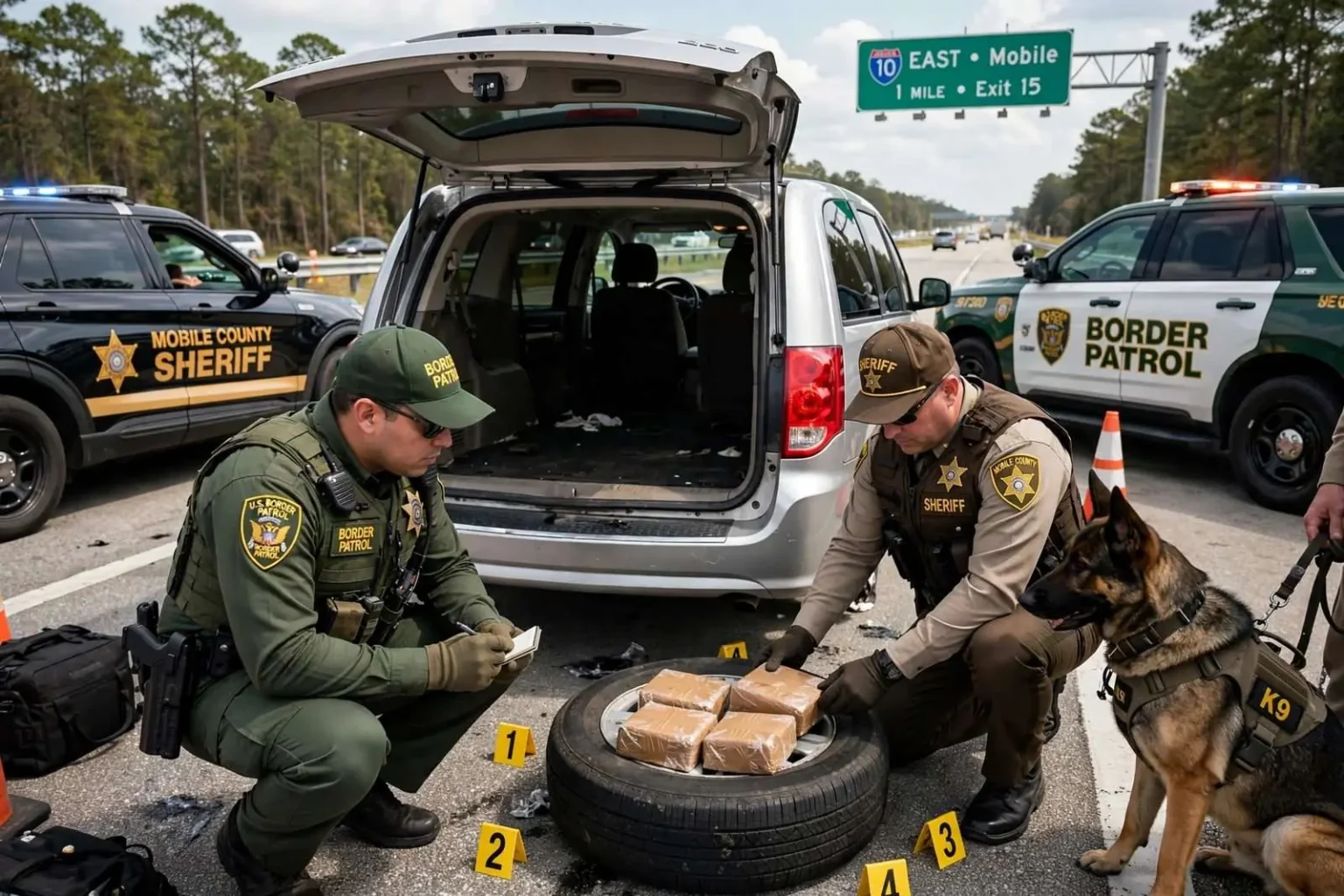
U.S. Border Patrol agents, working alongside Mobile County Sheriff’s Office deputies, stopped a 2020 Dodge Caravan traveling eastbound on I-10 last Thursday. The stop brought together two agencies whose cooperation on the highways around Mobile has become routine, pairing federal border authorities with county patrol deputies who know the local stretches of interstate and the traffic patterns that move through them every day.
Agents said the driver displayed nervous behavior and gave answers that did not add up during questioning at the scene. Inconsistencies in a driver’s account of a trip, combined with visible signs of nervousness, are among the indicators that trained officers use to decide whether a stop warrants a closer look at the vehicle, and officials said both were present during the questioning on the interstate.
A Border Patrol K9 on hand for the stop alerted to the possible presence of hidden contraband inside the vehicle, prompting a closer search. Canine alerts are a standard step in highway interdiction work, giving officers legal grounds and practical direction for a more thorough examination of compartments that would not otherwise draw attention. The K9’s alert pointed the search team toward the areas of the minivan where the drugs were ultimately found.
Drugs found in the spare tire
A Mobile County sheriff’s deputy assisting with the stop found four bricks of cocaine concealed inside the minivan’s spare tire. The hiding place reflected the kind of modification investigators see in smuggling cases, in which vehicle compartments are altered or used to stow packages that a visual inspection would likely miss without a canine alert or a detailed physical search.
Investigators estimated the seized drugs weighed roughly 10.47 pounds, with a street value of about $335,134.47. The weight and estimated value placed the seizure well above the amounts typically associated with personal use, and the packaging in bricks is consistent with distribution-level quantities moving along trafficking routes rather than with drugs destined for a single user.
The driver, identified as a 44-year-old Guatemalan national in the country on a visitor visa, was taken into custody at the scene. His immigration status became part of the case file alongside the smuggling allegations, and the arrest on the interstate marked the beginning of proceedings that would involve both the criminal charges tied to the drugs and the federal immigration system.
He now faces smuggling-related charges tied to the discovery. The charges flow from the cocaine found in the vehicle he was driving, and prosecutors will weigh the quantity, the concealment method and the circumstances of the stop as the case moves forward through the federal system that handles most interstate drug interdiction arrests in the region.
The case moves to federal hands
Following the arrest, the driver, the cocaine and the minivan were turned over to Homeland Security Investigations’ New Orleans office, which is expected to continue the case going forward. The handoff is a common arrangement in Gulf Coast interdiction work, where patrol-level agencies make the initial stop and seizure and then transfer the arrest to the federal investigative arm that has the resources to pursue the larger trafficking picture behind a single load.
HSI’s New Orleans office covers a district that includes the Gulf Coast states’ major corridors, and cases handed to it from stops along I-10 typically involve efforts to trace the load’s origin, its intended destination and any broader network connected to the shipment. The evidence from the scene, including the drugs themselves and the modified vehicle, becomes part of that federal investigation once the transfer is complete.
For the agencies involved, the stop demonstrated the division of labor that defines highway interdiction in the region. Border Patrol agents bring immigration and border-related authority along with canine support, the sheriff’s office contributes local knowledge of the interstate and the manpower to conduct detailed searches, and HSI takes over the investigative work that follows an arrest. The structure allows a single traffic stop to escalate quickly into a federal drug case without the local agency bearing the full weight of the prosecution.
A familiar method on Gulf Coast highways
Concealing narcotics inside spare tires, door panels and other vehicle compartments is a smuggling method federal agents say they encounter periodically along Gulf Coast highway corridors, including stretches of I-10 that run through Mobile County. The interstate serves as a principal east-west artery connecting Texas, Louisiana, Mississippi, Alabama and Florida, and its continuous route through the region makes it a favored path for loads moving between supply points and distribution markets.
Aftermarket compartments and repurposed vehicle spaces present a persistent challenge for interdiction officers. A spare tire well is large enough to hold multiple packages yet unremarkable to a passing glance, and similar hiding places in door panels, seat frames, gas tanks and battery compartments appear repeatedly in seizure reports across the Southeast. Training for highway interdiction emphasizes both the indicators that flag a vehicle for closer scrutiny and the search techniques that reveal these concealment methods.
Multi-agency cooperation between Border Patrol and local sheriff’s deputies, as seen in this stop, is common practice for interdiction efforts in the area. Mobile County’s position along the interstate, within reach of the Port of Mobile and the highways that feed it, places its deputies and federal partners at a natural chokepoint for traffic moving through the central Gulf Coast. Joint operations allow the agencies to pool personnel, canines and legal authorities during checkpoints and targeted enforcement periods.
No further details on the driver’s route or origin were released as the investigation continues. Officials withheld information about where the minivan began its trip and where it was headed, details that remain part of the active federal investigation. The seizure itself, however, added to the public record of narcotics interdiction along the I-10 corridor, where stops of this kind recur throughout the year and regularly produce arrests, seizures and handoffs to federal investigators.
What the seizure means for the region
Cocaine seizures of this size along the Gulf Coast reflect the continued movement of the drug through the region’s highways, ports and logistics networks. Mobile’s position as a deepwater port city with rail lines and interstate connections makes the surrounding corridors a natural screening ground for federal and local agencies, and loads intercepted on the highway represent one part of a supply chain that authorities try to disrupt at every stage.
The street value attached to a seizure like this one illustrates why distribution-level shipments continue to move despite the enforcement risk. Quantities packaged in bricks are typically destined for sale across multiple markets rather than for local consumption alone, and the estimated value gives prosecutors a figure they use in weighing charges and in describing the scope of the alleged operation in court filings.
For travelers on I-10 through Mobile County, stops of this kind are a visible reminder of the enforcement presence along the corridor. Drivers passing through the area regularly see the markings of Border Patrol vehicles and sheriff’s units staged near interchanges, particularly during coordinated enforcement periods. The agencies involved in last week’s stop have maintained that presence for years, and arrests arising from it are announced periodically as cases are transferred and charged.
The driver’s arrest at the scene also highlights how quickly a routine-looking traffic stop can develop into a federal case. What began as questioning about the trip became a canine deployment, a detailed search of the minivan, the discovery of four bricks hidden in the spare tire, and a custody transfer to federal investigators within a matter of hours. The minivan, now part of the evidence in the case, remains in federal hands along with the cocaine as the New Orleans office continues its investigation into the shipment and anyone connected to it.
How authorities track the supply chain
When a seizure like this one reaches HSI, investigators typically work backward from the vehicle. Registration records, toll data, phone information gathered under court authority and interviews with the driver all feed into an effort to identify who assembled the load, who paid for it and where it was headed. Those threads rarely resolve quickly, which is one reason officials release little information about routes and origins while a case remains open.
The courtroom phase of such cases unfolds separately from the public announcements. Charges tied to the cocaine discovered in the spare tire will be tested against the legality of the stop, the canine alert and the search that followed, each of which can become a point of challenge by the defense. For the agencies that made the stop, the documentation of those steps is as important as the seizure itself, because a case lost on procedure erases the value of the drugs taken off the road.
Residents of the Mobile area have watched this cycle repeat along the interstate for years: a stop, a seizure, an arrest and a quiet transfer of the case into the federal system. Last week’s discovery of four bricks inside a minivan spare tire followed the same well-worn path, and its outcome will join the long record of interdiction work that continues daily on the highways crossing the central Gulf Coast.