Rep. Bradley Byrne Returns from Cuba Trip, Says Havana Still Has Work to Do
Rep. Bradley Byrne visited Cuba in 2015 and remained cautious on normalized relations, even as Mobile's port and sister-city ties raised local stakes.
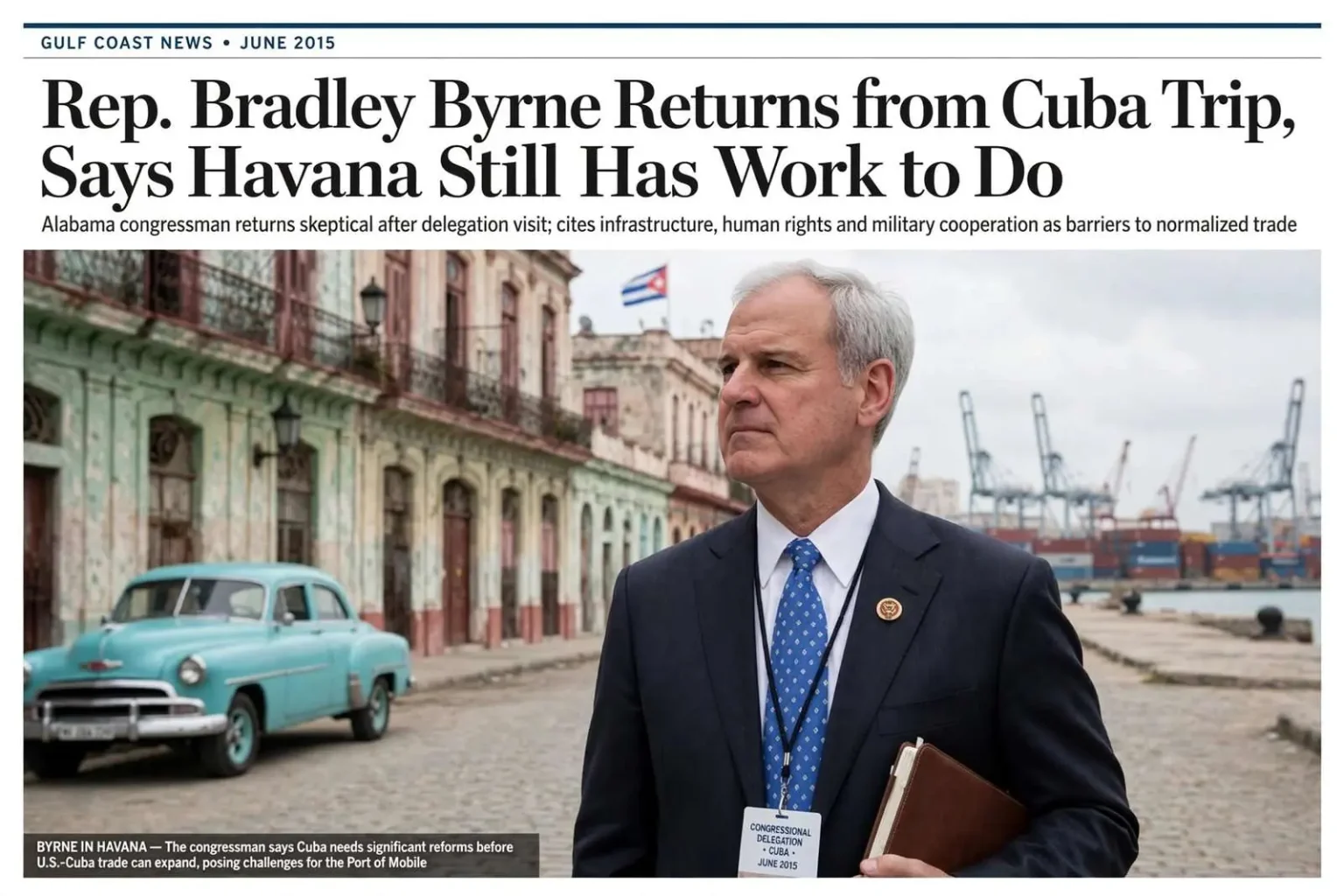
U.S. Rep. Bradley Byrne, R-Fairhope, returned from a congressional trip to Cuba in early summer 2015 with his skepticism about normalizing relations with the island nation largely unchanged, even as the Obama administration moved to formally restore diplomatic ties.
Byrne, who represents much of south Alabama including the Mobile area, traveled to Cuba as part of a bipartisan congressional delegation organized by a Washington-based group that advocates for closer U.S.-Cuba relations. The group met with Cuban government officials, business owners, scholars and everyday citizens during the visit, part of a broader wave of congressional trips to the country following the December 2014 announcement that the two nations would reestablish diplomatic relations.
The timing put Byrne’s trip in the local spotlight: Mobile has held a sister-city relationship with Havana for years, and the city’s port leaders have long argued that normalized trade with Cuba could open new shipping and business opportunities for the Port of Mobile.
What Byrne saw and what he concluded
Byrne acknowledged Cuba’s potential as a trading partner but said the country still needs significant reforms before that potential can be realized, pointing to its infrastructure and treatment of its own citizens as ongoing concerns. The infrastructure problem is visible to any visitor: decades of underinvestment have left Cuban ports, roads and warehouses unable to handle the container traffic a modern trading relationship would bring, a reality that tempers the enthusiasm of companies eyeing the island’s market of roughly eleven million people just off the Gulf Coast.
His position puts him at odds with the administration’s approach, which removed Cuba from the U.S. list of state sponsors of terrorism during the same period. Byrne has previously criticized the pace of normalization from the floor of the House, arguing the U.S. should extract firm concessions from Havana before easing restrictions further.
Following the trip, he added a new condition, calling on Cuban officials to bar military cooperation with U.S. adversaries such as Russia within Cuban airspace and waters. The demand reaches back to the island’s Cold War history — Cuba’s location ninety miles from Florida made it a Soviet foothold for decades, and the prospect of renewed Russian military activity in the hemisphere has remained a recurring worry for Gulf Coast lawmakers whose districts sit on the front line of any such positioning.
Why Cuba matters to the Port of Mobile
For a district anchored by one of the Gulf Coast’s busiest ports, the debate carries direct economic stakes, as any eventual opening of Cuban trade routes could reshape shipping patterns through Mobile for years to come. The Port of Alabama has spent two decades building itself into a container powerhouse — expanding its terminal, deepening expectations for the channel, and courting the shipping lines that move cargo between the Gulf, Latin America and the Caribbean.
Cuba sits inside that geography. An island a short sail from Florida, with a population that needs everything from poultry and grain to construction materials and machinery, represents a natural near-market for Gulf ports — the kind of short-haul trade where Mobile’s location gives it an edge. Port proponents have imagined agricultural exports, infrastructure-related cargo and growing container volumes flowing south, with return shipments of Cuban goods feeding the region’s food processing and distribution businesses.
The sister-city relationship between Mobile and Havana, maintained through years when formal relations were frozen, has always been framed as groundwork for that possibility — cultural contact kept alive so that commercial contact could follow when politics allowed. Byrne’s skepticism does not sever that groundwork, but it signals that Alabama’s Gulf Coast delegation intends to drive a hard bargain before the trade doors swing open.
The politics of normalization
The December 2014 announcement that the United States and Cuba would reestablish diplomatic relations set off a scramble in Washington over how far and how fast to go. The administration moved by executive action — easing travel categories, reopening the embassy channel and pulling Cuba from the terrorism list — while the embargo itself remains written into law, untouchable without an act of Congress. That split left lawmakers like Byrne holding real power over the endgame: the travel and trade rules can only be fully unwound by the House and Senate, and every member’s vote depends on exactly the kind of district-level calculus south Alabama illustrates.
Byrne’s approach — demanding concessions on infrastructure, human rights and military cooperation before supporting broader opening — places him in the mainstream of Gulf Coast Republican opinion, which has treated normalization as a negotiation rather than a concession. His framing that the embargo will eventually end and Americans will one day travel freely to Cuba distinguishes him from embargo defenders who oppose any opening; his argument is about the terms, not the destination. He described his approach as pushing for a better outcome rather than blocking engagement altogether.
The distinction matters for interest groups on both sides. Agriculture organizations and port authorities across the Gulf have lobbied for years to expand trade with Cuba, recalling the brief window in the early 2000s when American food exports flowed to the island under a carve-out that allowed cash sales of agricultural goods. Gulf ports, including Mobile, were direct beneficiaries then, and the memory of that trade — and of how quickly it faded when financing rules tightened — shapes their lobbying today.
What the region stands to gain — and lose
For Mobile, the stakes run through the port and beyond it. Container volumes feed trucking, warehousing and distribution jobs across south Alabama; agricultural exporters from the Black Belt and the wider Southeast route products through Mobile to reach Caribbean and Latin American markets; and every new shipping line that calls at the port adds to the industrial base along the Mobile River. Cuba, fully opened, would be a addition to that network rather than a transformation of it — but a meaningful one, in a region that has bet its economic future on maritime trade.
The counterweights are the ones Byrne named. A Cuban market without functioning port infrastructure cannot receive container ships at scale; a government that restricts what its citizens can buy limits demand regardless of supply; and the political risk of investing in Cuban trade remains high while the embargo’s legal architecture stands. Businesses that remember companies losing claims and assets after earlier Cuban openings came to nothing — properties nationalized in the revolution, debts unpaid — approach the market with that history in mind.
Byrne’s conclusion after walking Havana’s streets and meeting its officials and citizens was neither blockade nor embrace: go slow, demand reforms, and let the Gulf Coast’s ports be ready when the island’s is. For a congressman whose district ends at the docks where that trade would arrive, the position is both philosophy and constituency — a belief that engagement is coming, and that south Alabama should get its full worth from it.
The delegation trip and what these visits are for
Congressional delegations to Cuba have followed a familiar rhythm since diplomatic relations began thawing: a bipartisan group, arranged by an organization promoting engagement, several days on the island, and a schedule packed with meetings designed to show members every face of Cuban society at once. Government officials give their case for normalized relations; entrepreneurs describe the small private businesses now permitted under Cuban reforms; scholars explain the system’s history; and ordinary citizens, in carefully managed encounters, describe daily life under the embargo and the rationing that shapes it.
The trips are advocacy by itinerary, and members of Congress know it. What they take away depends on the member: some return convinced that engagement will accomplish what isolation could not, others confirmed that the Cuban government’s structure — the same party, the same ministries, the same restrictions on press and assembly — remains the obstacle. Byrne’s trip landed him firmly in the second camp, though his acknowledgment of Cuba’s potential as a trading partner kept him short of full opposition.
The wave of congressional travel after the December 2014 announcement reflected the moment’s urgency. With executive action proceeding and legislation looming, both supporters and opponents of normalization wanted first-hand impressions to carry into the coming debates — and members from Gulf Coast districts had an extra reason to go, since the trade question would land in their ports before most of the country noticed it anywhere.
A port district’s congressman
Byrne’s district map explains his priorities. Alabama’s First District runs along the state’s Gulf Coast and up through the timber and agricultural counties north of Mobile, taking in the Port of Alabama, the shipyards, and the distribution corridors that connect them. Port issues are not abstract in the district: the Alabama State Port Authority is among the region’s largest economic engines, and its fortunes set the tone for everything from trucking employment in Mobile County to soybean prices in the interior.
That constituency shaped the congressman’s Cuba position as surely as any ideology. A member whose port needs volume, whose farm counties need export markets, and whose naval and aviation installations need a secure Gulf cannot treat Cuba as a purely symbolic issue; the island sits at the intersection of all three. His demand that Cuba bar Russian military cooperation from its airspace and waters speaks to the installations, his infrastructure critique to the trade practicalities, and his insistence on concessions to the bargaining posture the district’s exporters have long favored.
The early-summer timing of his return left the normalization debate in mid-stream, with embassies not yet formally reopened and the large questions — the embargo, the claims, the full trade relationship — still ahead. Byrne’s trip added one more Gulf Coast voice to that debate, and one more reminder that whatever Washington decides about Cuba, the consequences will arrive first at ports like Mobile, where the ships would actually dock.