City-by-city breakdown of COVID-19 cases in Northwest Florida
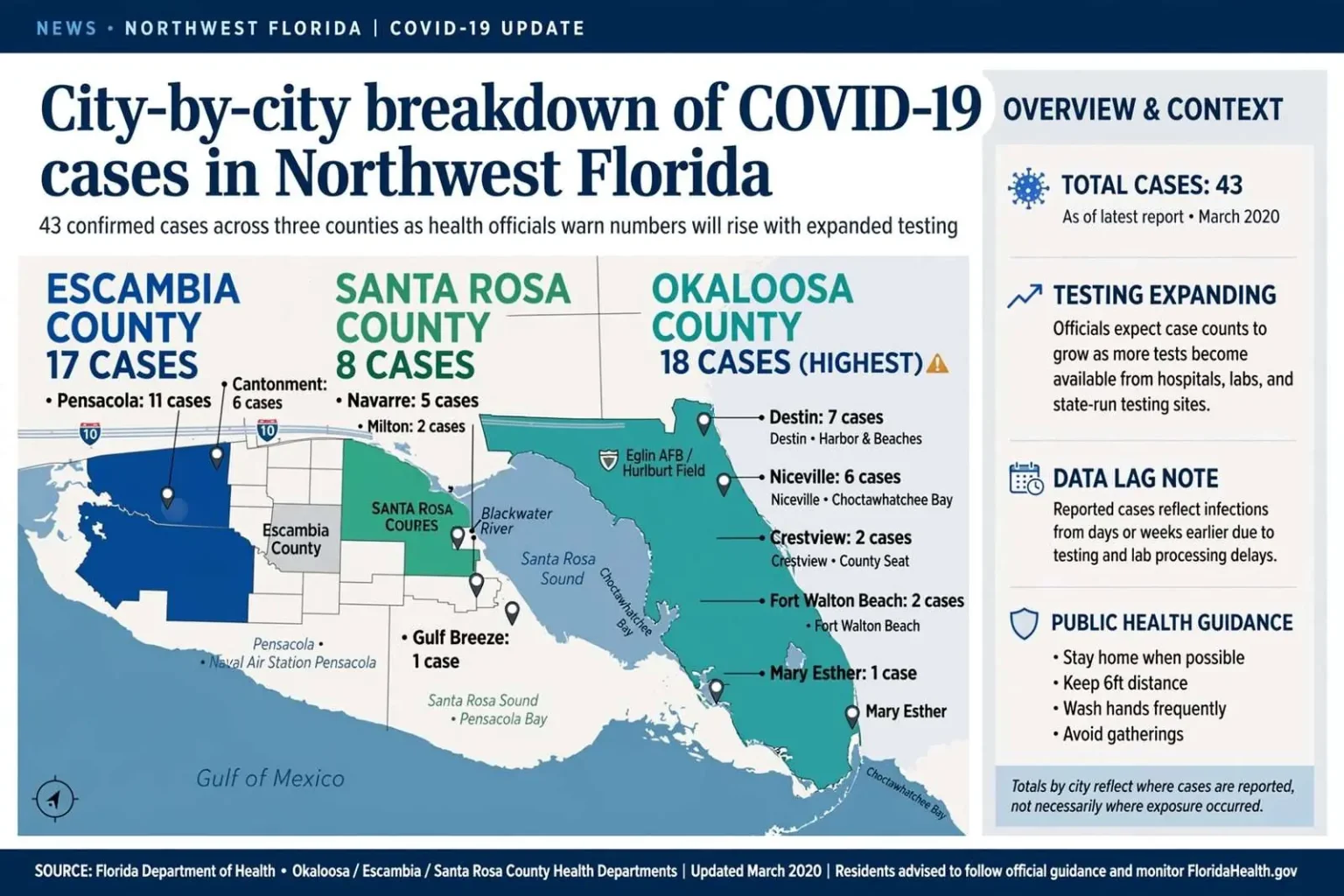
Northwest Florida reported 43 confirmed COVID-19 cases across Okaloosa, Escambia and Santa Rosa counties, with Okaloosa leading at 18, officials said.
PENSACOLA, Fla. — Northwest Florida has seen an increase in positive coronavirus cases, and health experts say the numbers will keep climbing as testing expands. The latest figures showed 43 people with COVID-19 across three Northwest Florida counties in the viewing area. Health officials cautioned that the totals reflect a rapidly changing situation, with new results arriving daily from commercial laboratories, hospital systems and state-run testing sites.
The three counties — Okaloosa, Escambia and Santa Rosa — anchor the western Panhandle, a stretch of the Gulf Coast better known for its beaches and military installations than for a public health emergency. The arrival of the virus in the region changed daily life almost overnight, closing schools, emptying restaurants and prompting officials to urge residents to stay apart from one another.
Public health leaders emphasized that the case counts published on any given day are a snapshot of infections contracted days or weeks earlier, because of the time it takes for symptoms to appear and for laboratory results to come back. That lag, they said, makes it difficult to measure exactly how quickly the virus is moving through the community at any moment.
Okaloosa County reports the highest number of cases
Okaloosa County recorded the highest number of cases among the three, with 18 people testing positive for COVID-19. The county’s cases were spread across several of its largest communities: Destin with 7, Niceville with 6, Crestview with 2, Fort Walton Beach with 2 and Mary Esther with 1.
Okaloosa County sits along the Emerald Coast between Pensacola and Panama City, and its economy leans heavily on tourism and the military. Eglin Air Force Base and Hurlburt Field employ thousands of service members and civilians, while Destin’s harbor and beaches draw visitors from across the Southeast each spring and summer.
Destin, a city of roughly 14,000 full-time residents, swells with vacationers during the spring break season, when crowded beaches and condominium towers are the norm. That seasonal influx, combined with steady travel along Highway 98 and U.S. 331 from inland points, has long made the coastal corridor a place where illnesses can spread quickly from one community to the next.
Niceville, home to Northwest Florida State College and a large retiree population, lies along Choctawhatchee Bay just north of Destin. Crestview, the county seat, sits inland along the Interstate 10 corridor at the crossroads of U.S. 90 and State Road 85, while Fort Walton Beach and Mary Esther line the sound between the mainland and Okaloosa Island.
Local officials in Okaloosa have stressed that the distribution of cases among cities does not necessarily indicate where infections occurred, since residents may be tested, treated or counted in the community where they live rather than where they were exposed.
Escambia County counts 17 cases, led by Pensacola
Escambia County, Florida’s westernmost county, reported 17 cases, with 11 in Pensacola and 6 in Cantonment. Pensacola is the region’s largest city and the seat of county government, home to Naval Air Station Pensacola, the Port of Pensacola and a downtown core of offices, hospitals and restaurants.
As the urban center of the Panhandle, Pensacola draws commuters from across the region and hosts travelers year-round. The city’s proximity to the Alabama line — Mobile lies just about an hour to the west along Interstate 10 — means residents regularly cross the state line for work, shopping and medical care, tying the two metro areas closely together.
Cantonment, an unincorporated community north of Pensacola along U.S. 29, is anchored by industry and surrounding rural land. Its inclusion in the case count underscored that the virus was not limited to the beaches and downtown districts, but was reaching communities of every size across the county.
Escambia County’s case total included residents of all ages, according to the state’s published data. Health officials declined to discuss individual patients, citing privacy protections, and noted that many early cases in an outbreak are typically linked to travel before community spread becomes the dominant pattern.
Santa Rosa County reports 8 cases across three communities
Santa Rosa County, which stretches from the Alabama line to the sugar-white sands of Navarre Beach, reported 8 cases: 5 in Navarre, 2 in Milton and 1 in Gulf Breeze. Milton, the county seat, sits along the Blackwater River northwest of Pensacola, while Gulf Breeze occupies the peninsula between Pensacola Bay and Santa Rosa Sound.
Navarre, a fast-growing beach community connected to the mainland by a single bridge over the sound, has expanded rapidly in recent decades as families and retirees moved to the coast. Its beaches are a major draw during the tourist season, and many of its residents commute to jobs in Pensacola or at the area’s military installations.
Gulf Breeze, immediately east of Pensacola across the bay, functions in many ways as a suburb of the city, and its residents shop, work and attend medical appointments in Escambia County. Milton’s position along the rail lines and rivers of the northern county has long made it a hub for communities such as Jay, Bagdad and Point Baker.
Health officials in Santa Rosa noted that with small numbers, a single additional test result can shift the picture in any one community overnight, and they urged residents not to read the city-level counts as precise measures of risk in their own neighborhoods.
Testing expansion is expected to drive the numbers higher
The experts’ warning that the numbers will keep climbing as testing expands reflects how the count of confirmed cases works. Early in an outbreak, limited test availability means many people with symptoms are never tested, so the official tally captures only a fraction of true infections. As more tests become available through hospitals, commercial laboratories and drive-through sites, more existing infections are counted, and the total rises even if the virus is spreading at the same pace.
Florida’s Department of Health operates county health departments in Okaloosa, Escambia and Santa Rosa counties, and those offices coordinate case investigations, contact tracing and public reporting. Investigators work to identify people who were in close contact with confirmed cases and advise them to quarantine, an effort that becomes more demanding as the number of cases grows.
Statewide, the Department of Health publishes daily updates on cases, testing and deaths, and the county-level figures for Northwest Florida are part of that larger picture. Officials have asked residents to rely on official sources rather than social media for information about the outbreak, noting that rumors about closures and cases have circulated widely in the region.
Residents respond with caution and a measure of resolve
Residents said they were disturbed by the sudden increase but understood the need to keep their distance. Across the three counties, the changes were visible in everyday life: parking lots emptied out, church services moved online, and families canceled spring trips and gatherings that once would have filled their calendars.
Local governments have taken a range of steps to slow the spread, from limiting beach access to restricting occupancy in restaurants and retail stores. School districts across the Panhandle moved to remote instruction, leaving parents to juggle work and childcare while campuses remain closed to students.
Health officials continue to recommend the same basic precautions: stay home when possible, keep at least six feet away from people outside your household, wash hands frequently with soap and water for at least 20 seconds, avoid touching the face, and disinfect commonly touched surfaces. Residents who develop fever, cough or shortness of breath are urged to call a health care provider before visiting a clinic or emergency room, so staff can prepare and limit exposure to others.
What comes next for the Panhandle
Area hospitals have also adjusted their operations in response to the outbreak, screening visitors, rescheduling elective procedures and setting aside capacity for a potential surge in patients. Health system leaders across the region have repeated the same message: the steps residents take now, before the peak arrives, will determine how much strain the community’s medical resources face in the weeks ahead.
With 43 confirmed cases across Okaloosa, Escambia and Santa Rosa counties and testing still ramping up, officials expect the regional totals to grow in the days ahead. They have asked residents to treat the rising numbers not as a cause for panic but as a reason to take distancing guidance seriously, particularly for older adults and people with underlying health conditions who face the greatest risk of severe illness.
The coming weeks are expected to show whether the measures now in place can slow the spread enough to keep hospitals from being overwhelmed. In the meantime, the county health departments continue to post updates, answer questions and trace contacts — and residents across the western Panhandle are adjusting to a new rhythm of life defined, for now, by caution and distance.