Coast Guard Rescues Three From Fishing Vessel Fire South of Pascagoula
The Coast Guard rescued three people from the burning fishing vessel Lucky Angel about 10 nautical miles south of Pascagoula Channel.
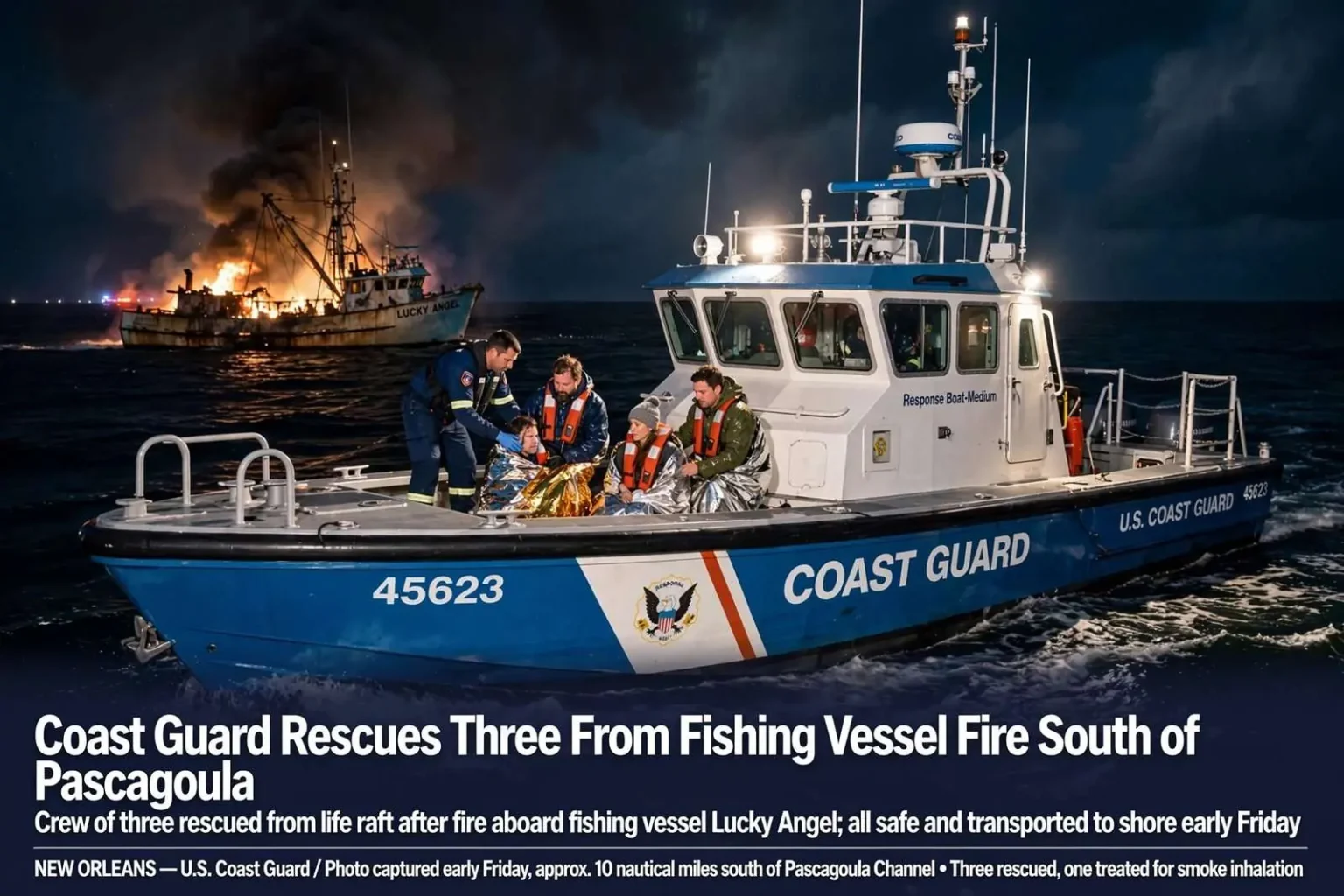
NEW ORLEANS — The Coast Guard rescued three people from the commercial fishing vessel Lucky Angel after it caught fire about 10 nautical miles south of Pascagoula Channel on Thursday, bringing the crew home to shore after a nighttime emergency on the Gulf of Mexico. All three people aboard were returned to shore safely, and the quick coordination between watchstanders, state agencies and local boat crews turned a potentially deadly vessel fire into a rescue with no loss of life.
Watchstanders at the Eighth Coast Guard District received a report around 10:30 p.m. from a crew member aboard the Lucky Angel that the vessel was on fire. The call came in at a critical moment — a burning commercial vessel at night, with the crew’s only escape routes being the ship’s life raft or the open water of the Gulf — and set in motion the emergency response that followed.
One crew member was taken to Singing River Hospital in stable condition after being evaluated by EMS, while the other two were evaluated and released to shore without requiring hospital transport. The Mississippi Department of Marine Resources provided a more precise location using a cell phone ping, a piece of technology-assisted search-and-rescue work that helped responders find the crew faster in the dark.
The rescue, step by step
A 45-foot Response Boat-Medium crew launched from Coast Guard Station Pascagoula, located the three people in a life raft and transported them to Bayou La Batre, where EMS crews were waiting. The sequence — report, pinpoint, launch, recover, transport — unfolded over a matter of hours across two states’ worth of emergency infrastructure, with the rescue itself completed in the early hours of Friday morning.
The 45-foot Response Boat-Medium is a workhorse of Gulf Coast search and rescue, built to handle sea states that would sideline smaller boats and equipped for towing, dewatering and crew recovery. Station Pascagoula’s crew faced a night sortie of roughly 10 nautical miles south of the channel, navigating toward a position refined by the cell phone ping provided through the Mississippi Department of Marine Resources.
Finding a life raft at night on open water is among the most difficult problems in search and rescue, since rafts sit low in the water, move with wind and current, and present a small radar and visual signature. The DMR’s phone-ping data narrowed the search area enough for the rescue crew to close the distance and recover all three mariners from the raft without injury beyond what they had already suffered.
Commercial fishing and the risks of the Gulf
The Lucky Angel’s emergency is a reminder of the risks that come with commercial fishing, one of the most dangerous occupations in the United States. Vessel fires at sea can start from engine room malfunctions, electrical faults, fuel leaks or galley accidents, and a fire aboard a fishing vessel spreads fast — the boats carry fuel, lubricants, propane and flammable gear, and the crew’s options are limited to firefighting with what is aboard or abandoning ship.
When a fire takes hold beyond the reach of shore-based firefighters, the life raft becomes the plan. Survival craft requirements under federal commercial fishing vessel regulations exist precisely for nights like this one, and the Lucky Angel’s crew putting to sea with a functioning raft and the means to call for help made the difference between a rescue and a tragedy.
The agencies behind the response
The Eighth Coast Guard District, headquartered in New Orleans, coordinates search and rescue across the Gulf of Mexico and the nation’s heartland waterways, and its watchstanders are the first link in any offshore emergency chain. When the 10:30 p.m. call came in from the Lucky Angel, the watchstanders’ job was to assess the urgency, task the nearest available rescue asset and keep communications open with the vessel as it burned — all while coordinating with state and local partners.
The Mississippi Department of Marine Resources’ contribution highlighted the interagency nature of modern search and rescue. Cell phone location data — imprecise on its own, but invaluable when combined with a vessel’s last known position — has become a standard tool for narrowing searches, and the DMR’s ability to obtain and relay that information quickly gave the Coast Guard a workable search box instead of a vast expanse of open Gulf.
Coast Guard Station Pascagoula, located at the mouth of the Pascagoula ship channel, serves as the primary rescue unit for the south Mississippi coast, standing watch over the waters south of Pascagoula, the barrier islands and the fishing and shipping traffic that moves through the channel daily. Its 45-foot Response Boat-Medium crews train for night operations, and the station’s proximity to the fire scene made it the natural launch point for the rescue.
On the receiving end, Bayou La Batre’s EMS crews stood ready when the rescue boat came in. The small Baldwin County fishing village has long served as a landing point for Gulf emergencies, with a working waterfront, hospital access and a location roughly midway along the coast that makes it a practical destination for rescues in the waters south of Pascagoula.
Singing River Hospital and the injured crew member
The one crew member transported for medical care went to Singing River Hospital in Pascagoula, where EMS evaluated the person in stable condition. After hours in a life raft on the Gulf, exposure and smoke inhalation are the primary medical concerns for rescued mariners, and hospital evaluation is standard even when injuries appear minor. The other two crew members were assessed by EMS on shore and did not require hospitalization.
The Pascagoula Channel and Gulf fishing grounds
The waters about 10 nautical miles south of Pascagoula Channel are familiar fishing grounds for the commercial fleets that work out of Pascagoula, Bayou La Batre and the small-boat harbors of the north-central Gulf. The channel itself is a federally maintained waterway serving the shipyards and ports of Jackson County, and the waters south of it host shrimp boats, oyster boats and other commercial vessels that run the Gulf’s fishing seasons year-round.
Vessel fires in these waters draw on a response network built from long experience. The Gulf Coast’s search and rescue system — Coast Guard stations and air units from Texas to Florida, state marine resources agencies, county EMS services and the fishing communities’ own mutual-aid habits — exists because emergencies like the Lucky Angel’s happen regularly in one of the busiest commercial waterways in the world.
What happens next for the Lucky Angel
The cause of the fire is under investigation, and the vessel’s fate — whether it burned to the waterline, sank or remained afloat — will be sorted out in the days that follow as salvage and insurance assessments proceed. Investigations of commercial vessel fires typically examine the engine room, electrical systems and fuel systems, looking for the origin point and any regulatory violations that may have contributed.
For the three crew members, the rescue ends a night that began as a routine fishing trip and became a fight for survival. All three were returned to shore safely — the outcome every search and rescue case hopes for, and the outcome that the coordination of the Eighth District watchstanders, the Mississippi Department of Marine Resources, Station Pascagoula’s boat crew and Bayou La Batre’s EMS delivered in the early hours of Friday morning.
Mariners heading out of the north-central Gulf ports are reminded that working communications equipment, registered emergency position-indicating radio beacons and functioning survival craft are the tools that turn a distress call into a rescue. The Lucky Angel’s crew had what they needed Thursday night — a way to call, a raft and responders ready to launch — and they are back on shore because of it.
How a vessel fire call unfolds
For those who have never heard the mechanics of an offshore emergency, the Lucky Angel case offers a clear picture of how the system works. It begins with a call — here, a crew member reaching watchstanders at 10:30 p.m. to report fire aboard. Watchstanders log the position, the number of people aboard, the nature of the emergency and the vessel’s survival equipment, then determine the fastest capable responder. In this case, Station Pascagoula’s 45-foot Response Boat-Medium was the right tool: close enough to reach the scene quickly, large enough to handle Gulf conditions at night, and crewed to take aboard survivors.
While the boat was underway, the Mississippi Department of Marine Resources worked the communications problem, obtaining a cell phone ping that sharpened the search picture. That coordination between federal and state agencies is routine on the Gulf Coast, but it matters enormously in the minutes that count. A rescue boat searching a 10-mile radius at night may spend hours; one vectored to a refined position finds the raft on the first pass.
The final link was medical. By the time the response boat turned for Bayou La Batre with three survivors aboard, EMS crews were already positioned at the dock, ready to evaluate smoke exposure, hypothermia and injuries as each person came ashore. From first call to hospital evaluation, the entire chain functioned the way it is designed to — and three Gulf fishermen are home because every link held.