A woman died Friday afternoon after she opened fire on Mobile County sheriff’s deputies who had come to a Coden property to investigate a disturbance call, and a deputy returned fire, striking her, according to the Mobile County Sheriff’s Office. The shooting unfolded on an otherwise quiet afternoon in a rural corner of southwestern Mobile County, and it left a family property marked by gunfire and a community asking how a disturbance call ended in a death.
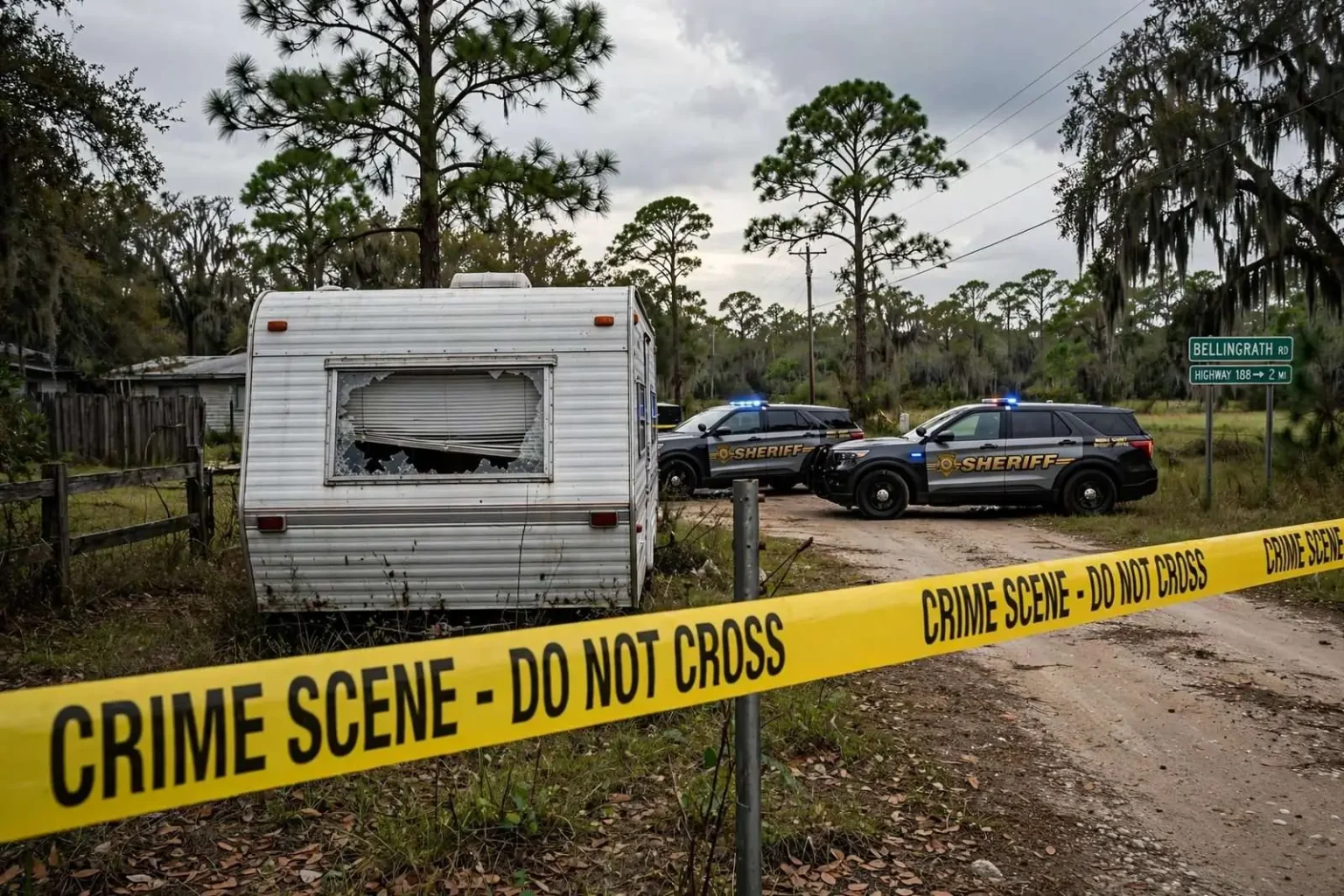
The incident began as a routine request for help. Deputies were dispatched to a residence on Bellingrath Road near Highway 188, in a part of southwestern Mobile County dotted with family compounds and shared homesteads, after someone at the property reported a disturbance. What they encountered when they arrived would prove anything but routine.
Capt. Paul Burch said the property is occupied by several members of the same extended family, and it was one of those relatives who first called for help. The arrangement — multiple households of parents, children, siblings and in-laws sharing one tract of land — is common in Coden and the surrounding bayou communities, where families have held the same homesteads for generations.
Deputies responding to the call were told by the person who reported the disturbance that the woman described as acting erratically had retreated into a camper trailer parked at the back of the property, Burch said. The report gave deputies a location and a description but no immediate indication of weapons, and they proceeded on foot toward the trailer to try to speak with her.
Shots from the trailer window
When deputies walked toward the trailer to try to make contact with her, she began shooting at them through a window without warning. “As deputies approached and attempted to establish contact, she began firing at them from a window,” Burch said. “One deputy returned fire and she was struck.”
The exchange was brief but intense. The woman fired multiple rounds at the deputies during the encounter, but no officers or other people on the property were hit, Burch said. She was pronounced dead at the scene. Deputies on the property secured the area and, in the hours that followed, the Sheriff’s Office worked to piece together the sequence of events that turned a family disturbance into a fatal shooting.
The fact that no deputies or family members were struck by the woman’s shots was among the few uncontested facts of the afternoon. Encounters in which a subject fires from within a structure pose particular danger not only to officers but to everyone on a shared property, and relatives who had gathered at the homestead were left to absorb both the gunfire and its aftermath.
What remains unknown
The Sheriff’s Office has not released the names of the deputy involved or the woman who was killed, and it remains unclear what led to the initial disturbance call or how long the confrontation lasted before shots were fired. Those questions — the nature of the disturbance, what prompted the woman’s erratic behavior, and whether she fired before or after any command was given — will be central to whatever review follows.
Deputies who arrived at the scene were responding to a call about a disturbance, not a shooting, which raises the standard questions investigators ask in such cases: what training and de-escalation options were available, what the deputies knew before approaching the trailer, and whether anything short of gunfire could have ended the encounter differently. Answers to those questions typically emerge only when the reviewing agency completes its work.
Officer-involved shootings in Alabama are typically reviewed by an outside agency, and it is standard practice for deputies involved in a shooting to be placed on administrative leave while the incident is investigated. The Mobile County Sheriff’s Office has not said whether that step has been taken in this case or which agency, if any, is leading the review.
How officer-involved shootings are reviewed
The practice of outside review exists to provide a layer of independence when an officer’s use of deadly force ends a life. In jurisdictions across Alabama, that review can be handled by the district attorney’s office, the Alabama Law Enforcement Agency, or another law enforcement agency called in to reconstruct the scene, collect evidence and interview witnesses before any conclusion is drawn about whether the force used was legally justified.
The process generally follows a familiar arc. Investigators map the scene, collect the weapons and shell casings involved, examine the ballistic evidence to establish who fired what, and interview the deputies and family members present. Findings typically go to a district attorney, who determines whether the use of force was lawful, and may be presented to a grand jury in contested cases. Only after that process concludes do agencies usually release names and detailed accounts.
Administrative leave for the involved deputy serves two purposes at once. It removes the officer from duty while the investigation proceeds, and it recognizes the psychological weight of a fatal encounter. Departments treat the leave as neither punishment nor exoneration — a distinction that matters to both the deputy and the public as the review unfolds.
Coden: a close-knit community on the sound
Coden is an unincorporated community in southwestern Mobile County near the Mississippi Sound, known for its fishing heritage and close-knit, multigenerational family properties similar to the one where Friday’s shooting occurred. The community sits at the end of a peninsula defined by bayous, boat launches and working waterfronts, where the seafood industry and family ties run generations deep.
Life in Coden moves to the rhythms of the water. Families share tracts of land passed down through decades, camps and trailers sit beside brick homes, and neighbors know one another by name and by boat. Law enforcement presence in the community is light by design — the area depends on sheriff’s patrols that cover a wide swath of rural Mobile County — and deputies who answer calls in such places often know the families involved.
Incidents of gunfire involving law enforcement remain rare in the small community, and neighbors along Bellingrath Road were left shaken by the violence on an otherwise quiet afternoon. For a community where most emergencies involve storms, fires or medical crises on the water, an afternoon of police gunfire in a family compound was an event unlike anything most residents had witnessed close to home.
The toll on family and community
The circumstances — an extended family calling for help with one of its own, and the call ending in her death — carry a weight that extends beyond the legal questions to come. The relatives who reported the disturbance sought assistance for a family member in crisis; hours later, they were witnesses to a fatal shooting on their own property.
Mental health crises figure in a substantial share of encounters that turn deadly between police and the public, and the pattern has driven reforms nationally — from crisis intervention training for deputies to co-responder models that pair officers with mental health professionals. Whether any such options were available or considered in this case will be a natural question for the review, as will what support the family’s original call for help was seeking.
Those answers, like the names of those involved, await the investigation. What is clear from Friday is the sequence: a family called for help, deputies approached a trailer at the back of the property, gunfire came from a window, and a deputy’s return fire ended the encounter within minutes.
A developing story
This is a developing story, and this article will be updated as the Mobile County Sheriff’s Office releases additional details, including the identities of those involved and the findings of any forthcoming investigation.
Until then, the facts on the record are these: a woman firing from a camper trailer on Bellingrath Road near Highway 188 was struck by a deputy’s return fire and pronounced dead at the scene; no officers or others on the property were injured; the Sheriff’s Office has identified no one publicly; and the questions that matter most — what prompted the disturbance, what the deputies knew, and whether the shooting was justified — now rest with the review process that follows every fatal encounter between law enforcement and the public.
When a welfare call becomes a deadly force encounter
The circumstances of Friday’s shooting fall into one of the most difficult categories in modern policing: a call for help regarding a person in crisis that ends with that person dead. Departments across the country have spent the past decade retraining officers for exactly these encounters, on the theory that the first minutes of contact — tone, distance, the decision to approach or to wait — often determine whether a disturbed person and a deputy walk away.
Deputies in Mobile County, as in most of Alabama, operate without dedicated mental health clinicians riding alongside them, and the judgment calls in a fast-developing encounter fall to the officers on scene. Approaching a trailer to make contact with a person reported as acting erratically is standard practice; whether that approach leaves room for de-escalation depends on what the deputies knew, what they could see and how the subject reacted in the seconds before the first shot.
Investigators will reconstruct those seconds with the tools available: interviews with the family members who called and the deputies who responded, the physical evidence in and around the trailer, and the ballistics that establish the sequence of fire. The woman fired multiple rounds, and the deputy who returned fire fired at least once; establishing the timing and the positioning of each will be central to the finding that follows.
The questions a review must answer
Any review of the incident will weigh a consistent set of questions. Was the deputy in reasonable fear of death or serious bodily injury when he fired — a standard that Alabama law, like that of other states, applies to use of deadly force? What did the deputies know before approaching: only the report of a disturbance and a woman behaving erratically, or additional information suggesting she was armed? What options existed between walking toward the trailer and not approaching at all?
The answers will determine whether the shooting is ruled justified, a determination that in most such cases hinges on the threat the deputies faced at the moment force was used rather than on the tragedy of the outcome. The fact that the woman fired multiple rounds without warning, striking no one only by chance, will factor heavily into that analysis.
The review will also examine the department’s side of the equation: whether the response followed policy, whether the involved deputy had received crisis intervention or de-escalation training, and whether the Sheriff’s Office’s handling of the aftermath — administrative leave, notification of a reviewing agency, communication with the family — met the standards the department has set for itself.
For the family on Bellingrath Road, none of that process returns what Friday took. Their call for help was the ordinary act of relatives confronting a loved one in crisis; the outcome was an extraordinary loss that no investigative finding can reverse. The community around them, and the deputies who answered the call, are left with the same afternoon to replay and the same question everyone in such cases asks — how it could have gone differently — until the review supplies what answers it can.