Coffeeville’s Ashton Shepherd Set to Open for Lee Ann Womack at The Steeple
Coffeeville native Ashton Shepherd opens for Lee Ann Womack at The Steeple in Mobile on Sept. 19, while working on her fifth studio album.
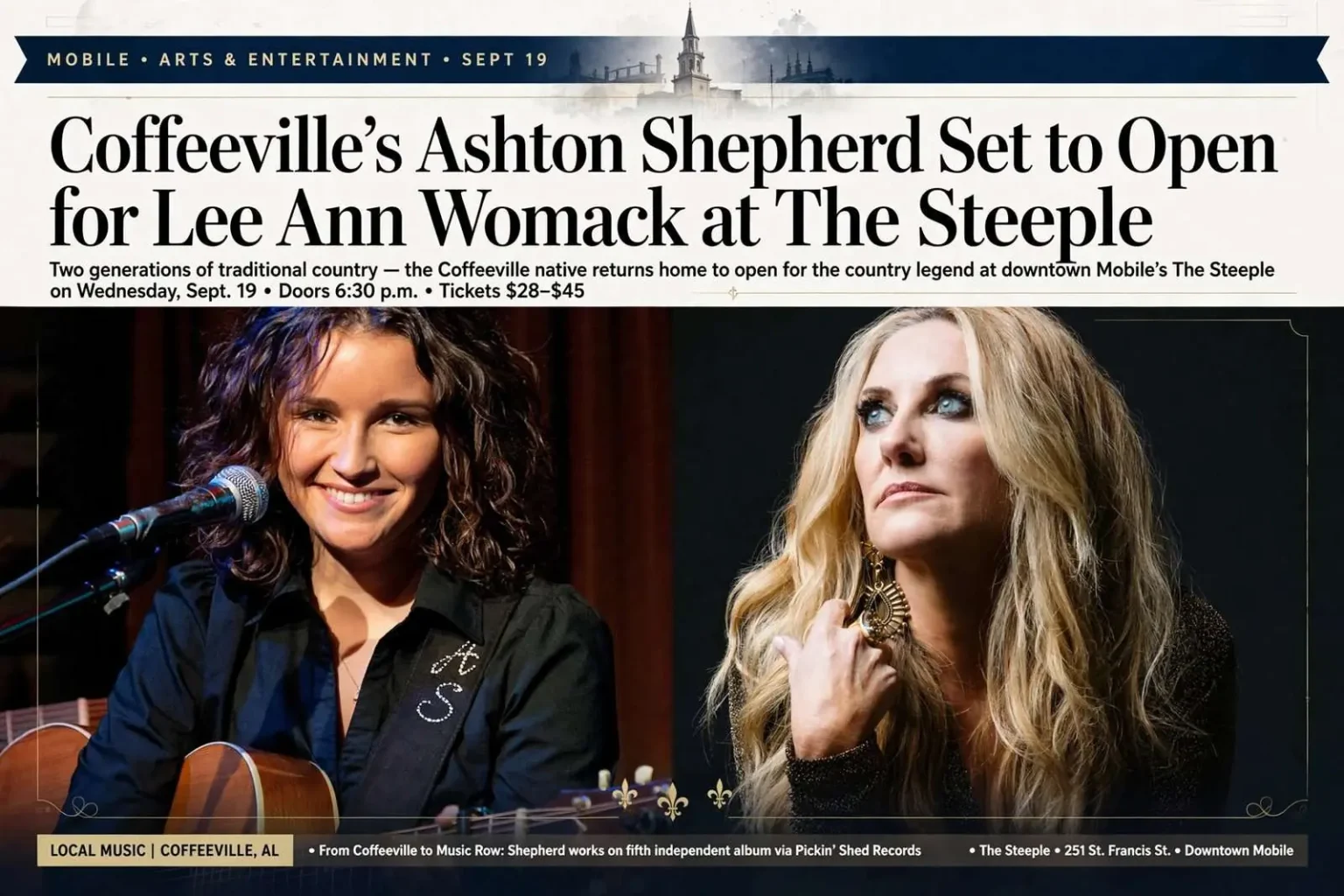
Country singer-songwriter Ashton Shepherd, a native of Coffeeville in Clarke County, is set to open for Lee Ann Womack at The Steeple in downtown Mobile on Wednesday, Sept. 19. Doors open at 6:30 p.m., and tickets range from $28 to $45 through the venue’s website. The pairing puts two generations of traditional-minded country women on one bill — the headliner a standard-bearer of classic country vocals, the opener one of Alabama’s own, returning to a Gulf Coast stage within driving distance of where it all started.
Shepherd, who grew up in the small Clarke County community before building a career in Nashville, is currently working on her fifth studio album. For an artist who first drew national attention as a young wife and mother singing in a style that skipped past pop-country trends entirely, a fifth record is a milestone few independent country artists reach. Her path — major-label start, family life, self-built comeback — has become part of her story as much as her songs.
From Coffeeville to Music Row
She was signed to MCA Nashville after the label was won over by her heartfelt songwriting and classic country delivery. At a time when the industry’s mainstream was drifting toward pop production, Shepherd’s fiddle-and-steel arrangements and unvarnished voice marked her as an outlier — and, briefly, a bet that traditional country could still sell. Her early records earned radio play and a national audience without asking her to trade the accent or the subject matter of home.
After parting ways with the major label, Shepherd launched her own independent imprint, Pickin’ Shed Records, named for the space at her home where she writes much of her music. The name tells you everything about the operation: the writing happens where the artist lives, in rural Clarke County, not in a Nashville writers’ room on Music Row. Running her own label made her responsible for every step a label team once handled — and she has been candid about what that learning curve looked like.
Learning the business from scratch
In a conversation ahead of the Mobile show, Shepherd reflected on the winding path her career has taken, from balancing motherhood with life on the road to learning the business side of the music industry from scratch after leaving her major-label deal. She said the shift to independence meant learning everything herself, from distributing records and getting music onto platforms like iTunes to designing her own promotional materials.
“It was literally like going back to school,” Shepherd said of the transition. “I had such a large team doing it for me through Universal. They connected the dots with the manager and the booking agents and business management and different publicists inside the label. The good news is that I paid attention to all of it through my career, but I never had to hands-on do it.”
Her account is a window into how much invisible labor a record deal absorbs. On a major label, an artist writes and records while agents, publicists and business managers handle the machinery; on their own, they become the machinery. For an artist raising a family in Coffeeville while keeping a national touring schedule, the DIY route has meant long nights on spreadsheets between shows — and, she says, a clearer sense of ownership over the result.
Shepherd also manages her own social media accounts, something she says has helped her build a closer relationship with her fan base. “The fact that how much the fans appreciate it… they know I’m going to be the one to answer them or respond, and I’m reading their comments,” she said. She believes that personal connection has become more valuable to her career than simply reaching the widest possible audience. In an era when followers can be bought and feeds can be scheduled by a publicist, an artist who genuinely answers her own comments is a rarity — and her fans have noticed.
The direct line runs both ways. Fans get access that a label filter once blocked; Shepherd gets immediate feedback on what resonates, which songs stick and what a show audience wants to hear again. For an independent artist without radio promotion muscle, that loop is not a vanity — it is distribution, marketing and market research in one, handled from the same coffee table where the songs get written.
New music on the way
The singer said fans picked up on hints she has dropped about new music, which she confirmed is in the works. She has been performing a mix of brand-new songs and older, unreleased material at recent shows and said she is sorting through 15 to 20 songs to determine which four or five to record first, with an eye toward choosing a single. The careful curation reflects the new economics of the business: with each recording funded by the artist herself, the first release has to earn its keep.
Shepherd said she has a photoshoot scheduled in Nashville to kick off promotion for the new project, with plans to record several songs by the end of September and potentially complete a full album before the end of October. The timeline is aggressive by any standard, but it reflects the freedom of the independent model — no label calendar to wait for, no release windows to negotiate, just the artist’s own schedule and studio time.
She is also considering releasing a companion set of stripped-down “work tape” versions of the songs alongside the finished, produced tracks. Work tapes — the rough recordings songwriters make as a song takes shape — carry a particular cachet with country audiences, who often say they prefer the naked version to the polished one. Releasing both would let listeners hear the song twice: as it was born and as it grew up.
“I’m super hopeful too,” Shepherd said. “I don’t know if it means another major deal or that I’ll grow extra legs in the independent market. I know it means something special.” The open-endedness is itself a position: after the major-label years, she is not chasing a logo on the album so much as an audience that shows up. Whatever the next record proves, she intends to measure it by the fans who stream it, come to the shows and answer back online.
The Mobile show
Wednesday’s show pairs Shepherd with headliner Lee Ann Womack at The Steeple, located at 251 St. Francis St. in downtown Mobile. Tickets are available through the venue’s website. The Steeple, a converted church building in the heart of downtown, has become one of the Gulf Coast’s favorite listening rooms — a venue where the acoustics reward singers who can actually sing, which makes it natural ground for both artists on the bill.
Womack, a Jacksonville, Texas native with a career spanning decades of country and Americana acclaim, brings a catalog of vocals-first recordings that dovetail with Shepherd’s traditional leanings. For Shepherd, opening for a singer of that stature is both a homecoming and a statement: the Coffeeville songwriter on a downtown Mobile stage, half an hour’s drive down the highway from where she learned to sing, sharing a bill with one of the genre’s respected voices.
For local fans, the night offers a look at both ends of a country music career — the established headliner and the independent artist building her second act one venue, one answered comment and one work tape at a time. Doors open at 6:30 p.m., and with the new album taking shape in the background, the Mobile audience will get an early hearing of songs that may define Shepherd’s next chapter before the recordings even hit the platforms.
Why her home region matters to the record
Place runs through Shepherd’s music the way the Tombigbee runs through Clarke County, and her home region has always been more than an origin story. The pineywoods around Coffeeville gave her the vernacular — the hunting camps, the front-porch pickin’, the small-town church calendar — that made her early records sound lived-in rather than manufactured. Nashville producers spent years trying to teach mainstream country what authenticity sounds like; Shepherd brought hers with her, and listeners in south Alabama recognized it instantly.
That regional loyalty pays off in the touring life too. Shows within driving distance of Coffeeville draw the fans who have followed her since the first record — the same families who watched her play local fairs and church benefits before the label deal. A Mobile date sits squarely in that home territory, which is why the Wednesday show functions as something more intimate than a tour stop: it is the neighborhood turnout for one of its own, five albums into a career that never moved her away for good.
The fifth album, when it arrives, will land in a very different industry than the one that signed her out of Coffeeville. Streaming replaced radio as the discovery engine, social media replaced the press kit, and a self-run label like Pickin’ Shed Records is no longer a consolation prize but a working model that a growing share of country artists now choose on purpose. Shepherd got there earlier than most, and by necessity — but the conversation ahead of the Mobile show made clear she has stopped treating independence as a detour. It is the road itself, and she is building the next record right on it.