Escambia County commission votes to keep public beaches closed
The Escambia County Commission voted 4-1 to keep public beaches in the Pensacola, Florida area closed as the coronavirus pandemic continued.
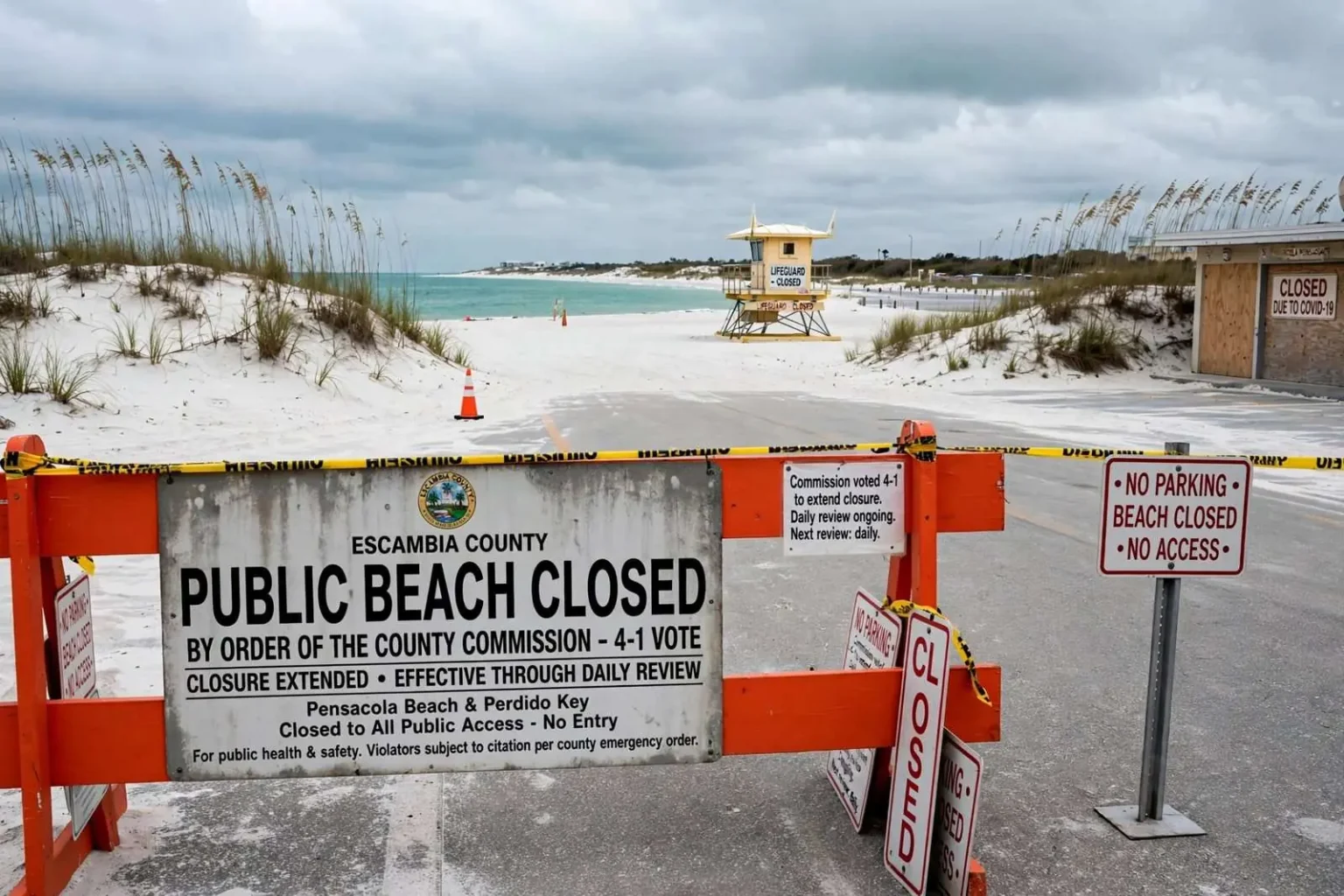
PENSACOLA, Fla. — The Escambia County Commission voted 4-1 to keep public beaches closed, extending a closure that had been set to expire. The decision came the day before a two-week beach closure was scheduled to end.
The vote extended one of the most visible pandemic-era restrictions on Florida’s Panhandle coast, keeping the sugar-white sands of Pensacola Beach and Perdido Key off-limits even as pressure built from residents, business owners and visitors to reopen. County commissions along the Gulf Coast faced the same calculation that spring: the beaches are the region’s economic engine, but they are also public spaces where crowds defeat the distancing that public health officials were urging. In Escambia County, the board sided with continued closure, at least for now.
The timing mattered as much as the vote itself. With the two-week closure expiring the following day, the commission had to decide whether to let the restriction lapse by default or affirmatively extend it. Choosing extension, the board signaled that conditions had not changed enough to justify reopening the shoreline to the public, whatever the economic cost to the beach communities that depend on seasonal traffic.
Underhill’s Lone Dissent
Commissioner Doug Underhill was the lone commissioner to argue for reopening the beaches to local residents. ‘I do believe it’s time to re-open the beaches to locals,’ Underhill said. ‘The governor’s already made sure the welcome mat to Florida has been already rolled up. If you’re not already here, don’t come. There’s no place for you to stay.’
Underhill’s argument rested on a distinction between locals and visitors. With the governor’s statewide restrictions aimed at discouraging out-of-state travel, the commissioner reasoned that out-of-town visitors were already staying away — hotels and short-term rentals were shut down, so there was nowhere for tourists to stay regardless. In that landscape, he argued, an open beach would serve primarily the people who lived in Escambia County year-round, who could walk on the sand while keeping their distance from one another.
Underhill said he believes the Escambia County Sheriff’s Office can help enforce social distancing on the beaches while they remain open, and he stressed the importance of getting people who work along the beaches back to work.
The enforcement argument addressed the chief practical objection to reopening: that crowds would ignore distancing and turn the sand into a vector for the virus. Underhill’s position was that the Sheriff’s Office, already stretched across pandemic-related duties, could manage beach behavior the way it manages any other public space. The jobs argument carried its own weight in a coastal economy built on restaurants, rental properties, charter boats, beach services and tourism retail, all of which sat idle while the sand stayed closed.
The majority was unmoved, and the 4-1 margin showed how wide the gap was between the dissent and the board’s consensus. Public health considerations, the example being set by neighboring counties and the state’s own guidance all pointed toward continuing the closure, and the majority chose to hold the line at least until data supported a change.
Residents Weigh In, Surfers Make Their Case
Dozens of residents submitted comments that were read at the meeting, with opinions both for and against reopening. The public comment record reflected the split that defined the pandemic’s early months on the Gulf Coast: some residents desperate for access to the water and the normalcy it represents, others worried that reopening would invite crowds and undo the progress of the shutdown.
A number of local surfers asked for an exception to allow them in the water, describing surfing as an isolated activity. ‘We specifically requested that the beaches remain closed, but an exception should be made for surfers,’ said local surfer Nolan Hasting. ‘Surfing is an isolated sport with the majority of us looking to find breaks without other surfers.’
The surfers’ position was notable for its restraint. Rather than calling for the beaches to open outright, they accepted the closure’s logic and asked only for a carve-out — access to the water by people who, by the nature of their sport, enter it alone or in small groups, space themselves out in the lineup, and never touch shared equipment. Hasting’s comments described a community that actively avoids crowds, making the case that allowing surfers in the water would add almost nothing to the public health risk while preserving access to the Gulf for a small, self-policing group.
The exception was not adopted, and the beaches remained closed to all comers. For the surfing community along the Panhandle, the decision meant weeks away from the water during a season when Gulf surf — often stirred up by spring weather systems — can offer some of the year’s best conditions.
What Comes Next
The commission said it will continue reviewing public health data daily and could call an emergency meeting to revisit the decision. That commitment to daily review set up a rolling process rather than a fixed calendar: the closure would end when the data said so, not on a predetermined date. An emergency meeting, if called, could reopen the beaches ahead of the next regular session if conditions improved quickly — or tighten restrictions if they worsened.
Escambia County’s position among Florida’s Gulf Coast counties made its decision one that neighboring communities watched closely. The county’s beaches — Pensacola Beach on Santa Rosa Island and the Perdido Key shoreline — draw visitors from across the Southeast, and any reopening in Escambia would create pressure on adjacent jurisdictions to align. The county’s daily-review commitment acknowledged that reality: whatever the board decided next would ripple up and down the coast.
The vote also captured the broader tension that defined the pandemic’s first spring in Florida’s beach towns. Tourist economies need visitors; public health orders needed the visitors to stay home. The governor’s messaging — the rolled-up welcome mat Underhill referenced — tried to thread that needle by discouraging travel without dictating every local closure. County boards like Escambia’s were left to make the fine-grained calls, weighing empty hotels against crowded sand, and every decision drew organized supporters and opponents.
For now, the board’s answer was patience. The beaches would stay closed, the data would be reviewed each day, and the residents of Escambia County — surfers included — would learn by announcement, not by calendar, when the sand reopened. The 4-1 vote, the comments read into the record, and the promise of daily review together illustrated how local government operated that season: publicly, incrementally, and one two-week window at a time.
Reading submitted comments aloud at the meeting became a hallmark of the pandemic-era public meeting. With gathering restrictions in place and residents unable to fill the chamber in the usual numbers, the written comment substitute gave the board a direct sample of community sentiment — and gave the audience a picture of how divided their neighbors were. Dozens of submissions, split between reopen-now voices and keep-it-closed voices, meant whichever way the board voted, a substantial share of the public would leave the meeting unhappy.
The surfers’ exception request fit into a pattern that played out in coastal communities nationwide that season: groups whose activities were inherently isolated asking to be distinguished from crowds. Joggers, anglers, boaters and surfers all made versions of the same argument — that the purpose of the closure was preventing crowds, and their activities did not create them. Boards generally struggled with how to draw those lines. An exception for surfers raises immediate enforcement questions — who qualifies, how it is checked, whether the exception becomes cover for general beach access — which is why many commissions, including Escambia’s, rejected carve-outs even when they found the logic sympathetic.
Underhill’s dissent, meanwhile, foreshadowed the direction many coastal communities eventually took: reopening first to residents, with visitor access following later as lodging and travel restrictions lifted. The locals-first approach attempted to balance the economic and mental-health benefits of beach access against the risk of importing visitors during the outbreak’s buildup. Escambia’s board did not adopt that framework in this vote, but the daily data review meant the question would return — and the lone vote for reopening preserved the argument for the next session.
The beaches themselves make the stakes easy to understand. Pensacola Beach’s stretch of Santa Rosa Island and the shoreline of Perdido Key rank among the most celebrated in the country, drawing a tourist economy that funds a large share of the county’s businesses and a meaningful slice of its local government revenue through tourism-related taxes. A closed beach does not just idle lifeguard stands and concession stands; it stops the spending that restaurants, grocery stores, gas stations, vacation rentals and hundreds of seasonal workers depend on. Every additional week of closure deepened that hole, which is precisely why the board revisited the question daily rather than letting the closure run unexamined.