Bring Your Photographs: The Excelsior Band Is Collecting Its Own History on Oct. 17
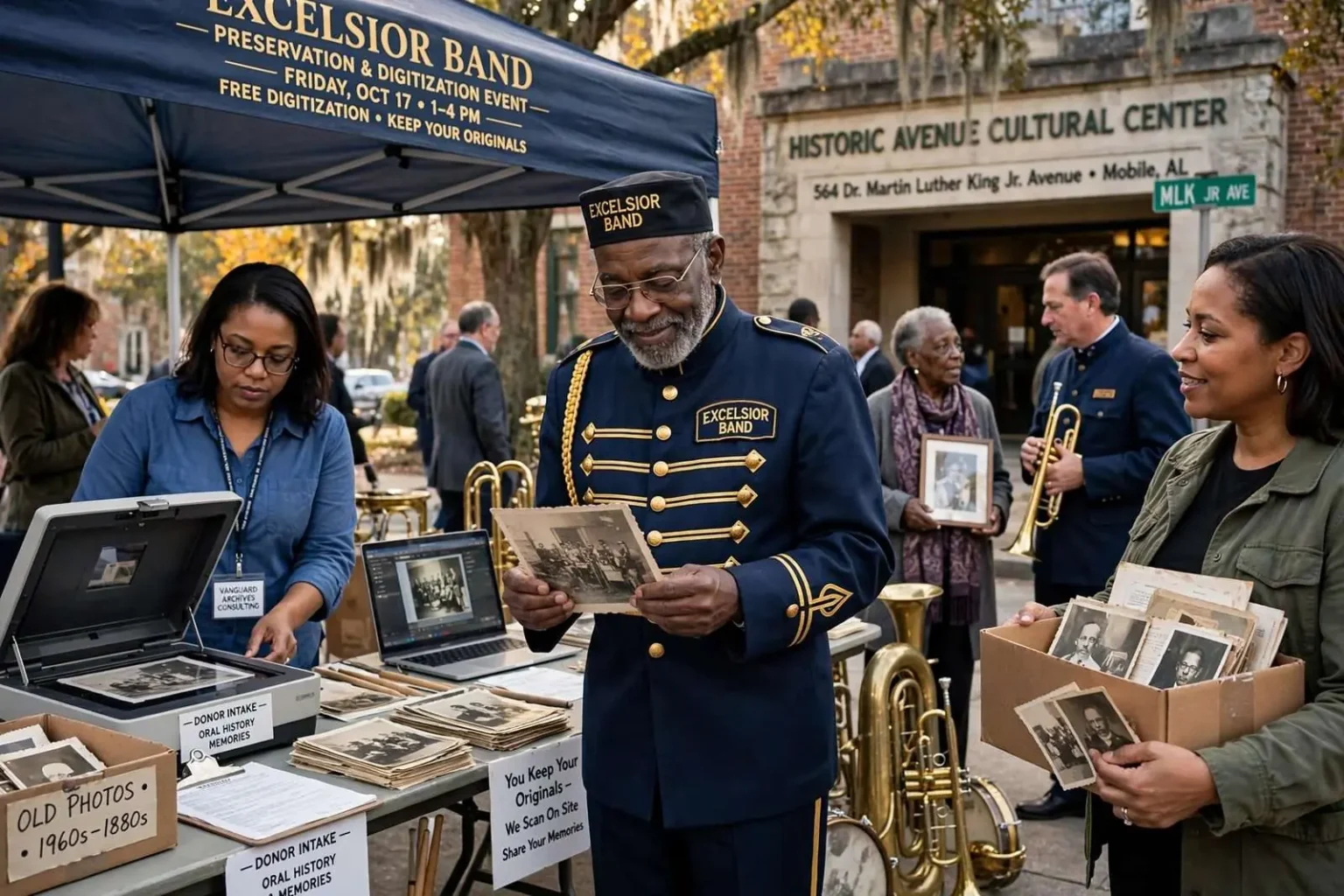
Mobile's Excelsior Band and Vanguard Archives Consulting will host a history preservation event Oct. 17 from 1 to 4 p.m. at the Historic Avenue Cultural Center, digitizing community photographs, recordings and documents on site while attendees keep their originals.
MOBILE, Ala. — Mobile’s Excelsior Band is asking the community for help assembling its own archive, and the ask is specific: bring what you have.
The band, in partnership with Vanguard Archives Consulting, invites community members, friends, families and supporters to a preservation event on Saturday, Oct. 17, from 1 to 4 p.m. at the Historic Avenue Cultural Center, 564 Dr. Martin Luther King Jr. Avenue.
Update: The event, billed as Community Archives Day, is being organized through Excelsior Band Preservation Inc., the effort working to build a historical archive of the band. Organizers say photographs, recordings, programs and other memorabilia connected to the band are all welcome. The event takes place Saturday afternoon; an earlier version of this story listed the wrong day of the week.
143 Years of Mobile History
Band member Hosea London said the archive is about handing a long tradition to the next generation. “We talking 143 years of Mobile history, so if we don’t preserve it and pass this tradition down to young people, you know, traditions die,” London said. “You gotta have somebody who can teach it, and then you gotta have somebody who’s willing to receive it.”
London said many people know the sound of the band without knowing what goes into keeping it going. “A lot of people don’t really know the tradition,” he said. “We been around a long time, but they don’t really know what it takes to make sure the Excelsior Band exist for another 100 years.”
What the Band Means to Mobilians
For many residents, the band is inseparable from Carnival season. “You gotta see them or it’s not really Mardi Gras,” one resident said.
Cheryl Wiggins said the music offers a brief escape. “It makes me feel happy,” Wiggins said. “It makes me feel like just for maybe that moment that bad stuff has gone away and let’s just have fun for just a little while and everybody get along.”
Longtime Mobile resident Michelle James tied the band to family memories. “They been here since I been born,” she said. “When I tell you they jam, they jam!” James recalled her mother enjoying the band at parades: “For so long when we came to the Mardi Gras, I always seen the Excelsior Band hanging around and my mom was always jamming to the beat.”
Those are exactly the kinds of memories — and the snapshots that often go with them — that organizers hope people will bring to the archive day.
What They Are Looking For
The band is asking the community to help preserve its history through photographs, recordings, programs, documents, memorabilia and memories. Any associated material is welcome.
That breadth is deliberate. An institutional archive assembled only from official records captures decisions and dates. An archive built from what a community has in its closets captures everything else — the parades, the weddings, the funerals, the second lines, the faces of people whose names no official record preserved.
You Keep Your Originals
The most important logistical detail: material may be digitized on site, allowing attendees to keep their original materials.
That arrangement removes the barrier that stops most people from contributing to a community archive. Families are understandably reluctant to hand over a photograph of a grandfather, and rightly so — a donated item leaves the household permanently.
On-site digitization changes the transaction entirely. A person brings a photograph, an archivist scans it at archival resolution, records what the contributor knows about it, and hands the original back within minutes. The archive gains the image and its context; the family keeps its photograph.
Community members are also invited to bring a limited number of personal photographs and documents for free digitization — a service that costs money elsewhere and is being offered here at no charge.
Nothing is required to participate. Attendees can come simply to share memories.
Memories Count as Material
The inclusion of memories alongside photographs and documents is not a courtesy. Oral history is a recognized archival practice, and in many cases it is the only source for information that was never written down.
A photograph of a band on a street corner is a photograph. The same photograph, with someone present who can identify the year, the occasion, the corner and the musicians, becomes a document. That identifying knowledge exists only in people’s heads, and it is the part of an archive that disappears first.
The Excelsior Band
The Excelsior Band is one of Mobile’s enduring musical institutions, a jazz brass band whose presence in the city’s Mardi Gras parades, celebrations and civic life spans 143 years, according to band members.
Mobile’s brass band tradition sits within the broader Gulf Coast lineage that includes New Orleans, and bands of this kind have historically played across the full range of community occasions — Mardi Gras parades, funerals, weddings, church events, civic ceremonies and street performances.
That range is exactly what makes a community-sourced archive valuable. A band that plays at everything appears in photographs taken by everyone, and a substantial visual record of its history exists in private hands rather than in any institution.
The Venue
The Historic Avenue Cultural Center on Dr. Martin Luther King Jr. Avenue is itself situated in a historically significant part of Mobile, along a corridor central to the city’s Black community and its cultural life.
Holding the collection event there rather than at a library or university is a choice that matters. People are more likely to bring family materials to a place they already know and trust, in their own neighborhood, than to an institution they have no relationship with.
Why These Events Matter Now
Community archiving projects have grown in number over the past two decades, driven by a recognition that traditional archives systematically underrepresent certain communities — not through any single decision, but through the accumulated effect of what institutions collected and from whom.
The material that fills those gaps is largely in private hands: photographs in albums, recordings on formats that are becoming unplayable, programs and flyers in boxes. It is also perishable. Photographic prints fade, magnetic tape degrades, paper deteriorates, and every household transition — a move, a downsizing, a death — is a moment when boxes get discarded.
A digitization event captures material at the moment it is still recoverable.
If You Go
What: Community Archives Day, an Excelsior Band preservation and digitization event with Excelsior Band Preservation Inc. and Vanguard Archives Consulting
When: Saturday, Oct. 17, 1 to 4 p.m.
Where: Historic Avenue Cultural Center, 564 Dr. Martin Luther King Jr. Avenue, Mobile
Bring: Photographs, recordings, programs, documents, memorabilia, memories — or nothing at all
Cost: Free, including digitization; originals are returned to you
Related coverage from South AL News
- Excelsior Brass Band Named Mobile's Best Brass Band Again, 143 Years Into Its Mardi Gras Run
- Ghost Tours, Legends and Paranormal Investigators: The Temple Opens Its Doors for a Haunted October ArtWalk on Oct. 9
- Bring the Dog, the Cat and Anything Else: Blessing of the Animals Set for Oct. 3 in Gulf Shores
- $300 for a Solo Act, $500 and a Flora-Bama Gig for a Band: Foley Elks Host Two Nights of Competition