Fairhope Arts and Crafts Festival Drew Record-Scale Crowds in 2011
Fairhope’s 2011 Arts and Crafts Festival drew an estimated 200,000 visitors over three days, with more than 200 artists and strong sales reported.
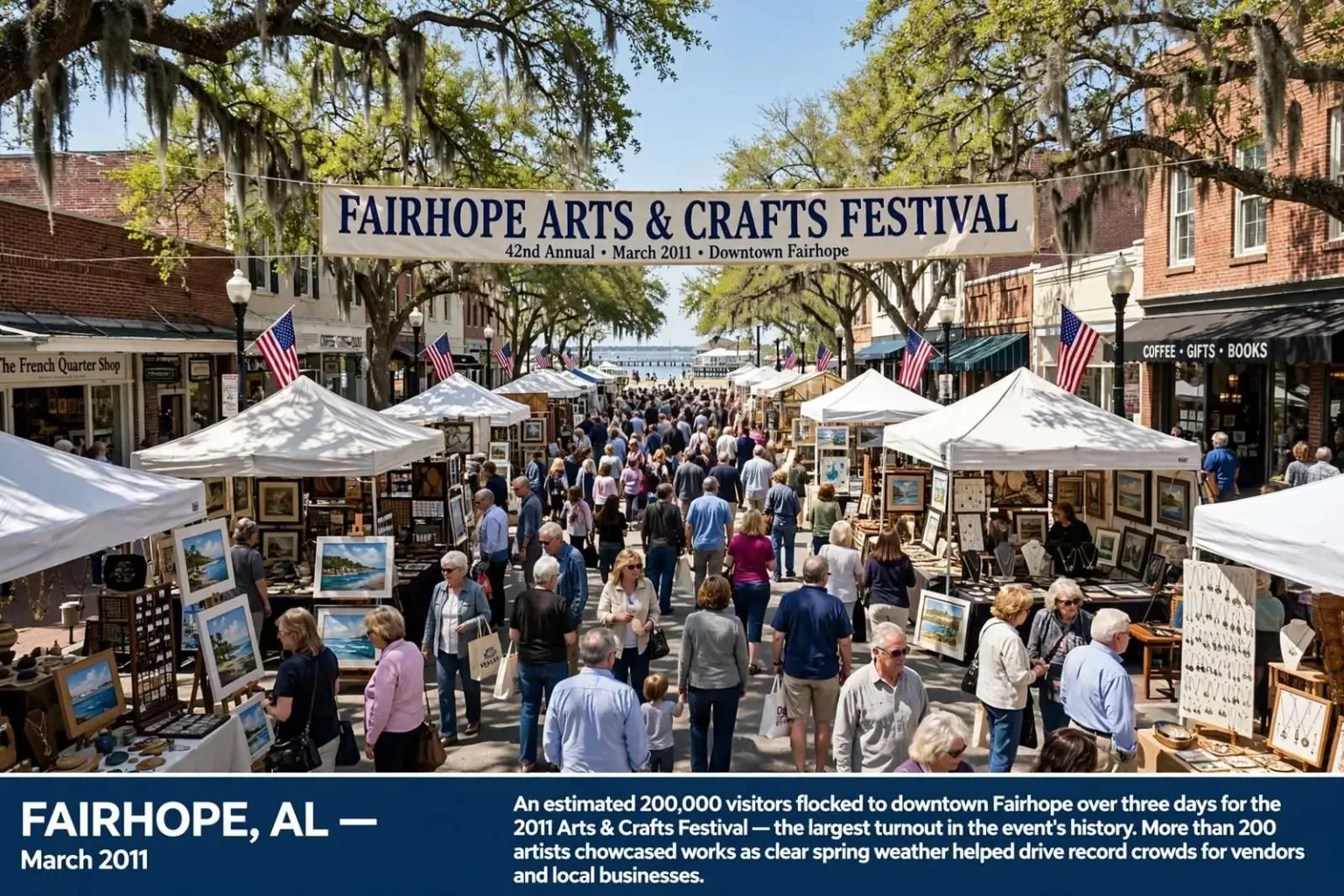
Fairhope’s annual Arts and Crafts Festival drew an estimated 200,000 visitors over three days in March 2011, as favorable weather helped produce one of the largest turnouts in the event’s history.
More than 200 artists took part in the festival, displaying and selling work across downtown Fairhope. The combination of a large crowd, an extensive artist lineup and bright spring conditions created one of the strongest weekends in memory for vendors and for the surrounding business community.
Attendance and artist sales
Festival co-chair Diane Herzog said longtime participants were reporting some of their best sales in years. For artists who tour the Southeast’s spring festival circuit, that kind of word of mouth matters — sales reports travel between exhibitors and shape which shows become must-book stops on the following year’s calendar.
Organizers described the weekend as exceptionally busy from start to finish. The event had long been a major attraction for Fairhope, bringing visitors from across the region to browse art, shop and experience the city’s downtown setting, but the 2011 edition stood out even against that history. Clear conditions encouraged sustained crowds throughout the weekend rather than the surge-and-lull pattern that rain or heat can impose on an outdoor show.
The traffic was not confined to the artist booths. High attendance carried into Fairhope’s restaurants, shops and other downtown destinations, filling streets that sit just blocks from the bluff overlooking Mobile Bay. For a weekend each March, the festival effectively functions as the largest single surge of visitors the city receives all year, and the merchants along its main corridors plan accordingly.
A festival woven into the town’s identity
Fairhope sits on the eastern shore of Mobile Bay in Baldwin County, a small city whose downtown — walkable, tree-lined and oriented toward its waterfront park — has long made it a natural host for outdoor cultural events. The Arts and Crafts Festival grew alongside that setting, and by 2011 it had become one of the anchor events of the Gulf Coast’s spring calendar.
The festival’s mix of artists and scenic setting remained central to its appeal. Exhibitors travel from across the region and beyond to show work in a venue where visitors can stroll between booths, walk down to the pier and enjoy the town’s restaurants, all within a few blocks. That combination draws a broad audience — serious collectors with purchase lists, casual browsers, and families making a day trip across the Bay from Mobile or up Highway 98 from the beach communities to the south.
What 200,000 visitors means
Attendance estimates for outdoor festivals are necessarily approximations, but the scale indicated by organizers — hundreds of thousands of visitors over a three-day run — places the Fairhope festival among the largest events of its kind in the region. An estimate of that size, sustained over a single weekend in a city of Fairhope’s modest population, means the town’s normal traffic pattern is transformed: parking pushes outward for blocks, streets close to vehicles, and downtown businesses see crowds comparable to a holiday weekend.
For the artists, the numbers translate directly into opportunity. With an audience of that size passing through a three-day show, even a small fraction of visitors making purchases can produce the kind of sales results that longtime exhibitors described as their best in years. Outdoor festivals function as a marketplace as much as an exhibition, and the 2011 edition was, by the accounts organizers gathered, an especially successful one.
For the city, the event’s draw highlighted the role of arts programming in Fairhope’s identity and visitor economy. The town has long cultivated a reputation as a haven for writers, artists and craftspeople, and a festival that fills its downtown with 200-plus exhibitors each spring both expresses that identity and reinforces it — giving residents an annual cultural occasion while introducing thousands of first-time visitors to the city’s shops, restaurants and waterfront.
The wider spring calendar
The festival does not operate in isolation. It anchors a stretch of the spring season when the Eastern Shore draws visitors for a series of outdoor events, and its timing in March puts it ahead of the summer beach season that dominates Baldwin County’s tourism economy. Restaurants and lodging providers in Fairhope and neighboring Daphne and Spanish Fort see the weekend as one of their strongest of the year outside the summer months.
Regional festivals of this scale also feed on each other: exhibitors who sell well in Fairhope return the following year and spread the word to other artists, while attendees who discover the town for the festival often come back for ordinary weekends. That compounding effect is why cities invest in events like this one, and why organizers in 2011 were careful to note that the weather-aided crowds and strong sales reflected an event that had been building its audience for years.
A record the city remembers
This article records the festival’s reported turnout and sales atmosphere in 2011. Attendance estimates and sales observations were those shared by organizers during the event’s closing weekend.
The 2011 festival’s combination of favorable weather, a deep artist lineup and enthusiastic crowds made it a reference point for the event’s organizers in the years that followed. For the artists who exhibited, the show delivered the kind of sales that keep a festival on the regional circuit; for Fairhope’s merchants, it delivered one of the busiest weekends of the year; and for the city, it affirmed the annual gathering’s place as the signature cultural event on the Eastern Shore’s spring calendar.
The factors behind that success are the same ones that have sustained the festival through its long run: a downtown setting that visitors genuinely enjoy, a curated field of more than 200 artists representing a wide range of media and price points, and a host community that turns out in force. When those elements align with a weekend of clear March weather, the result is the kind of record-scale turnout Fairhope saw in 2011 — an estimated 200,000 visitors over three days, and sales reports from veteran exhibitors that ranked among the best they had seen in years.
Behind the scenes of a three-day show
An event of 200,000 visitors does not assemble itself. In the weeks before the festival, downtown Fairhope transforms: exhibitor booths are laid out along the streets and in designated display areas, stages and seating are positioned, portable facilities and first-aid stations are staged, and parking and shuttle arrangements are extended to absorb the influx. City crews, volunteers and festival officials spend months on the logistics, and the smooth operation visitors experience is the product of that preparation.
Volunteers are the visible backbone during the show itself. From artist check-in before the gates open to booth-sitting, information booths and cleanup after the final evening, the festival runs on community labor drawn from across the Eastern Shore. That civic involvement is part of why the event has endured: it is not simply staged in Fairhope, it is produced by Fairhope.
For the exhibiting artists, a festival weekend follows its own rhythm. Load-in happens before the first visitors arrive, often in the dark; sales peaks arrive midday and again in the late afternoon; and the final hours frequently determine whether the show ends in the black. Artists who do well in Fairhope consistently cite the same variables — the volume of foot traffic, the crowd’s willingness to buy original work rather than only browsing, and the town’s setting, which keeps visitors on site longer than a parking-lot show would.
The economic ripple beyond downtown
The festival’s economic footprint extends well past the artists’ booths. Visitors rent rooms and vacation homes across Baldwin County, fill restaurants from Fairhope’s downtown to Highway 98, and detour into neighboring towns before and after the show. Service workers, from servers to hotel staff, see one of their strongest weekends of the season, and the timing in March gives the coastal economy a boost well before the summer beach rush begins.
Local nonprofits and community groups also benefit, both through festival-related fundraising and through the visibility a captive regional audience provides. An event that reliably draws a five-figure-to-six-figure daily crowd becomes a platform for the organizations and businesses that set up around it — and the kind of annual appointment that regional media cover, extending the town’s reach far beyond the Gulf Coast.
Weather: the invisible exhibitor
Organizers credited the 2011 turnout in large part to clear conditions that encouraged sustained crowds throughout the weekend. Anyone who follows the outdoor festival circuit understands how decisive that can be. A rainy Saturday can cut an audience in half and push weekend sales below break-even for artists who paid entry fees, booth rent and travel costs to get there. A dry, bright three-day stretch, by contrast, keeps visitors coming back each day — and turns browsers into buyers who return for the piece they kept thinking about.
The 2011 edition had all of it: weather, turnout and sales aligned. The result was an estimated 200,000 visitors across three March days, more than 200 artists showing work in one of the South’s most picturesque downtowns, and reports from veteran exhibitors that ranked the weekend among the most successful of their careers. For Fairhope, it was a demonstration of what the festival had become — not merely a local arts and crafts show, but one of the defining cultural and economic events of the Alabama Gulf Coast spring.