Ferry Pass residents demand drainage fixes at town hall after repeated flooding
Ferry Pass residents pressed Escambia County Commissioner Robert Bender for drainage fixes after repeated flooding left homes near Escambia Bay underwater.
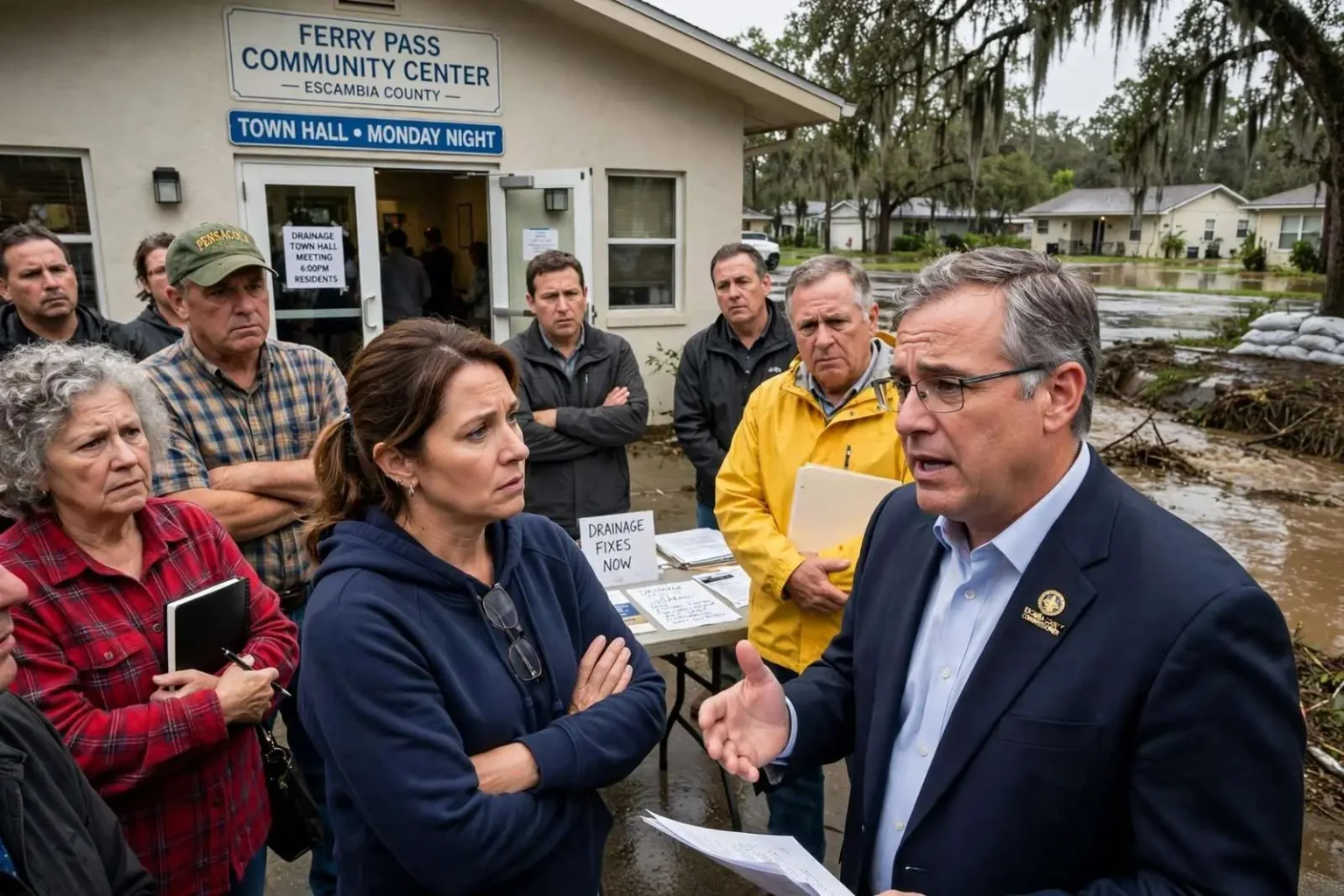
Residents just north of Pensacola are frustrated with drainage problems that have flooded their homes, and they brought their concerns to a town hall Monday night. The meeting drew neighbors who have watched the same ditch fail in storm after storm, and who came looking for something more concrete than the assurances they have heard before.
Michelle Head’s home on Lyric Lane took nearly two feet of water. “Every time it rains, we go out and look at the ditch to see if it’s going to flood,” she said — a sentence that captures the way recurring flooding rewires daily life. For the residents along this drainage path, rain is no longer weather; it is a threat to be monitored, checked and braced for.
The Ditch That Decides Everything
The ditch runs from a retention pond on Johnson Avenue out into Escambia Bay, but many homes along it flood during a hurricane or tropical storm. That simple description — a single drainage channel connecting a retention pond to the bay — is the entire flood-control system for the neighborhood, and its limits define the residents’ risk. When heavy rain arrives faster than the channel can carry it away, the water has only one place to go: into the homes along its course.
Head and her neighbors have now lost belongings and several cars twice in six years. The repetition is what separates their situation from a one-time disaster. Two floods in six years means families here have rebuilt twice, replaced vehicles twice, and lived long enough in between to know exactly what the next storm could take. It also places the neighborhood in the category flood-mapping experts know well — areas where losses repeat not because the storms are unprecedented but because the drainage is insufficient for the water the storms bring.
The ditch’s dimensions tell the story in numbers. In some areas it is only seven feet wide. Engineers and drainage professionals can do a great deal with channels, but a seven-foot-wide ditch receiving stormwater from a developed, paved watershed and discharging toward Escambia Bay has a ceiling that no maintenance can raise. Widening — the remedy engineers describe — requires money, easements and construction, which is precisely what residents came to the town hall to press.
The Town Hall and the Commissioner
The group joined Commissioner Robert Bender at the town hall. Bender, who represents the Ferry Pass area on the Escambia County Board of County Commissioners, has made infrastructure and flooding concerns a visible part of his constituent work, and Monday night’s meeting gave residents direct access to the official whose office influences county drainage spending and project priorities.
For residents, the town hall was both an opportunity and a test. The opportunity was to put two floods in six years, a seven-foot ditch and a list of losses on the public record in front of the person who can move money. The test was whether the answers would differ from the promises that followed previous floods.
Engineers and the Money Question
Engineers said they are working to secure money from the Department of Agriculture to widen parts of the ditch. The reference is to federal rural and community infrastructure funding administered through the USDA, which has long financed water, drainage and community facility projects in areas that commercial markets underserve — and which county governments across the Florida Panhandle have tapped for exactly this kind of improvement.
The engineering framing matters as much as the funding source. Widening parts of the ditch — not wholesale rebuilding — suggests a project scoped to the channel’s worst choke points, where seven-foot sections throttle flow enough to back water up into yards and homes during storm events. Targeted widening is cheaper and faster than a full-channel rebuild, but it also means the fix’s ceiling depends on how well engineers have identified the true bottlenecks.
Grants of this kind move slowly by design: applications, environmental review, easement acquisition, design and construction each take time. That gap between the project’s promise and its pace is where Monday night’s frustration lived.
Head’s Verdict on the Meeting
Head left the meeting unconvinced. “I don’t feel any better,” she said. “I don’t feel a sense of security. I don’t feel like anything’s going to get done because promises have already been made and haven’t been kept.”
Her verdict distilled the town hall’s core problem: credibility. A community that has heard promises after previous floods measures every new commitment against the ones that did not materialize, and no amount of engineering detail can substitute for a project actually breaking ground. Head’s words were not a rejection of the fix being proposed — widening the ditch — but of the confidence that this time would be different.
The burden her statement places on county government is concrete. Restoring trust in a neighborhood that has flooded twice in six years requires visible milestones: a grant application confirmed, easements signed, design documents published, a construction date residents can verify. Anything short of that reads, to a homeowner watching the weather forecast, as the next version of a broken promise.
Ferry Pass and the Geography of the Problem
Ferry Pass sits just north of Pensacola in Escambia County, a community whose name remembers an old crossing over the water — fitting for a place where the relationship between land and water is the whole story. The area’s low elevations and its proximity to Escambia Bay mean stormwater has never had far to travel before finding homes, and decades of development have covered the ground with roofs and pavement that shed rain faster than any natural landscape ever did.
The neighborhood’s drainage path — retention pond on Johnson Avenue, ditch, Escambia Bay — is a miniature of the region’s stormwater logic. Retention ponds exist to hold back the first surge of a storm; ditches exist to carry the rest away. When the outlet is undersized, the retention pond fills, the ditch overtops, and the water goes looking for basements, floors and driveways. Every home along the channel lives downstream of that arithmetic.
Hurricanes and tropical storms are the stress tests the system fails. A Gulf storm does not merely deliver more rain than an ordinary downpour — it delivers surge and wind that can block outfalls with debris, and rain that arrives in bands faster than any undersized channel can pass. Residents who say their homes flood “during a hurricane or tropical storm” are describing a system that works in fair weather and fails precisely when it matters.
What Two Floods in Six Years Cost
The losses Head and her neighbors described — belongings and several cars, twice in six years — represent the kind of damage that flood insurance partially covers and ordinary life does not absorb easily. Vehicles parked in driveways are typically uninsured against flood; contents losses routinely exceed what policies pay; and the deductible-and-rebuild cycle lands on families whose budgets were already set before the water came.
There is also the compounding cost that does not appear in any single claim: the diminished value of homes in a repeatedly flooded pocket, the stress of every storm forecast, and the way families in these neighborhoods begin planning their lives around the ditch — parking vehicles on higher ground, moving belongings off floors, watching the rain gauge the way sailors watch the sky.
What the County Can and Cannot Do Alone
Monday night’s meeting also illuminated the structure of flood responsibility in Florida. Counties own and maintain much of the stormwater infrastructure outside city limits, but the money for major improvements usually weaves together several sources: county funds, state legislative appropriations, FEMA hazard mitigation grants, and USDA programs of the kind engineers described pursuing. No single pot typically covers a channel-widening project outright, which is why the answers residents received centered on applications rather than construction dates.
The commissioner’s position in that structure is pivotal but bounded. Bender can direct county staff to pursue funding, elevate the project in the capital improvements queue and keep the neighborhood’s case in front of state and federal agencies — but he cannot conjure a grant or waive the review processes attached to public money. Residents’ impatience is with the whole system, and the town hall gave them a place to aim it.
Engineers’ candor about seeking USDA money was, in its way, informative: it told the room that the project is real enough to be in active pursuit of funding, and not yet far enough along to promise a date. Both halves of that message are true at once, and the distance between them is exactly the space where trust erodes for families who measure progress in storm seasons survived.
Living With a Seven-Foot Answer
Until the widening happens, the neighborhood’s options are the personal ones flood veterans always recite: flood insurance verified and current, vehicles parked where water has not reached before, irreplaceable belongings stored high, and an evacuation plan that assumes the ditch will fail. These adaptations reduce losses; they do not reduce the rain, and they do not widen the channel.
The deeper fix — the one engineers outlined — would give the system the capacity its watershed now demands. Widening the seven-foot sections would let storm surges of rain move to the bay faster, lower the peak the retention pond must hold, and pull the odds back toward the residents for the first time in years. Projects of this scale in Gulf Coast communities routinely run into the logistics that follow the money: easement negotiations with property owners along the ditch, environmental review near the bay, and construction sequencing that keeps the existing channel working while it is rebuilt.
None of that is a reason the project cannot happen; it is an explanation of why Monday’s answers sounded procedural to people listening for rescue. The gap between an engineer’s timeline and a flooded homeowner’s patience is the permanent condition of infrastructure politics on the Gulf Coast, and Monday night put both sides of it in the same room.
What Would Change Minds
Head’s closing assessment — no comfort, no security, no faith that anything will get done — sets a measurable test for the officials who attended. The county’s next steps are all observable: whether the USDA application advances, whether the widening project appears in the county’s funded project list, whether easement work begins along the choked sections, and whether the next hurricane season passes with Lyric Lane dry.
For the residents of the Johnson Avenue-to-Escambia Bay drainage path, the arithmetic of belief is simple. Two floods in six years bought their skepticism; only construction will spend it down. A town hall, a commissioner’s attendance and an engineer’s funding search are the beginning of an answer — not, in Head’s words, the feeling that anything is going to get done.
The Bigger Picture on the Panhandle’s Drainage
Ferry Pass’s ditch is one instance of a regional condition. Communities across the Florida Panhandle — from Pensacola’s suburbs east through the beach towns — carry drainage systems designed for a smaller, wetter-vacancy era, now serving neighborhoods built out to the curb line. Each heavy storm renews the same conversation in a different neighborhood, and Escambia County has spent years working through a backlog of channels, culverts and outfalls that no longer match their watersheds.
That is why Monday night’s town hall mattered beyond one ditch. It documented, on the record and in front of the elected official responsible, a specific failure with a specific remedy — a seven-foot channel that floods homes twice in six years, and an engineering plan to widen it funded from Washington. What remains is the part residents will believe only when they see it: the application won, the easements signed, the excavation begun, and a hurricane season that ends with water where it belongs — on its way to the bay.
For Michelle Head and her neighbors, the measure of Monday night will not be the words spoken in the meeting room but the rain that falls afterward — and whether, the next time they walk out to check the ditch, they are looking at a construction project instead of a threat.