Mobile City Council Denies Food Pak Rezoning on Old Shell Road; Variance Request Returns Dec. 3
The Mobile City Council rejected a request to rezone a residential tract at 5070 Old Shell Road for a new Food Pak grocery, while a separate variance bid returns Dec. 3.
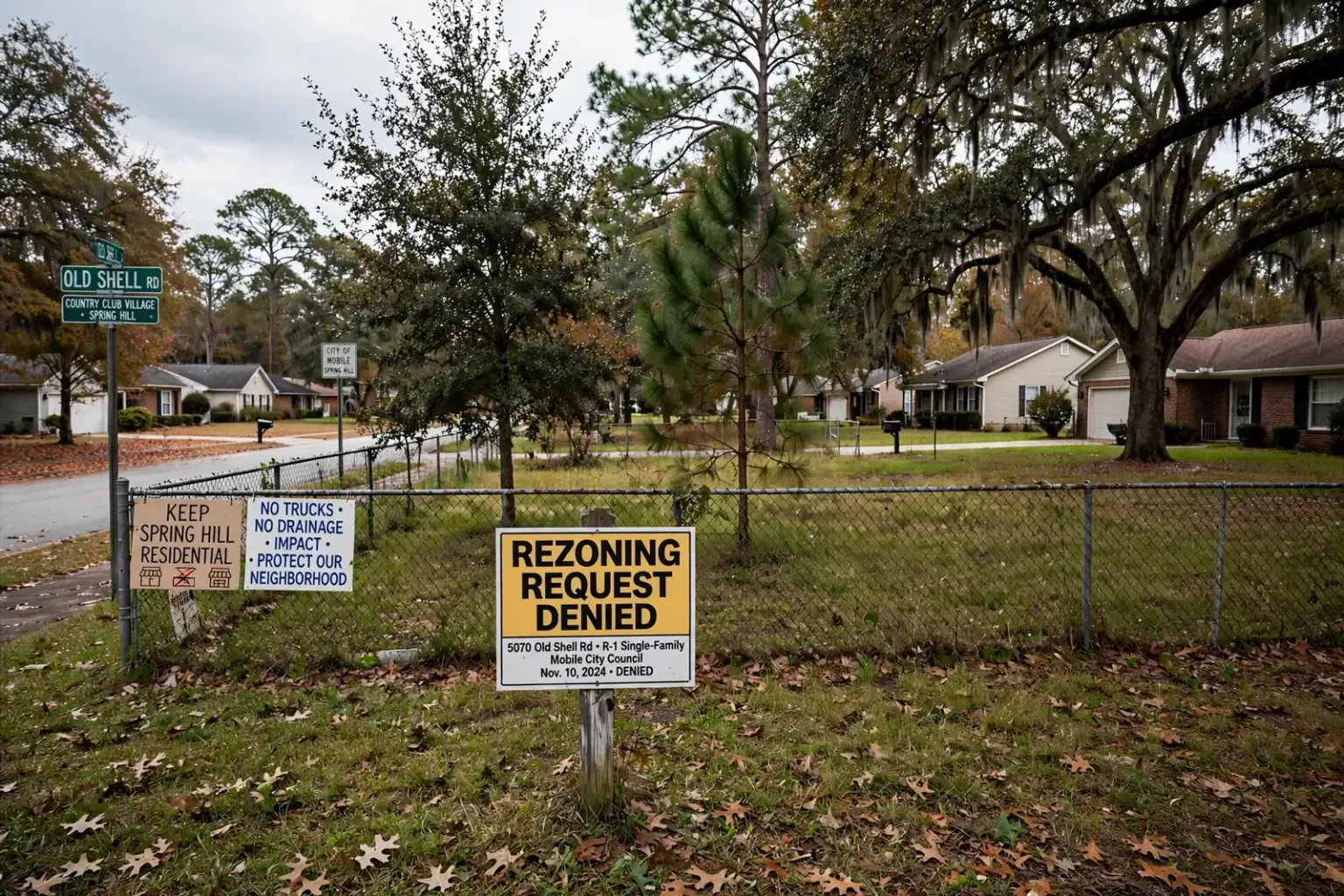
MOBILE, Ala. — Homeowners in the Country Club Village area of Spring Hill came away with a win Tuesday, Nov. 10, when the Mobile City Council turned down a Food Pak rezoning request that would have opened a vacant residential tract at 5070 Old Shell Road to a new neighborhood grocery store. The vote keeps the land, which sits near Lavretta Park, in its single-family classification for now.
The outcome leaves the longtime Spring Hill grocer still searching for a path forward. Its owners have said the lease at its current store, a short distance away at 5150 Old Shell Road, runs out in February 2027, and a second, separate request tied to the same property remains pending before another city board.
Neighbors Raised Traffic, Drainage and Truck Concerns
Several people who live near the site spoke against the plan during Tuesday’s council session. Their objections centered on how a commercial building would change daily life on surrounding residential streets. Among the issues they listed:
- Delivery trucks making regular trips to and from a store set among houses
- Parking demand and where customers would leave their vehicles
- Additional traffic along Old Shell Road and nearby side streets
- Stormwater and drainage from new pavement and a building footprint
- The lasting effect of placing commercial zoning permanently inside a residential neighborhood
That last point carried particular weight. Once a parcel is rezoned for business, the new classification generally stays with the land regardless of who owns it or what eventually operates there. Residents argued that even a modest store would open the door to a commercial designation that could outlast the grocery itself.
The Council’s Reasoning
Council members who explained their votes leaned heavily on the parcel’s history and on the city’s own review. One council member backed denial, pointing out that the tract has carried residential zoning since 1967 and that two earlier efforts to rezone it for commercial use had already failed.
The same council member said that of the nearby residents who weighed in with the Planning Commission in writing, 87% were against the change, a figure that underscored how much resistance had built up in the surrounding blocks.
A second council member also supported the Planning Commission’s findings, saying the proposed change did not satisfy the criteria the city uses to judge whether a rezoning is justified.
What Food Pak Proposed
The request asked the city to move the undeveloped parcel from R-1, the classification reserved for single-family homes, to B-2, a neighborhood business district intended for smaller-scale commercial uses that serve nearby residents.
The applicant made the case that Food Pak has been part of the neighborhood for 35 years and that the business had already scaled back its plans to address concerns. The building was trimmed to roughly 6,000 square feet, down from an earlier and larger design.
The land itself already had a different future mapped out on paper. Earlier, the city had signed off on splitting the tract into six home sites for a proposed development known as The Cottages of Spring Hill. That earlier approval reflected the type of use the existing zoning anticipates: houses rather than storefronts.
A Months-Long Review
Tuesday’s vote capped a debate that had stretched across several months as the grocer looked for a new home ahead of its lease deadline.
The first formal step came Sept. 17, when the Mobile Planning Commission voted unanimously to recommend denial. The commission cited four main reasons:
- The proposed store was not compatible with the homes around it
- The change could affect nearby property values
- Infrastructure serving the site was not adequate for the proposed use
- No changed conditions had been shown that would justify rezoning the land
In Mobile, as in most Alabama cities, the Planning Commission reviews rezoning requests first and sends a recommendation to the City Council, which holds the final say. The council is not bound by the commission’s recommendation, but a unanimous recommendation against a request is a significant signal, and in this case the council agreed with it.
How Rezoning Decisions Generally Work
Zoning is the tool cities use to sort land into districts, each with its own list of allowed uses, building sizes, setbacks and other standards. Residential districts are designed to protect neighborhoods from activities such as heavy traffic, loading operations and late-hour business activity, while business districts allow those uses in areas planned to handle them.
When a property owner asks to move land from one district to another, local officials typically weigh several questions. Is the new use consistent with the city’s long-range plans? Will it fit with what is already around it? Can roads, drainage and utilities handle it? And has something changed in the area since the original zoning was put in place that makes a different classification appropriate? Planning boards often treat the last question as a key test, because zoning is meant to provide stability for people who buy homes or invest based on the existing rules.
Rezoning is considered a legislative decision, which is why it ultimately rests with an elected body. Public comment plays a meaningful role, and written comments submitted to the Planning Commission become part of the record the council reviews.
Balancing Convenience and Neighborhood Character
Debates like this one are common in mature parts of a city, where most land is already built out and the remaining vacant tracts sit next to established homes. A neighborhood grocery offers obvious convenience, including shorter trips for everyday items and a familiar business that many residents have used for years. At the same time, a store brings a steady rhythm of customer cars, early-morning restocking and refrigerated trucks, along with lighting, signs and trash collection that differ from what a residential street usually experiences.
Local governments try to manage that tension through the zoning map itself. Neighborhood business districts are generally drawn along major roads or at intersections where commercial activity can be absorbed without spilling deep into residential blocks. When a request would introduce business zoning onto land that has been planned for homes, decision-makers tend to look closely at whether the change would set a precedent for similar requests nearby. In this case, the long residential history of the tract and the failure of earlier commercial requests weighed heavily against the change.
The Board of Zoning Adjustment Request Still Pending
The council’s vote does not necessarily close the book on the proposal. The grocer has also filed a second application, this one with the Mobile Board of Zoning Adjustment, asking for permission to run a grocery store on the residentially zoned land without changing its zoning classification at all.
That request is for a use variance, which follows a different process than the rezoning the council rejected. Instead of changing the map, a variance asks for an exception from the rules that apply to a particular property. Zoning boards generally reserve variances for situations in which applying the rules strictly would cause an unusual hardship tied to the land itself, and use variances, which allow an activity the district does not otherwise permit, are typically among the hardest kinds of relief to obtain.
The Board of Zoning Adjustment took up the application Nov. 5 but held it over without a decision. The matter is now scheduled to return on Thursday, Dec. 3. The board has not approved the proposed store.
What Comes Next for the Grocer and the Neighborhood
For now, the property remains zoned for single-family homes, and the earlier subdivision approval for six residential lots reflects what the current rules allow on the site.
The Dec. 3 hearing is the next point at which the proposal could move forward or stall. Residents who opposed the rezoning are likely to follow that session closely, since a variance, if granted, could allow a store without the permanent business zoning they objected to on Tuesday. The grocer, meanwhile, faces a February 2027 lease expiration at its existing Old Shell Road location, adding pressure to find a solution in the coming months.
Meetings of the Board of Zoning Adjustment are open to the public, and residents who want to weigh in can typically submit comments ahead of a hearing or speak during the public portion of the agenda. Agendas and application materials are generally posted by the city’s planning and zoning staff in advance of each meeting.
Key Details at a Glance
- Property: Vacant residential parcel at 5070 Old Shell Road in Country Club Village, near Lavretta Park in Spring Hill
- Request denied: Rezoning from R-1 single-family residential to B-2 neighborhood business
- Council vote: Tuesday, Nov. 10
- Planning Commission: Unanimously recommended denial Sept. 17
- Proposed store size: About 6,000 square feet, reduced from earlier plans
- Current store: 5150 Old Shell Road, with a lease ending in February 2027
- Still pending: Use variance request before the Board of Zoning Adjustment, held over to Thursday, Dec. 3
The fight over the parcel reflects a familiar tension in established neighborhoods: residents value a nearby grocery store, but many also want firm lines between commercial activity and the streets where they live. How the Board of Zoning Adjustment handles the variance request will determine whether Food Pak has a realistic route to building on the site, or whether the business will need to look elsewhere along the Old Shell Road corridor before its lease runs out.