

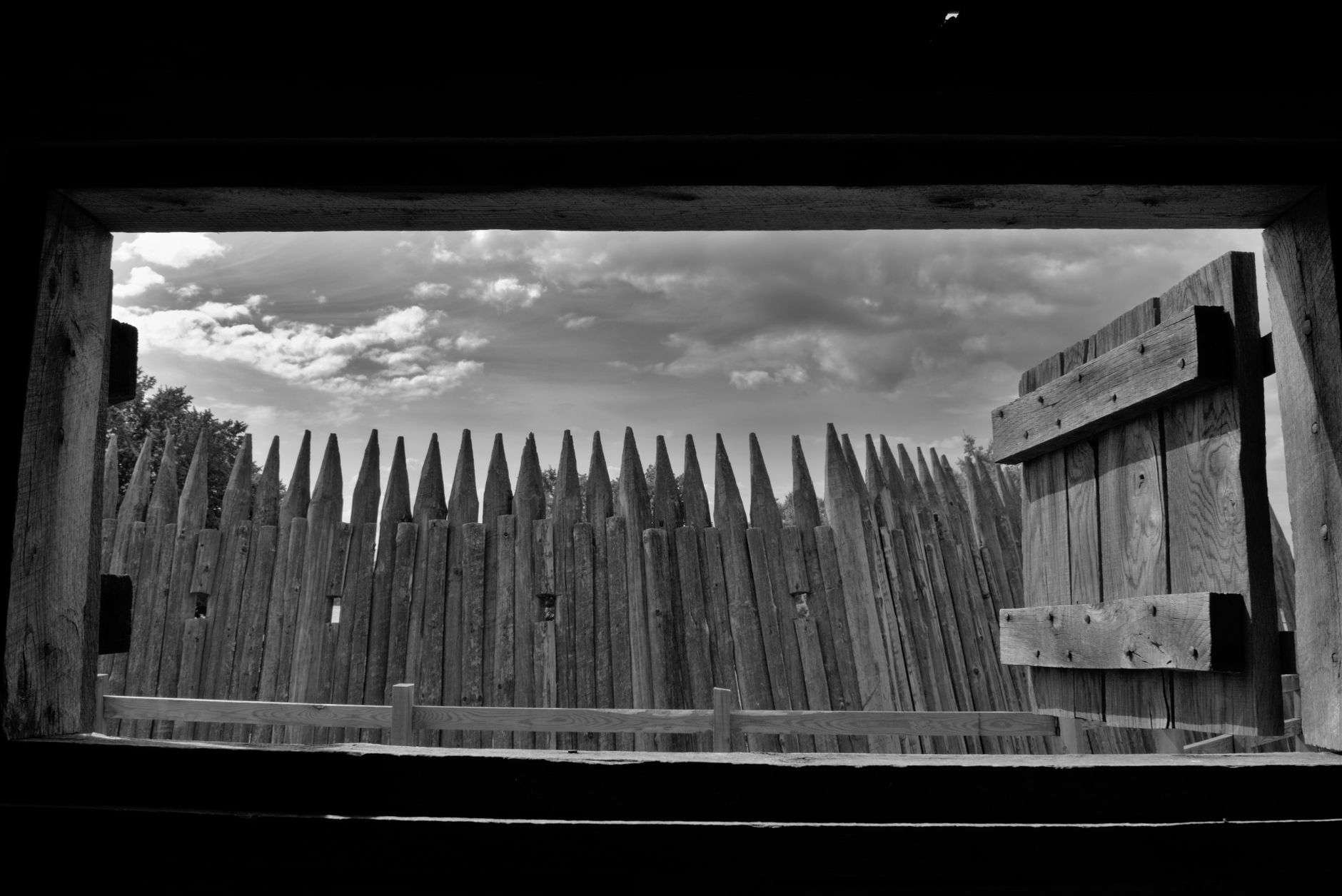
GROVE HILL, Ala. — Today the Fort Sinquefield site east of Grove Hill is a quiet, park-like clearing. The grass is mowed, historical markers are scattered across the grounds, and a replica corner wall of sharpened logs hints at the stockade that once stood there. Two hundred thirteen years ago this month, it was the scene of one of the most harrowing episodes of the Creek War in Clarke County.
In early September 1813, Creek warriors struck two settler homes near the fort, killing a dozen women and children, and then attacked Fort Sinquefield itself. The fort held, at the cost of two lives, and the story of how the defenders and a group of women caught outside its walls survived has been retold in Clarke County for more than two centuries.
A frontier of hastily built forts
Fort Sinquefield was one of at least 10 forts thrown together in Clarke County during the Creek War of 1813-1814. The stockade enclosed about an acre of land and had a single blockhouse. Of all those Clarke County forts, it was the only one attacked, and it was one of just two forts in southwest Alabama targeted by the Creeks.
The war began as a conflict within the Creek Nation itself. A faction that came to be known as the Red Sticks rose against Creek leaders who had accommodated American demands, driven by economic hardship, resentment over the steady advance of white settlement, and a religious revitalization movement influenced by the Shawnee leader Tecumseh. The fighting drew in American settlers and militia after the Battle of Burnt Corn Creek on July 27, 1813.
As tensions rose through the summer of 1813, pioneer families across the region left their farms and gathered inside the nearest fort for protection. The other fort attacked in southwest Alabama was Fort Mims, across the Alabama River in neighboring Baldwin County. On Aug. 30, 1813, Red Stick warriors overran it, killing about 250 settlers and militiamen and taking at least 100 people captive.
Fort Mims stood on Samuel Mims’s plantation in the Tensaw District. At noon on Aug. 30, roughly 700 Red Sticks led by William Weatherford and other leaders rushed through the fort’s open gate. The garrison commander, Maj. Daniel Beasley, was killed in the opening minutes. Capt. Dixon Bailey and a band of militiamen held off the attackers for hours before fire arrows set the fort’s buildings ablaze. News of the disaster spread quickly through the settlements, and it was against that backdrop, only two days later, that the violence reached the families around Fort Sinquefield.
The Kimbell-James Massacre
Late in August, before the Fort Mims attack, the James and Kimbell families decided to leave Fort Sinquefield and return to their homes a few miles away.
On the afternoon of Sept. 1, 1813 — two days after Fort Mims — Creek warriors swept down on the two homes while the men were away. Twelve women and children were killed. Four men and boys who had been absent returned to find the aftermath and fled to the fort.
Sarah Merrill and her infant son were the only survivors of the attack on the households, which became known as the Kimbell-James Massacre. Merrill was scalped and left for dead along with her child. She regained consciousness and set out for the fort, but she could not carry her baby the whole distance, so she hid him in a hollow log. The infant was later recovered alive. Merrill survived as well, although her head wound left her unable to spend time in the sun for the rest of her life.
Soldiers from nearby Fort Madison went to the massacre site and recovered the bodies, carrying them to Fort Sinquefield to be buried just outside the stockade.
Turkeys that were not turkeys
The Creeks returned while the settlers were outside the walls. As people prepared to go back inside after the burial, someone remarked on seeing turkeys nearby. The “turkeys” turned out to be the feathers of warriors’ headdresses. Roughly 100 warriors led by Hillis Hadjo, also known as Josiah Francis or the Prophet Francis, charged, and the settlers barely had time to reach the safety of the fort.
The Encyclopedia of Alabama dates the assault on the fort to Sept. 2, 1813, the day after the massacre. It describes the most perilous moment of the attack this way:
“Stranded between the warriors and safety, though, was a group of women who had been washing laundry at a spring located at the base of a ravine about 300 yards behind the fortification. Thinking quickly, Isaac Hayden, who was from the detachment out of Fort Madison, turned his pack of hunting dogs on the approaching warriors and caused enough confusion to allow all but one of the women to make it to the fort gate. Hayden was the last person to make it inside, just as his horse was shot from under him.”
Local accounts put the size of Hayden’s pack at around 60 dogs. The spring sat at the bottom of a steep grade below the fort, and that the women made it back up the hill with only one of them killed is remarkable. One story handed down through the generations holds that one of the women ran with a wash pot turned upside down over her head.
Two hours of fighting
The warriors kept up their assault on the fort for nearly two hours. One settler inside was killed — the Encyclopedia of Alabama identifies him as Stephen Lacey — and at least five of the attackers died, with an unknown number wounded. Eventually the Creeks withdrew.
The fort’s occupants did not stay to wait for another attack. They abandoned Fort Sinquefield and fled to Fort Madison, a larger and better-garrisoned post a few miles to the south.
From Fort Mims to statehood
The staggering loss of life at Fort Mims galvanized American civilian and military forces on what was then the untamed southwestern frontier of the young United States. “Remember Fort Mims” became a rallying cry decades before Texans took up “Remember the Alamo” in their fight for independence in the 1830s.
Tennessee militia under Andrew Jackson, along with other American forces and allied Cherokee and Creek warriors, campaigned against the Red Sticks through the fall and winter. The war effectively ended with a crushing defeat of the Red Sticks at the Battle of Horseshoe Bend on March 27, 1814. Under the Treaty of Fort Jackson, signed Aug. 9, 1814, the Creeks were forced to give up more than 20 million acres of land to the United States — a cession that helped open the way for Alabama statehood in 1819. By the 1830s, the Creeks and other tribes of the Southeast had been forced to move to lands in the West.
Keeping the story alive
Clarke County has worked for generations to remember what happened at Fort Sinquefield. D.C. Mathews, who served in the Alabama Legislature and as the county’s school superintendent, loved to tell the story. He acquired the Fort Sinquefield site and regularly brought students there. In 1931, a monument was placed at the site, paid for with nickels and dimes contributed by Clarke County schoolchildren.
The fort site is listed on the National Register of Historic Places. It is cared for by the Clarke County Historical Society and Museum, which is based at the historic Alston-Cobb House in Grove Hill, the county seat.
Visiting the sites
Those who want to see the places connected to the events of September 1813 can visit several sites in Clarke and Baldwin counties:
- Fort Sinquefield: Open and accessible to the public off U.S. Highway 84 just east of Grove Hill, along the unpaved Fort Sinquefield Road. Interpretive signs explain the conflict, and the replica log wall and the 1931 monument mark the fort’s location.
- Kimbell-James Massacre marker: A historical marker stands a short distance farther east on U.S. 84 at the west intersection of Main Street in Whatley. The actual massacre site is nearby but is not open to the public.
- T.H. Ball marker: Next to the massacre marker is one honoring T.H. Ball, Clarke County’s first historian, who is buried in a family cemetery near the massacre site. Ball’s book A Glance into the Great South-East, or, Clarke County, Alabama, and Its Surroundings, from 1540 to 1877 chronicled the county’s early history, including its frontier years.
- Fort Mims: Off Alabama Highway 59 at Tensaw in north Baldwin County. Managed by the Alabama Historical Commission, the site is open to the public and features a reconstructed blockhouse and stockade. A re-enactment is held there each August on the anniversary weekend of the attack.
Standing in the mowed clearing today, it takes some imagination to picture the palisade, the frightened families inside, and the women racing up the ravine from the spring as dogs charged past them toward the warriors. The markers, the replica wall and the schoolchildren’s monument are there to help visitors do exactly that.