

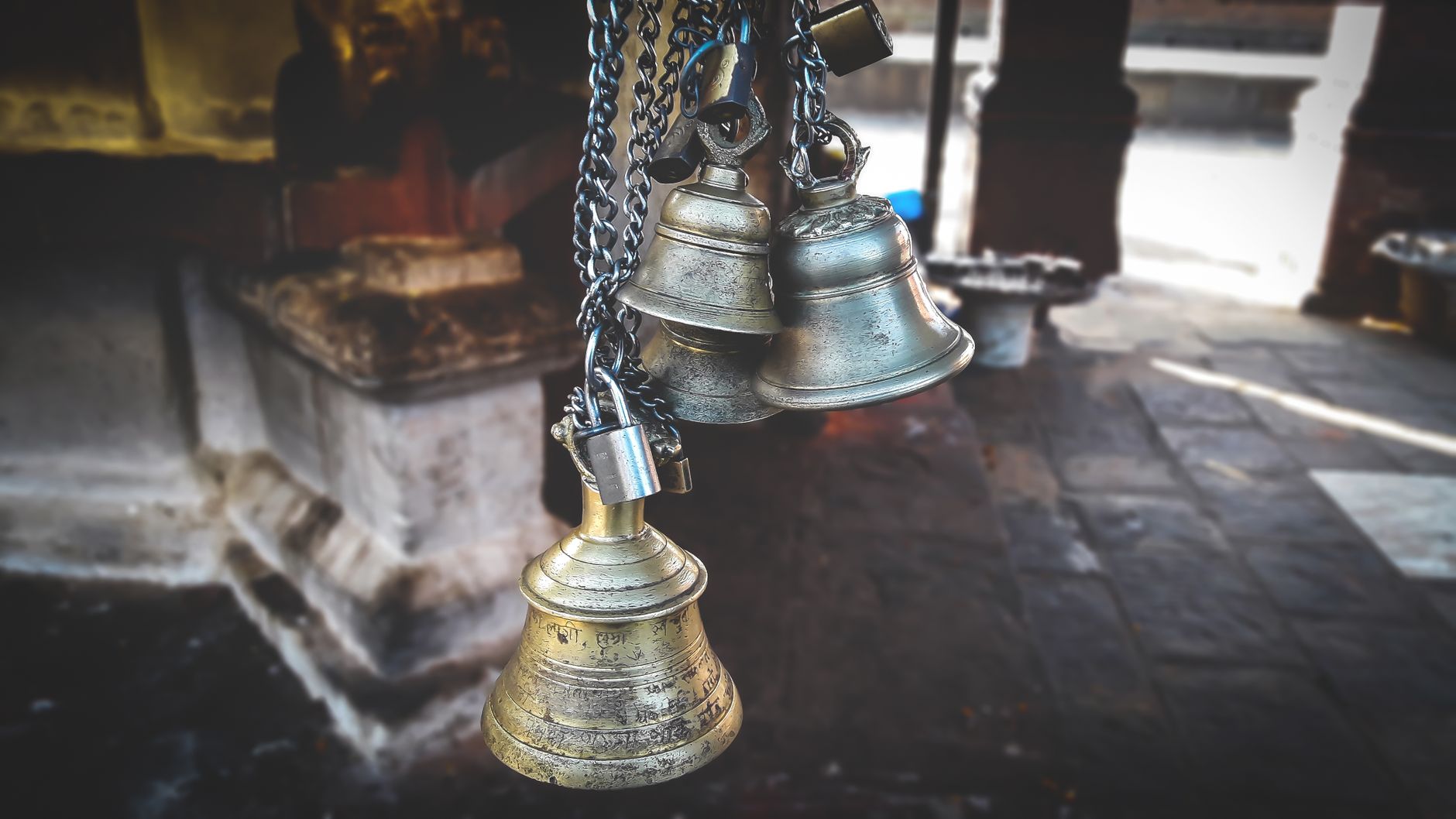
A brass bell now hangs from an iron yoke in a landscaped backyard in Fairhope, where its main job these days is to announce that it’s time for cocktails. Before that, it rang out birdies on a Point Clear golf course. Before that, it kept time for workers at a Selma foundry. And before any of that, it almost certainly rode atop a steam locomotive, clanging a warning as the train rolled into town. The restored Birdie Bell has had a remarkable journey, and thanks to a group of Fairhope friends and a Foley metalworker, it is ringing once again.
A Bell, a Porch and a Point Clear Childhood
Bells have long held a special place along the Eastern Shore of Mobile Bay. Growing up spending summers in Point Clear, this writer’s family bought a home just north of Bailey’s Creek when he was nine years old. Out front stood a cast-iron bell with a long lanyard that reached all the way back to the screen porch. Rumor had it the bell would ring at the first sign of a jubilee, calling neighbors down to the water to share in the seafood harvest.
Jubilees are one of the Eastern Shore’s most famous natural phenomena. On certain summer nights, usually in the hours before dawn, low oxygen levels in the bay’s bottom waters push flounder, blue crabs, shrimp and other bottom-dwelling creatures into the shallows along the shoreline, where residents gather them by the bucketful. Mobile Bay is one of very few places in the world where the event happens with any regularity, and generations of Eastern Shore families have kept an ear out for the call.
Truth be told, that particular bell never rang for a jubilee. Instead, it was rung to tell the children it was time to get out of the water and come to supper. It worked every time.
From Selma to the Gulf Coast
The Birdie Bell’s story centers on Susie and Larry Cerf, who moved to Fairhope from California a few years ago. Susie grew up in Selma, as did her cousins, the late Ann Miller of Fairhope and Belle Bear of Pensacola. The cousins convinced the Cerfs that they should move closer to home. It is a familiar pattern: a great many good people who hail from Selma have made their way to the Gulf Coast over the years.
Selma, set on a bluff above the Alabama River in the heart of the state’s Black Belt, has a long industrial history tied to the river and the railroads that once converged there. That history is where the bell’s story begins.
Susie’s grandfather, Maurice I. Bloch, owned the Selma Foundry and Machine Company. “My grandfather, Maurice I. Bloch, owned the Selma Foundry and Machine Company, but did not manufacture the bell,” Susie said. “The railroad tracks came right through the middle of the factory so the products they manufactured could be loaded directly onto the rail cars.”
Because of that close relationship with the railroad, the family believes the bell came from one of the early steam locomotives that serviced the foundry before the engine became obsolete. In its foundry days, the bell served as the factory’s timekeeper, ringing at 8 a.m. to start the workday, at noon to signal the lunch break and at 5 p.m. to send workers home.
Birdies on the Azalea Course
When the foundry closed, Susie’s father gave the bell to Mark and Ann Miller. The Millers found an inspired new use for it. For years, it stood on the first green of the Azalea course at Lakewood Golf Club in Point Clear, where any golfer who made a birdie on the opening hole could ring it. Thus, the Birdie Bell got its name.
Lakewood Golf Club, associated with the historic Grand Hotel in Point Clear, has been a fixture of Eastern Shore golf for generations, and its courses wind through moss-draped oaks and pines near the bay. A bell ringing across the first green made for a memorable, and very public, celebration of a good start.
After the Millers moved from their home on the golf course, the bell spent four or five years taking up space in their garage. Ann felt it should stay in the family, and when Larry and Susie decided to build a home in Fairhope, she offered it to them.
A Neighbor Who Wouldn’t Let It Go
The Cerfs weren’t quite sure what to do with a 300-plus-pound bell, and they even considered getting rid of it. That’s when friend and neighbor Jim Ellis stepped in. An engineer whose hobby is woodworking, Ellis saw the potential in restoring the bell and flatly forbade them from giving it away. The question was what to do with it.
Ellis did some asking around and came up with the name of Joe Strange, who has owned and operated Fairhope Iron Shop for years and is affectionately known as “Iron Joe.” Strange was gradually winding down his business, and his son-in-law introduced him to Brandon Sylvester, a longtime friend who was well versed in welding and in working on and repairing heavy equipment. The son-in-law told Sylvester that Joe was really busy and needed some help.
Sylvester, originally from Indiana, has lived in Foley for years and has been welding since he was 17. Working with Strange opened a new door for him.
“Joe introduced me to the ornamental side of metalworking,” Sylvester said. “It’s a lot more fun.”
Tracing the Bell’s Railroad Roots
Meanwhile, Ellis had begun researching the bell’s origins, and once he met Sylvester, the two of them tracked down a good deal of its history. Sylvester reached out to a friend in the railroad industry to learn more.
“The best we can determine, the bell came off a steam locomotive manufactured between 1870 and 1915, but there are no manufacturing marks to determine who made it,” he said.
Bells were standard equipment on American steam locomotives, typically mounted atop the boiler and rung to warn people and animals near the tracks and to signal a train’s approach to stations and crossings. The Birdie Bell still has its original handle, which would have reached back into the locomotive’s cab so the engineer could pull it to signal that the train was arriving.
The bell itself is brass and hangs from an iron yoke, or headstock, that allows it to swing freely, just as it would have on the locomotive.
Restoring a Piece of History
With Ellis driving the project, he produced a set of engineering sketches and worked closely with Sylvester to restore the bell to its former glory. The goal was for it to rest in the backyard of the Cerfs’ new home.
Sylvester, to whom Strange now refers all of his work, took the bell down to its original metal and restored it beautifully. Then came the question of what it would stand on. At more than 300 pounds, it needed a substantial base that would hold it at least six feet off the ground.
“We repurposed everything to keep the bell in its original form,” Sylvester said. While rooting through a big yard of old metal one day, he found an I-beam, and it became the bell stand.
Everyone had a role. Susie served as project manager, Ellis was the technical adviser, Sylvester handled the restoration and Larry cheered them on every step of the way. The pride among the group is obvious when they talk about the finished product.
“The biggest challenge may have been lifting the bell onto its resting place,” Sylvester said. That, the group says with a laugh, is a whole other story.
Today, the Birdie Bell stands elegantly in the Cerfs’ backyard, surrounded by beautiful landscaping. It makes quite a statement.
A Metalworker Looking for the Next Project
Sylvester loves ornamental work and has been building a portfolio of projects around the area. He recently fabricated the railings, handrails and gates at St. James Church in Fairhope, and he has built wedding arches for florists along with other decorative metal pieces.
“I get excited about repurposing old metal. I do all the design work,” he said. “Any project, whether it’s residential or commercial, I’d love to talk to you about it.”
All of his business, he said, has come by word of mouth. “I have a mobile unit with all the equipment, so I can work on site anywhere in the coastal area. I’d like to get into more metal art projects in the future.”
For homeowners with a family heirloom of their own, the Birdie Bell offers a useful model:
- Research the object’s history first. Family stories, industry contacts and period photographs can help narrow down age and origin.
- Bring in someone with technical know-how to plan how the piece will be displayed safely, especially if it is heavy.
- Work with a skilled craftsperson who respects the original materials and form.
- Consider repurposed materials that suit the object’s character.
Four Lives of One Bell
Few objects can claim a résumé like this one. The Birdie Bell has served as the signal bell for an early steam locomotive, as the timekeeper at a Selma foundry, as a celebration bell for golfers at Lakewood and, now, as the Cocktail Bell at the Cerfs’ home in Fairhope. Along the way, it has connected three generations of a Selma family, a circle of Fairhope friends and a metalworker who found his calling in ornamental work.
It is a fitting chapter for a bell with such an illustrious journey. And if it happens to ring just before sunset on a Fairhope evening, the neighbors will know exactly what it means.